Sunset Planets

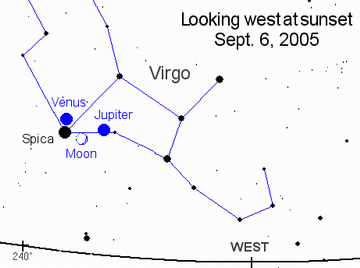
August 29, 2005 A map of the western sky on Sept. 6, 2005.

Venus, Jupiter and the Moon are gathering for a beautiful sunset sky show

Something nice is happening in the sunset sky. Venus and Jupiter, the two brightest planets, are converging, and they're going to be beautifully close together for the next two weeks.

Image: A map of the western sky on Sept. 6, 2005.

Step outside tonight when the sun goes down and look west. If there are no trees or buildings in the way, you can't miss Jupiter and Venus. They look like airplanes, hovering near the horizon with their lights on full blast. (Venus is the brighter of the two.) You can see them even from brightly-lit cities.

Try catching the pair just after sundown and just before the first stars appear. Venus and Jupiter pop into view while the sky is still twilight-blue. The scene has a special beauty.

When the sky darkens completely, look to the left of Jupiter for Spica, the brightest star in the constellation Virgo. Although it's a bright star, Spica is completely outclassed by the two planets.

Venus and Jupiter are converging at the noticeable rate of 1o per day, with closest approach coming on September 1st when the two will be a little more than 1o apart. (How much is 1o? Hold your pinky finger at arm's length. The tip is about 1o wide.)

When planets are so close together, not only do you notice them, you'll have a hard time taking your eyes off them. They're spellbinding.

There's a biological reason for this phenomenon: In the back of your eye, near the center of the retina, lies a small patch of tissue called "the fovea" where cones are extra-densely packed. "Whatever you see with the fovea, you see in high-definition," explains Stuart Hiroyasu, O.D., of Bishop, California. "The fovea is critical to reading, driving, watching television; it has the brain's attention." The field of view of the fovea is 5o. When two objects converge to, say, 1o as Venus and Jupiter will do, they can beam into your fovea simultaneously, signaling your brain—attention, please!

After September 1st, the two planets separate, but the show's not over. On September 6th, with Jupiter and Venus still pleasingly close together, the slender crescent Moon will leap up from the sun's glare and join the two planets. Together, they'll form a compact triangle that will simply knock your socks off.

Feel like staring? Do.

Source: Science@NASA (Author: Dr. Tony Phillips)


print this article email this article download pdf blog this article bookmark this article     Stumble it Digg this share on Facebook retweet share on Reddit add to delicious
Rate this story - not rated yet


August 29, 2005 all stories

Comments: 0

not rated yet
  • Stumble this up

  • Digg this

  • share this

  • hide
  • Related Stories

  • STAR TRAK for November: Mars is prominent again
    created Nov 02, 2009 | popularity not rated yet | comments 0
  • Kepler and the Search for Life in Our Galaxy
    created Sep 15, 2009 | popularity not rated yet | comments 0
  • Astronomers unveil an amazing, interactive, 360-degree panoramic view of the entire night sky
    created Sep 14, 2009 | popularity not rated yet | comments 0
  • Galileo's notebooks may reveal secrets of new planet
    created Jul 09, 2009 | popularity not rated yet | comments 0
  • A serious search for extraterrestrial life
    created May 26, 2009 | popularity not rated yet | comments 0


Other News

Deep creep means milder, more frequent earthquakes along Southern California's San Jacinto fault

Deep creep means milder, more frequent earthquakes along Southern California's San Jacinto fault

Space & Earth / Earth Sciences

created 7 hours ago | popularity 4.7 / 5 (3) | comments 0

With an average of four mini-earthquakes per day, Southern California's San Jacinto fault constantly adjusts to make it a less likely candidate for a major earthquake than its quiet neighbor to the east, the ...


Success in 'space elevator' competition (AP)

Success in 'space elevator' competition (Update 3)

Space & Earth / Space Exploration

created Nov 05, 2009 | popularity 4.3 / 5 (33) | comments 50

(AP) -- A robot powered by a ground-based laser beam climbed a long cable dangling from a helicopter on Wednesday to qualify for prize money in a $2 million competition to test the potential reality of the ...


In a Galaxy Far, Far Away...

In a Galaxy Far, Far Away...

Space & Earth / Astronomy

created Nov 06, 2009 | popularity 4.8 / 5 (5) | comments 15

(PhysOrg.com) -- Astronomers have published the discovery of the farthest known object in the cosmos: a star that exploded when the universe was only 630 million years old -- only 4.6% of its current age. ...


'Dropouts' pinpoint earliest galaxies

'Dropouts' pinpoint earliest galaxies

Space & Earth / Astronomy

created Nov 06, 2009 | popularity 4.2 / 5 (10) | comments 13

Astronomers, conducting the broadest survey to date of galaxies from about 800 million years after the Big Bang, have found 22 early galaxies and confirmed the age of one by its characteristic hydrogen signature ...


Space hotel taking bookings for 2012 opening

Space hotel taking bookings for 2012 opening

Space & Earth / Space Exploration

created Nov 05, 2009 | popularity 4.4 / 5 (20) | comments 11

(PhysOrg.com) -- The first orbiting space hotel is on track to open for its first customers in 2012, but hurry, as bookings are filling fast.