Finding a Way to Test for Dark Energy
What is the mysterious dark energy that's causing the expansion of the universe to accelerate? Is it some form of Einstein's famous cosmological constant, or is it an exotic repulsive force, dubbed "quintessence," that could make up as much as three-quarters of the cosmos? Scientists from Lawrence Berkeley National Laboratory (Berkeley Lab) and Dartmouth College believe there is a way to find out.
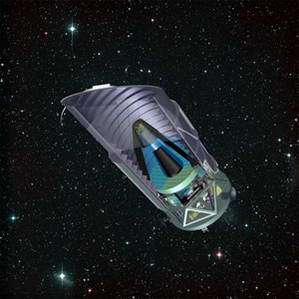
Image: The SuperNova/Acceleration Probe, SNAP, is a satellite designed to study dark energy through the discovery and precision measurement of thousands of distant supernovae.
In a paper to be published in Physical Review Letters, physicists Eric Linder of Berkeley Lab and Robert Caldwell of Dartmouth show that physics models of dark energy can be separated into distinct scenarios, which could be used to rule out Einstein's cosmological constant and explain the nature of dark energy. What's more, scientists should be able to determine which of these scenarios is correct with the experiments being planned for the Joint Dark Energy Mission (JDEM) that has been proposed by NASA and the U.S. Department of Energy.
"Scientists have been arguing the question 'how precisely do we need to measure dark energy in order to know what it is?'" says Linder. "What we have done in our paper is suggest precision limits for the measurements. Fortunately, these limits should be within the range of the JDEM experiments."
Linder and Caldwell are both members of the DOE-NASA science definition team for JDEM, which has the responsibility for drawing up the mission's scientific requirements. Linder is the leader of the theory group for SNAP — the SuperNova/Acceleration Probe, one of the proposed vehicles for carrying out the JDEM mission. Caldwell, a professor of physics and astronomy at Dartmouth, is one of the originators of the quintessence concept.
In their paper in Physical Review Letters Linder and Caldwell describe two scenarios, one they call "thawing" and one they call "freezing," which point toward distinctly different fates for our permanently expanding universe. Under the thawing scenario, the acceleration of the expansion will gradually decrease and eventually come to a stop, like a car when the driver eases up on the gas pedal. Expansion may continue more slowly, or the universe may even recollapse. Under the freezing scenario, acceleration continues indefinitely, like a car with the gas pedal pushed to the floor. The universe would become increasingly diffuse, until eventually our galaxy would find itself alone in space.
Either of these two scenarios rules out Einstein's cosmological constant. In their paper Linder and Caldwell show, for the first time, how to cleanly separate Einstein's idea from other possibilities. Under any scenario, however, dark energy is a force that must be reckoned with.
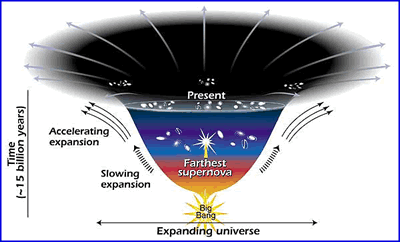
Image: Today's universe is expanding at an accelerating rate because dark energy counteracts the force of gravity. In the early universe matter was closer together, and gravity still slowed its expansion.
Says Linder, "Because dark energy makes up about 70 percent of the content of the universe, it dominates over the matter content. That means dark energy will govern expansion and, ultimately, determine the fate of the universe."
In 1998, two research groups rocked the field of cosmology with their independent announcements that the expansion of the universe is accelerating. By measuring the redshift of light from Type Ia supernovae, deep-space stars that explode with a characteristic energy, teams from the Supernova Cosmology Project headquartered at Berkeley Lab and the High-Z Supernova Search Team centered in Australia determined that the expansion of the universe is actually accelerating, not decelerating. The unknown force behind this accelerated expansion was given the name "dark energy."
Prior to the discovery of dark energy, conventional scientific wisdom held that the Big Bang had resulted in an expansion of the universe that would gradually be slowed down by gravity. If the matter content in the universe provided enough gravity, one day the expansion would stop altogether and the universe would fall back on itself in a Big Crunch. If the gravity from matter was insufficient to completely stop the expansion, the universe would continue floating apart forever.
"From the announcements in 1998 and subsequent measurements, we now know that the accelerated expansion of the universe did not start until sometime in the last 10 billion years," Caldwell says.
Cosmologists are now scrambling to determine what exactly dark energy is. In 1917 Einstein amended his General Theory of Relativity with a cosmological constant, which, if the value was right, would allow the universe to exist in a perfectly balanced, static state. Although history's most famous physicist would later call the addition of this constant his "greatest blunder," the discovery of dark energy has revived the idea.
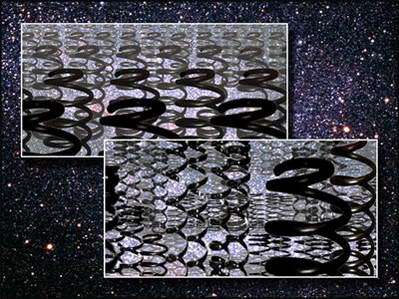
Image: Dark energy is an exotic repulsive force that could make up as much as three-quarters of the cosmos. Possibilities include a cosmological constant or dynamical quintessence, both of which can be represented by scalar fields, like a field of springs covering every point in space. For a cosmological constant (left), each spring would be the same length and motionless. For quintessence (right), each spring would be stretched to a different length.
"The cosmological constant was a vacuum energy (the energy of empty space) that kept gravity from pulling the universe in on itself," says Linder. "A problem with the cosmological constant is that it is constant, with the same energy density, pressure, and equation of state over time. Dark energy, however, had to be negligible in the universe's earliest stages; otherwise the galaxies and all their stars would never have formed."
For Einstein's cosmological constant to result in the universe we see today, the energy scale would have to be many orders of magnitude smaller than anything else in the universe. While this may be possible, Linder says, it does not seem likely. Enter the concept of "quintessence," named after the fifth element of the ancient Greeks, in addition to air, earth, fire, and water; they believed it to be the force that held the moon and stars in place.
"Quintessence is a dynamic, time-evolving, and spatially dependent form of energy with negative pressure sufficient to drive the accelerating expansion," says Caldwell. "Whereas the cosmological constant is a very specific form of energy — vacuum energy — quintessence encompasses a wide class of possibilities."
To limit the possibilities for quintessence and provide firm targets for basic tests that would also confirm its candidacy as the source of dark energy, Linder and Caldwell used a scalar field as their model. A scalar field possesses a measure of value but not direction for all points in space. With this approach, the authors were able to show quintessence as a scalar field relaxing its potential energy down to a minimum value. Think of a set of springs under tension and exerting a negative pressure that counteracts the positive pressure of gravity.
"A quintessence scalar field is like a field of springs covering every point in space, with each spring stretched to a different length," Linder said. "For Einstein's cosmological constant, each spring would be the same length and motionless."
Under their thawing scenario, the potential energy of the quintessence field was "frozen" in place until the decreasing material density of an expanding universe gradually released it. In the freezing scenario, the quintessence field has been rolling towards its minimum potential since the universe underwent inflation, but as it comes to dominate the universe it gradually becomes a constant value.
The SNAP proposal is in research and development by physicists, astronomers, and engineers at Berkeley Lab, in collaboration with colleagues from the University of California at Berkeley and many other institutions; it calls for a three-mirror, 2-meter reflecting telescope in deep-space orbit that would be used to find and measure thousands of Type Ia supernovae each year. These measurements should provide enough information to clearly point towards either the thawing or freezing scenario — or to something else entirely new and unknown.
Says Linder, "If the results from measurements such as those that could be made with SNAP lie outside the thawing or freezing scenarios, then we may have to look beyond quintessence, perhaps to even more exotic physics, such as a modification of Einstein's General Theory of Relativity to explain dark energy."
"The limits of quintessence," by R.R. Caldwell and Eric V. Linder, is now online at arxiv.org/abs/astro-ph/0505494 and will appear in a forthcoming edition of Physical Review Letters.
Source: Lawrence Berkeley National Laboratory


