World' First Transparent Ceramic Lens
August 2, 2004
WORLD’S FIRST TRANSPARENT CERAMIC LENS

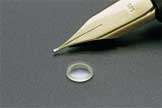
CASIO, Inc., in conjunction with its parent company, CASIO COMPUTER CO., LTD., Tokyo, Japan today announced that using its proprietary optical technology, CASIO COMPUTER CO., LTD., has developed the world’s first lens using transparent ceramics. This breakthrough will make it possible to create zoom lenses for cameras with greatly reduced profiles.

Ever since CASIO’s EXILIM thin card-size digital camera went on sale, the entire digital camera market has undergone a huge change. Compact digital cameras offering mobility in a small package have become mainstream, while there has been a major push in technological development to find better methods of creating smaller, thinner cameras.

“CASIO has become known around the world for its innovation and leadership in the digital camera arena, and today’s breakthrough announcement reaffirms that position,” said John Clough, president of Casio, Inc. “CASIO created the market for truly pocketable and stylish digital cameras with its award-winning EXILIM line, and we can now look forward to even smaller cameras that pack an every greater array of features.”

CASIO is continuing to take the lead in this field by creating the world’s first transparent ceramic lens using LUMICERA, a transparent ceramic developed by Murata Manufacturing Co., Ltd.

LUMICERA has the same light transmitting qualities as optical glass commonly used in today’s conventional camera lenses, however it has two very important properties that caught CASIO’s attention. Not only is LUMICERA’s refractive index ( nd = 2.08 ) much greater than that of optical glass (nd = 1.5 – 1.85 *2), it also offers superior strength. CASIO has been able to create a ceramic lens with extremely high levels of precision thanks to several factors. Under recommendations from CASIO the material itself has been refined for use in digital camera optical lenses by endowing it with improved transmission of short wavelength light and eliminating pores (air bubbles) that reduce transparency. CASIO has also established a complete process involving the perfect combination of polishing material, time and pressure, and by treating the lens with a special coating compatible with a high refractive index.

By incorporating this lens into the construction of the zoom lenses developed by CASIO, a reduction in profile of approximately 20% has been made possible.

Source: Casio


Rank not rated yet
Tags

Relevant PhysicsForums posts

More news stories

Anonymous knocks CIA website offline (Update)

The website of the Central Intelligence Agency was inaccessible on Friday after the hacker group Anonymous claimed to have knocked it offline.

Technology / Internet

created 16 hours ago | popularity 4.7 / 5 (14) | comments 21

New power source discovered

(PhysOrg.com) -- Researchers at the Massachusetts Institute of Technology (MIT) and RMIT University have made a breakthrough in energy storage and power generation.

Technology / Energy & Green Tech

created Feb 10, 2012 | popularity 4.7 / 5 (36) | comments 11 | with audio podcast

Google users warned of threat to smartphone wallets

Users of Google smartphone wallets were being warned on Friday that there is a way to crack pass codes intended to thwart thieves from going on illicit shopping sprees.

Technology / Internet

created 15 hours ago | popularity 5 / 5 (3) | comments 0

Engineering images bring life to submerged city

(PhysOrg.com) -- Photo-realistic 3D mapping and digital reconstruction of an ancient underwater city in Greece have earned a team from the University of Sydney's Faculty of Engineering and Information Technologies ...

Technology / Engineering

created Feb 10, 2012 | popularity 4.3 / 5 (3) | comments 5

Zuckerberg's focus drives Facebook's ascent

When Mark Zuckerberg showed up to rent Judy Fusco's Los Altos, Calif., house in the fall of 2004, soon after he'd arrived in Silicon Valley, the landlord was immediately struck by his confidence.

Technology / Internet

created 21 hours ago | popularity 1 / 5 (2) | comments 2


Could Venus be shifting gear?

(PhysOrg.com) -- ESA’s Venus Express spacecraft has discovered that our cloud-covered neighbour spins a little slower than previously measured. Peering through the dense atmosphere in the infrared, the ...

Fool's gold may prove an unlikely alternative to overexploited catalytic materials

Catalytic materials, which lower the energy barriers for chemical reactions, are used in everything from the commercial production of chemicals to catalytic converters in car engines. However, with current catalytic materials ...

The power of estrogen -- male snakes attract other males

A new study has shown that boosting the estrogen levels of male garter snakes causes them to secrete the same pheromones that females use to attract suitors, and turned the males into just about the sexiest ...

Employers feel no love for unscrupulous practice of 'service sweethearting'

A new study led by two Florida State University marketing professors finds that some frontline service employees who are rewarded for hikes in customer loyalty and satisfaction also may engage in "service ...

Two new moons for Jupiter

Advances in technology have lead to the discovery of new planets outside of our Solar System, and now even new moons in our own backyard.

Complex wiring of the nervous system may rely on a just a handful of genes and proteins

Researchers at the Salk Institute have discovered a startling feature of early brain development that helps to explain how complex neuron wiring patterns are programmed using just a handful of critical genes. ...