Samsung Adds Gigabyte Densities to MultiMediaCard Line-up
August 30, 2005 Samsung Adds Gigabyte Densities to MultiMediaCard Line-up

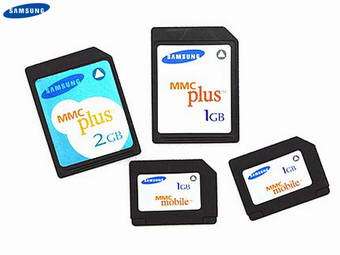
Samsung Electronics today announced that it is sampling Gigabyte MultiMediaCards (MMCs) with customers: 1GB and 2GB MMC plus cards, and the industry's first 1GB MMC mobile card. The higher densities and faster speeds of Samsung's Version 4.1 memory cards will allow consumers to gain higher performance from advanced mobile consumer devices, such as mobile phones, digital still cameras (DSCs), PDAs, MP3 music players and PMPs (portable multimedia players).

The new cards are capable of transmitting data at 52MBytes per second, up to 20 times faster than previous MMC versions, by supporting wider (x4 and x8) bus widths and faster clock speeds (up to 52MHz).

The industry's first gigabyte-density MMC mobile devices are targeted at mobile phone applications. The memory card is half the size of the MMC plus and capable of dual-voltage support (1.8 or 3.3V), satisfying both the low voltage and the low power consumption requirements for mobile phones.

The new MMC plus devices, which run on 3.3V and are up to three times faster than SD™ Memory Cards, are well-suited for digital cameras, which require fast response times for manipulating advanced features.

The new gigabyte cards add to Samsung's original line-up of 64MByte, 128MByte, 256MByte and 512MByte MMC cards. The 1GB MMC mobile, as well as the 1GB and 2GB MMC plus cards are available now for customer sampling with mass production slated for next month. Each MMC device is compatible with existing MMC (Version 4.1) specifications, established by the MultiMediaCard Association (MMCA).

The MMCA (www.mmca.org), a global association formed in 1998 to develop international MMC standards for memory, is addressing market demands for smaller form factors, higher performance and lower power consumption in the enactment of those standards.

According to market research firm Gartner, the global MMC market is expected to grow from $796 million this year to about $1.6 billion by 2008, at a 26 percent compounded annual growth rate.


print this article email this article download pdf blog this article bookmark this article     Stumble it Digg this share on Facebook retweet share on Reddit add to delicious
Rate this story - not rated yet


August 30, 2005 all stories

Comments: 0

not rated yet
  • Stumble this up

  • Digg this

  • share this

  • hide
  • Related Stories


Other News

Review: New BlackBerry Storm improves on original (AP)

Review: New BlackBerry Storm improves on original

Electronics / Consumer & Gadgets

created 11 hours ago | popularity 4.5 / 5 (2) | comments 0

(AP) -- The first touch-screen BlackBerry phone, the Storm, got a few things right, but generally it was a chore to use.


Kindle DX

Schools shun Kindle, saying blind can't use it

Electronics / Consumer & Gadgets

created 23 hours ago | popularity not rated yet | comments 4

(AP) -- Amazon's Kindle can read books aloud, but if you're blind it can be difficult to turn that function on without help. Now two universities say they will shun the device until Amazon changes the setup.


Dell 5130cdn

Dell Launches World's Fastest Office Color Laser Printer

Electronics / Consumer & Gadgets

created 2 hours ago | popularity not rated yet | comments 0

(PhysOrg.com) -- Dell today announced three new commercial workgroup printers to help businesses of all sizes increase productivity and lower their total cost of printing.


Tech toys over $100 that are worth every penny

Electronics / Consumer & Gadgets

created 14 hours ago | popularity not rated yet | comments 0

Picking a Christmas gift for the nerd in your life is never easy. In the holiday stampede, it's all too easy to pick an outdated gadget or obsolete program. And mistakes can be costly.


Engineers Will Create Planetary Rover From Retinal Implant Test Robot

Engineers Will Create Planetary Rover From Retinal Implant Test Robot

Electronics / Robotics

created 20 hours ago | popularity 5 / 5 (1) | comments 0

(PhysOrg.com) -- The research, led by Wolfgang Fink, will aid both people with visual impairments and scientists involved in planetary exploration.