New 'Alien Nanofiber' Has Potential Anti-Counterfeiting Applications
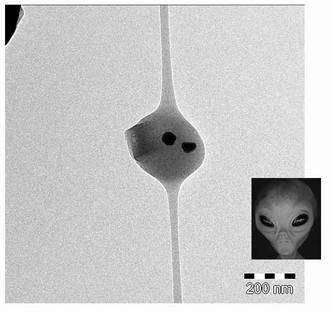
Under a powerful microscope it looks like an alien – something out of Roswell, N.M., or "The X-Files."
But a brand-new, tiny fiber dubbed the “alien nanofiber,” co-invented by a North Carolina State University textiles professor and a chemical engineering professor from the University of Puerto Rico, Mayaguez, has the potential to become a big deterrent to counterfeiters.
Image: The new nanofiber looks like an alien, but has the potential to serve anti-counterfeiting purposes.
NC State’s Dr. Juan Hinestroza, assistant professor of textile engineering, chemistry and science, and Dr. Carlos Rinaldi, assistant professor of chemical engineering at the University of Puerto Rico, Mayaguez, created novel nanoscale fibers that can be placed inside a garment or paper document and serve as a “fingerprint” that proves the garment or document is genuine. Graduate student Carola Barrera and high school student Aldo Briano are also involved in the research.
At about 150 nanometers in diameter, the fibers are smaller than living cells and invisible to the naked eye. A nanometer is one-billionth of a meter; for comparison purposes, the Web site for the National Nanotechnology Initiative, a federal research and development initiative that coordinates multiagency efforts in nanoscale science, says that a human hair is about 80,000 nanometers wide, while a sheet of paper is about 100,000 nanometers wide.
The tiny fibers are designed to have within them even smaller nanoparticles with an electrical, magnetic or optical “signature” that can prove a product genuine. The product would need only be scanned, or read, by a device looking for the particular signature.
For example, Hinestroza says, name-brand clothing with nanofibers can be scanned at different points in the supply chain to ensure pirated clothing doesn’t get into retail outlets or into your closet. Passports with nanofibers can be scanned to ensure their legitimacy. Ostensibly, paper money with nanofibers would help ensure fake twenties don’t get into your wallet – or the grocer’s till.
“The fibers can essentially serve as molecular bar codes,” Hinestroza says. “We can control the position, frequency and distribution of particles inside the fibers, and their signature.”
He also says that manufacturers wouldn’t need to change the ways they make things in order to include the nanofibers.
“These fibers can be easily incorporated into existing textile manufacturing facilities,” Hinestroza said. “Textile products are the perfect vehicles for incorporating nanotechnology into commercial applications.”
The process used to create the nanofibers is called electrospinning, a textiles manufacturing process first used in the 1930s but now being put to use to create tiny fibers.
In their electrospinning research, the scientists apply electrical charges to water-based polymer solutions containing tiny nanoparticles, including magnetic particles or quantum dots, tiny particles that, depending on their size, display colors. When enough electrical charge is applied to the solution, an unstable jet – or narrow stream of solution and nanoparticles – moving like a whip through air, is formed. The whipping motion elongates the jet while the solvent evaporates, producing a tiny fiber containing the nanoparticles.
The researchers then tested the fibers and found the fibers had magnetic properties.
Hinestroza and Rinaldi have been invited to present their nanofiber findings at a number of academic conferences in the next few months.
The research is sponsored by a National Science Foundation Nanoscale Exploratory Research grant, and by the NC State Nanotechnology Steering Committee.
Source: North Carolina State University


