Nobel prize winner Joseph Rotblat dies
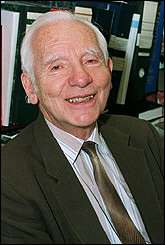
September 2, 2005 Joseph Rotblat

Scientists around the world paid tribute to Joseph Rotblat, a Polish nuclear physicist and Nobel peace prize winner, who died at age 96.

Rotblat, who resigned from the Manhattan Project during World War II, died in his sleep in his home in London Wednesday, the Guardian reported Friday.

Born in Warsaw in 1908, he started work on nuclear weapons at Liverpool University in 1939 in Britain and was part of the Manhattan Project in Los Alamos, N.M.

However, after he learned intelligence indicated the Germans were not working on a nuclear weapon, he left the effort. He returned to Britain and pursued medical physics at St. Bartholomew's hospital in London. He later co-founded the Pugwash conferences, a movement to discourage the use and proliferation of nuclear weapons.

Rotblat and the Pugwash group won the Nobel peace prize in 1995.

"He's been an inspiration to people all over the world. He devoted his life to preventing the use, spread or existence of nuclear weapons," said Robert Hinde, chairman of Pugwash conferences in Britain and emeritus professor at Cambridge University.

Copyright 2005 by United Press International


print this article email this article download pdf blog this article bookmark this article     Stumble it Digg this share on Facebook retweet share on Reddit add to delicious
Rate this story - 3 /5 (4 votes)


September 2, 2005 all stories

Comments: 0

3 /5 (4 votes)
  • Stumble this up

  • Digg this

  • share this

  • hide
  • Related Stories

  • Experts warn glaciers in Indian Kashmir melting
    created Oct 13, 2009 | popularity not rated yet | comments 0
  • 'Masters of light' win Nobel Physics Prize
    created Oct 06, 2009 | popularity not rated yet | comments 0
  • Heart of a galaxy emits gamma rays
    created Oct 02, 2009 | popularity not rated yet | comments 0
  • Solving the Nuclear Pore Puzzle
    created Aug 19, 2009 | popularity not rated yet | comments 0
  • Chance of nuclear war is greater than you think: Stanford engineer makes risk analysis
    created Jul 20, 2009 | popularity not rated yet | comments 0


Other News

Building a more versatile laser

Building a more versatile laser

Physics / Optics & Photonics

created 16 hours ago | popularity 4.1 / 5 (10) | comments 0

(PhysOrg.com) -- One of the drawbacks associated with using semiconductor lasers is that many of them can only produce a beam of a single wavelength, and can only send that beam in one direction at a time. ...


Engineer Discovers Why Particles Like Flour Disperse on Liquids

Engineer Discovers Why Particles Like Flour Disperse on Liquids

Physics / General Physics

created 7 hours ago | popularity 4.3 / 5 (6) | comments 1

(PhysOrg.com) -- Even if you are not a cook, you might have wondered why a pinch of flour (or any small particles) thrown into a bowl of water will disperse in a dramatic fashion, radiating outward as if it ...


Measuring Electron Orbitals

Measuring Electron Orbitals

Physics / General Physics

created 17 hours ago | popularity 5 / 5 (4) | comments 0

(PhysOrg.com) -- For the first time, it has been possible to measure electron density in individual molecular states using what is known as the photoelectric effect. Now published in Science, this method repres ...


Scientists demonstrate 'universal' programmable quantum processor

Scientists demonstrate 'universal' programmable quantum processor

Physics / Quantum Physics

created Nov 15, 2009 | popularity 4.6 / 5 (20) | comments 11

Physicists at the National Institute of Standards and Technology have demonstrated the first "universal" programmable quantum information processor able to run any program allowed by quantum mechanics -- th ...


Do we need dark matter?

Do we need dark matter?

Physics / General Physics

created Nov 12, 2009 | popularity 4.1 / 5 (18) | comments 33

It's the biggest problem in physics: the matter we can see in the universe accounts for just five per cent of the observed gravity that holds galaxies together.