Strings As Structural Elements? Engineers Devise Mathematics For New Age Structures
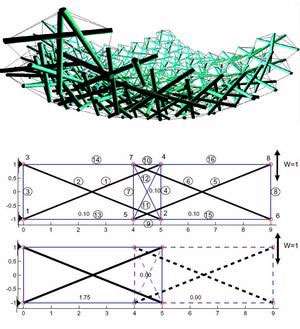
Scientists at the University of California, San Diego (UCSD) have devised two mathematical tools considered to be major contributions to the optimal design of a new generation of deformable bridges, buildings, shape-controllable airplane wings, radio antennas, and other alternatives to current structural technologies. Two reports will be published in the International Journal of Solids and Structures, with the first appearing in the April issue.
The deformable characteristic is made possible with strong, ultra-light truss-like arrangements of rods suspended by strings or wires. The resulting structure incorporates tensegrity, a combination of “tension” and “integrity.”
“Although tensegrity structures are not yet part of mainstream design engineering, we think their amazing properties explain why you find this arrangement in spider webs, the protein cytoskeleton of cells, and many other biological structures,” said Robert E. Skelton, a professor of mechanical and aerospace engineering in UCSD’s Jacobs School of Engineering.
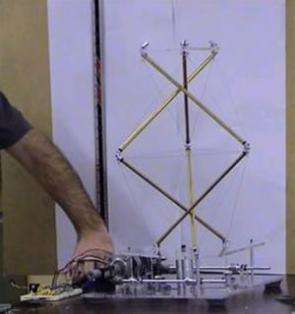
Skelton and his students have pioneered the development of rigorous scientific tools to analyze the balance of forces and movement in many types of tensegrity systems. Unlike the arms and legs of a puppet, which hang from strings, a robotic tensegrity limb would be held in tension by a system of cables. Built-in actuators could pull those cables to direct the robot to wave or pick up a block.
Skelton and postdoctoral fellow Milenko Masic describe in the April issue of the International Journal of Solids and Structures a mathematical method for optimizing the initial tension of strings within defined extremes of motion.
In a second paper in the journal, which is available online, Skelton, Masic, and UCSD mathematics professor Philip E. Gill describe an optimization algorithm that will help tensegrity designers maximize the strength and minimize the weight of the rods and cables.
A new generation of tensile-element materials has mechanical properties that are superior to those of traditional compressive elements, and the optimization algorithm by Skelton, Masic, and Gill incorporates the strength constraints of those materials. That information is used to help specify how to design a structure with the least material while retaining the desired stiffness as the structure changes shape.
“A tensegrity-based wing could change shape as an airplane gains speed, but if the stiffness was relaxed the wing would fall off” said Skelton. “In mathematical terms, our algorithm directs the tensegrity structure to maintain its stiffness as it moves from one equilibrium position to another. The beauty of this approach is we don’t have to continually use energy to maintain the shape at each new equilibrium position.”
The optimization algorithm relies on mathematical parameters that define the pitch (upward tilt), yaw (left or right swings), and separation distance of each of a series of identical rods. “For a tensegrity-based wing to maintain its stiffness as it changes shape, the algorithm defines an optimal ‘surface’ in the space of our three parameters,” Skelton said. “We would then very selectively make some strings shorter and others longer in order to change the wing shape as we move along a predetermined equilibrium surface.”
Artists such as Buckminster Fuller and Kenneth Snelson appreciated the concept of tensegrity. They created sculptures with stainless steel rods and tension wires, but most engineers have regarded tensegrity sculptures as museum curiosities. “Tensegrity, as a concept, has been around for more than 50 years, but until now we have lacked the mathematics needed to make it an engineering tool,” said Skelton. “There are lots of ways to put sticks and strings together that give you nothing but a useless pile. However, our new computational tools enable us to design structures such as an airplane wing that can extend and retract like a bird’s wing.”
Skelton said optimized tensegrity structures with Mylar, Kevlar, titanium, and specialty steels may help the next generation of engineers use those and other strong, lightweight materials to reduce costs and increase performance in a variety of new ways. “The mathematical tools we’re developing could revolutionize the way engineers design all sorts of structures,” Skelton said.
Source: University of California, San Diego, By Rex Graham


