New Solar Underwater Robot Technology
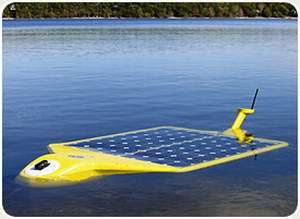
A new solar-powered underwater robot technology developed for undersea observation and water monitoring will be showcased at a Sept. 16 workshop on leading-edge robotics to be held at the National Science Foundation (NSF) in Arlington, Va.
Image: Solar-powered Autonomous Underwater Vehicle (SAUV). Photo: RPI/Sanderson in collaboration with Autonomous Undersea Systems Institute, Falmouth Scientific Inc., and Naval Undersea Warfare Center.
Arthur C. Sanderson, professor of electrical, computer, and systems engineering at Rensselaer Polytechnic Institute, will display the robotic technology being developed by a team of research groups, including Rensselaer, and led by the Autonomous Undersea Systems Institute directed by D. Richard Blidberg.
Sanderson also will participate on a panel of six robotics experts who recently completed a study to be released at the Sept. 16 workshop. The World Technology Evaluation Center International Study of Robotics is a two-year look at robotics research and development in the United States, Japan, Korea, and Western Europe.
As the principal investigator of an NSF-funded project called RiverNet, Sanderson is working collaboratively with other researchers to develop a network of distributed sensing devices and water-monitoring robots, including the first solar-powered autonomous underwater vehicles (SAUVs).
“Once fully realized, this underwater robot technology will allow better observation and monitoring of complex aquatic systems, and will support advances in basic environmental science as well as applications to environmental management and security and defense programs,” said Sanderson.
The SAUV technology allows underwater robots to be deployed long-term by using solar power to replenish onboard energy. Long-term deployment of SAUVs will allow detection of chemical and biological trends in lakes, rivers, and waterways that may guide the management and improvement of water quality. Autonomous underwater vehicles equipped with sensors are currently used for water monitoring, but must be taken out of the water frequently to recharge the batteries.
According to Sanderson, the SAUVs communicate and network with one another in real time to assess a water body as a whole in measuring how it changes over space and time. Key technologies used in SAUVs include integrated sensor microsystems, pervasive computing, wireless communications, and sensor mobility with robotics. Sanderson notes that the underwater vehicles have captured the attention of the U.S. Navy, which will evaluate their use for coastal surveillance applications.
The SAUV weighs 370 pounds, travels at speeds of up to 2 miles per hour, and is designed to dive to depths of 500 meters.
Sanderson and his colleagues will continue field testing the vehicles in coming months at locations including Rensselaer’s Darrin Fresh Water Institute on Lake George, N.Y., to determine communication, interaction, and maneuvering capabilities in testing dissolved oxygen levels, one of the most important indicators of water quality for aquatic life.
Sanderson is collaborating on SAUV development with the Autonomous Undersea Systems Institute, Falmouth Scientific Inc., the Naval Undersea Warfare Center, and Technology Systems Inc.
The Sept. 16 workshop is sponsored by NSF, NASA, and the National Institutes of Health (NIH). The international robotics study was organized by the World Technology Evaluation Center, a United States-based organization conducting international research assessments.
“This gathering of researchers and their robots shows the necessity of federal support for basic research that leads to new technologies with useful applications in health care, the environment, and industry,” said Sanderson.
Source: Rensselaer Polytechnic Institute


