NASA Prepares for Space Exploration in Undersea Lab
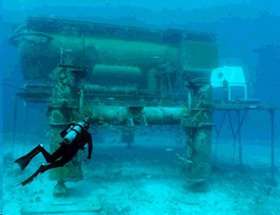
NASA will send three astronauts and a Cincinnati doctor under the ocean next month to test space medicine concepts and moon-walking techniques. During the mission, called the NASA Extreme Environment Mission Operations (NEEMO) project, new long-distance medical techniques that could help keep spacefarers healthy will be practiced.
Doctors thousands of miles away will guide aquanauts as they perform surgeries on a patient simulator. Doctors also will remotely control robotic instruments to do the work. The procedures simulated in Aquarius may one day be used to respond to emergencies on the International Space Station, the moon or Mars.
Canadian astronaut Dave Williams will lead the undersea mission April 3-20 on board the National Oceanic and Atmospheric Administration (NOAA) Aquarius Underwater Laboratory. NASA astronauts Nicole Stott and Ron Garan and Dr. Tim Broderick of the University of Cincinnati round out the crew. Jim Buckley and Ross Hein of the University of North Carolina at Wilmington will provide engineering support.
The crew members will conduct simulated undersea "moon walks" to test concepts for future lunar exploration. During those simulated moon walks, they will construct an underwater structure with the help of a remotely operated vehicle, similar to what may be done by the next travelers to the moon. This will be the ninth undersea mission conducted by NASA in cooperation with NOAA.
A "mission control" at NASA's Johnson Space Center, Houston, will monitor the underwater expedition. Johnson's Exploration Planning Operations Center will simulate future space challenges, among them the two-second communications delay between Earth and the moon.
"This mission will be the longest NEEMO and Aquarius mission," said NEEMO Project Manager Bill Todd. "Our partnerships with other agencies and countries should provide a treasure chest of useful medical and exploration operations knowledge."
NEEMO 9 will demonstrate and evaluate innovative technologies and procedures for remote surgery. Dr. Mehran Anvari will remotely guide astronauts through diagnosis and surgery and use virtual-reality technology to remotely guide simulated surgery by robots. Anvari is director of the McMaster University Centre for Minimal Access Surgery at St. Joseph's Healthcare, Hamilton, Ontario, Canada.
Similar in size to the space station's living quarters, Aquarius is the world's only permanent underwater habitat and laboratory. The 45-foot long, 13-foot diameter complex is three miles off Key Largo in the Florida Keys National Marine Sanctuary. It rests about 62 feet beneath the surface. A surface buoy provides an outlet for power, life support and communications. A shore-based control center monitors the habitat and crew. Aquarius is owned and funded by NOAA and operated by the University of North Carolina at Wilmington. The NEEMO missions are a cooperative project among NASA, NOAA and the university.
This mission originally was scheduled for October 2005, but it was postponed due to hurricanes. Because of the NEEMO and space shuttle mission schedules, Williams is replacing NASA astronaut Lee Morin as commander.
Source: NASA


