Looking to understand why Sun's corona shines hotter than the Sun itself
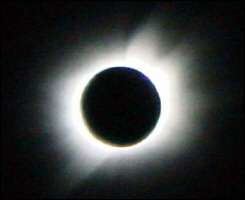
Scientists from around the world joined this Greek island's 250 residents and countless visitors Wednesday in cheering the drama of the Moon totally blocking the Sun, revealing the dancing glow of its corona.
"It was even more fabulous than we expected," said Jay Pasachoff, professor of astronomy at Williams College (in Williamstown, Mass.) who observed his 42nd solar eclipse. "All the technical equipment worked perfectly, the corona shone brightly, and the activity around sunspots on the eastern edge of the Sun provided an even more dramatic show than predicted."
Chair of the International Astronomical Union's Working Group on Eclipses, Pasachoff led an expedition of dozens of scientists and students to record images from the rare, three-minute event. They are capturing data over many eclipses to understand better why the Sun's corona, the outer halo of million-degree gas, shines hotter than the Sun itself. Most of the corona is visible from Earth only for the fleeting time that the Moon totally blocks the Sun's direct rays.
Tourists and residents, who had packed the tiny island's harbor-side, cheered at the appearance of the "diamond ring" effect that brought the total eclipse to a close while ships blew their horns in celebration.
Two of the group's experiments involved taking rapid series of images, ten times per second, with new electronic cameras through specially designed filters. One filter passes a narrowly defined color in the green portion of the light spectrum and the other passes a narrowly defined color in the red.
Each is emitted by gas in the corona from iron that has been heated to such high temperatures that it has been stripped of 13 or 9 electrons, respectively, from its normal 26.
A third experiment used a filter that provides an even more narrowly defined coronal color. Known as a Fairy-Perot, it was designed and built by the Johns Hopkins University Applied Physics Laboratory for David Rust, a solar astronomer there. Rust and his colleague Matthew Noble were in Kastellorizo. Williams alumnus Rob Wittenmyer '98, now a graduate student in astronomy at the University of Texas, assisted them.
A fourth experiment involved a specially built telescope that matches a defunct one aboard the Solar and Heliospheric Observatory (SOHO), a satellite built and operated by the European Space Agency and NASA. Bernhard Fleck, SOHO project scientist, was on Kastellorizo with the Williams team.
The group also captured a further variety of digital and film images. They included work by several veterans of previous Williams eclipse expeditions, including Lee Hawkins from Appalachian State University in North Carolina and Jonathan Kern of the Large Binocular Observatory in Tucson, Ariz. Kern made images with a camera and filter modified to flatten the extensive dynamic range of the corona to enable the delicate coronal structure to show on a single piece of photographic film.
Also collaborating was John Seiradakis of the Aristotle University of Thessaloniki and two of his students. They were joined by Margarita Metaxa of Athens, who works with Pasachoff on the International Astronomical Union's Commission on Education and Development, and two of her students.
The Williams contingent included Bryce Babcock, coordinator of science facilities and staff physicist, and Steven Souza, instructor in astronomy and observatory supervisor, along with six students: Megan Bruck '07 of Tempe, Ariz., Paul Hess '08 of Simsbury, Conn., Shelby Kimmel '08 of Newton, Mass., Jesse Levitt '08 of Natick, Mass., Amy Steele '08 of Orlando, Fla., and Anna Tsykalova '08 of Ardmore, Pa. Also assisting was the expedition's medical officer, amateur astronomer Paul Rosenthal, M.D., of Williamstown.
For the current expedition, Williams College received a grant from the National Science Foundation, to support the faculty, students, liaison with Greek colleagues and various equipment and shipping expenses. Pasachoff also received an earlier grant from the Committee for Research and Exploration of the National Geographic Society. The new electronic cameras were supplied by an equipment grant to Williams and MIT from the Planetary Sciences Division of NASA. They could be used because the eclipse cameras and Pluto cameras have similar specifications. Additional support was provided by the scientific honor society Sigma Xi, the Massachusetts Space Grant, the Rob Spring Fund, and the Ryan Patrick Gaishin Fund. Some of the photographic equipment was lent by the National Geographic Society and by Nikon.
Wednesday's eclipse began at dawn on the eastern tip of Brazil and raced across the Atlantic Ocean and eastern and northern Africa before passing over this easternmost point of Europe. From here it swept across Turkey before ending at dusk in Mongolia.
Though brief (the longest lasted seven minutes) total eclipses draw astronomers and thrill-seekers from great distances, in this case multiplying the population of this tiny island--filling every hotel room and camping on the town's soccer field.
The next total eclipse of the Sun occurs in 2008 over a narrow path from northernmost Canada, over Greenland and Russia, to central China.
Source: Williams College


