Sandia conducts tests at Solar Tower to benefit future NASA space explorations
Missions of interest include Saturn's Titan
For the last two years, tests have been conducted at Sandia National Laboratories' National Solar Thermal Test Facility to see how materials used for NASA's future planetary exploration missions can withstand severe radiant heating.
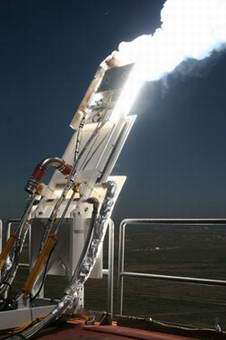
The tests apply heat equivalent to 1,500 suns to spacecraft shields called Advanced Charring Ablators. The ablators protect spacecraft entering atmospheres at hypersonic speeds.
Image: Solar power heats NASA space shield material. The tests apply heat equivalent to 1,500 suns to spacecraft shields. (Photo courtesy of Bill Congdon, Applied Research Associates, Inc.)
The test facility includes a 200-ft. "solar tower" surrounded by by a field of hundreds of sun-tracking mirror arrays called heliostats. The heliostats direct sunlight to the top of the tower where the test objects are affixed.
Under a work agreement, researchers at Sandia and Applied Research Associates, Inc. are conducting the tests for NASA Marshall's In-Space Propulsion/Aerocapture Program. The R&D effort is tied to NASA's plan for a future Titan mission with an orbiter and lander. Titan is Saturn's largest moon.
The tests are led by Sandia solar tower expert Cheryl Ghanbari and Bill Congdon, project principal investigator for Applied Research Associates, Inc.
The tests are designed to simulate atmospheric heating of spacecraft that enter Titan, including low levels of convective heating combined with relatively high levels of thermal radiation.
The primary ablator candidates for the Titan mission are low-density silicones and phenolics, all under 20 pounds-per-cubic-foot density.
To date, more than 100 five-inch diameter samples have been tested in the solar environment inside the tower's wind tunnel using a large quartz window.
Congdon says because of Titan's relatively high radiation environment, some initial concerns had to be put to rest through testing. He says radiation might penetrate in-depth within the ablator, causing an increased "apparent" thermal conductivity and degrading insulation performance.
"Radiation could also generate high-pressure gasses within the ablator leading to spallation," Congdon says.
"We have been testing at the solar tower to see how the candidate Titan materials can withstand the expected range of heating conditions," Ghanbari says. "Titan has a nitrogen-rich atmosphere and nitrogen is used in the tests to similarly reduce ablator oxidation, while energy from the sun-tracking heliostats is focused on the samples."
Congdon says ground tests are necessary to understand and model surface ablation of the materials that will be severely heated during Titan entry.
During thermal radiation testing conducted in the solar tower, all of these concerns were addressed and found not to be a problem for the ablators of interest.
About the tests
The National Solar Thermal Test Facility consists of an eight-acre field of 220 solar-collection heliostats and a 200-ft.-tall tower that receives the collected energy at one of several test bays. A single heliostat includes 25 mirrors that are each four feet square. Total collection area of 220 heliostats is 88,000-square feet.
Because the heliostats are individually computer controlled, test radiation can be a shaped pulse as well as a square wave in terms of intensity vs. time, says Ghanbari.
Test samples are mounted high in the receiver tower, and the heliostats direct the sunlight upward to irradiate the sample surface. The samples are mounted in a water-cooled copper plate inside the wind tunnel with a quartz window that allows entry of the concentrated radiation.
Exposure is controlled by a fast-moving shutter and by pre-programmed heliostat movement. Radiation flux is calibrated before and after each test by a radiometer installed to occupy the same position as the test sample. Cooling effects from imposed surface flows are calibrated via a flat-plate slug calorimeter.
The materials are subjected to square pulse environments at flux levels of 100 and 150 W/cm2 for time periods that far exceed predicted flight durations for such high heating. They are also tested to "exact" flux vs. time environments (simulating actual flight conditions) using programmed heliostat focusing at the solar tower facility.
The material samples are installed in the tower's wind tunnel and exposed to the solar beam at flux levels up to 150 W/cm2, which is approximately 1,500 times the intensity of the sun on earth on a clear day. During exposure, air blows past the sample at about mach 0.3 with a high-speed nitrogen sub-layer close to the sample surface.
Ghanbari says tests can be conducted only during about four hours midday bracketing solar noon. Haze, clouds, and high winds that affect the heliostats can degrade test conditions.
Current results
"All of the candidate materials showed no spallation and very good thermal performance to these imposed environments," Congdon says. Recently, five 12-inch by 12-inch panel samples were tested on top of the tower. Up to 20 additional 12-inch panels will be tested late in the summer followed by testing of 2-foot by 2-foot panels later in the year.
Additional tests for convective heating have been conducted on identical material samples at the Interaction Heating Facility (IHF) at NASA's Ames Research Center.
Sandia is a multiprogram laboratory operated by Sandia Corporation, a Lockheed Martin company, for the U.S. Department of Energy's National Nuclear Security Administration. With main facilities in Albuquerque, N.M., and Livermore, Calif., Sandia has major R&D responsibilities in national security, energy and environmental technologies, and economic competitiveness.
Source: Sandia National Laboratories


