Astronomers discover evidence of football-field sized moonlets in Saturn's A ring
March 30, 2006
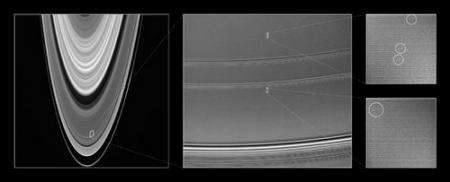
The left image shows the B ring, Cassini Division, A ring and F ring, with the location of the propeller-shaped disturbances indicated. The center image is a closer view of the A ring, showing the radial locations where propeller features were spotted. In the right-hand image, the propellers appear as double dashes in the two close-up images. The unseen moonlets, each roughly the size of a football field, lie in the center of each structure. (The horizontal lines in the image represent electronic noise and do not correspond to ring features.)
New observations of propeller-shaped disturbances in Saturn's A ring indicate the presence of four small, embedded moons -- and most likely millions more, Cornell University astronomers report.
This is the first evidence of the existence of moonlets bridging the gap in size between the larger ring moons Pan and Daphnis (several miles each in diameter) and the much smaller ice particles that comprise the bulk of the rings. The discovery could lead to a better understanding of the origin and formation of Saturn's rings and the solar system as a whole.
Matthew Tiscareno, a Cornell research associate, is lead author of a paper describing the discovery in the March 30 issue of the journal Nature.
The four disturbances, which appear as pairs of slightly offset bright horizontal streaks in an otherwise bland region of the ring, were captured in two images taken in 2004 by NASA's Cassini spacecraft. Astronomers say the streaks are indicators of orbiting moons about 100 meters (328 feet) in diameter: about the length of a football field, but still too small for even Cassini's highly sensitive Imaging Science Subsystem (ISS) to see directly, but large enough to exert an observable gravitational pull on the particles around them.
"The discovery of these intermediate-sized particles tells us that Pan and Daphnis are probably just the largest members of the ring population, rather than interlopers from somewhere else," said Tiscareno.
A continuum of particle sizes lends strong support to the theory that Saturn's rings were formed when another object fragmented close to the planet, breaking into pieces which were then captured by Saturn's gravitational pull.
"There has always been the question about whether the rings were primordial material that was unable to grow into a moon or debris left over from a breakup event," said Joseph Burns, Cornell professor of astronomy and of theoretical and applied mechanics and paper co-author, along with Cornell research associate Matthew Hedman and researchers at other institutions. The discovery doesn't rule out the accretion model, but "it's a step in that direction," said Tiscareno. "It's hard for direct accretion to produce particles this large. It's much easier if you start with a solid icy core, like a shard from a breakup."
The discovery also helps explain fully cleared openings such as the Encke and Keeler gaps within the rings. The gravitational influence of a larger moon like Pan or Daphnis wraps around the circumference of the rings, creating a gap. The smaller moonlets begin to create this effect, the researchers say, but their influence is not strong enough to prevent particles from falling into the rings ahead of and behind them.
Like a motorboat's wake on a smooth lake, the four observed disturbances are particularly visible since the area they inhabit is otherwise smooth. But the fact that four were found in just two images covering only a tiny fraction of the ring makes it likely that millions more exist. By studying them further, researchers hope to gain a better understanding of how Saturn's rings formed -- and even about how solar systems form around stars.
"The structures we observe with Cassini are strikingly similar to those seen in many numerical models of the early stages of planetary formation, even though the scales are vastly different," said Carl Murray, a co-author and astronomer at Queen Mary College, University of London. "In this way, Cassini is giving us unique insight into the origin of planets."
The Cassini-Huygens mission is a cooperative project of NASA, the European Space Agency and the Italian Space Agency. The Jet Propulsion Laboratory, a division of the California Institute of Technology, manages the mission for NASA.
During its Saturn tour, as currently planned, Cassini will complete 74 orbits of the ringed planet, 44 close flybys of the moon Titan and numerous flybys of Saturn's other icy moons.
Source: Cornell University
-
Shaking down frozen helium: In a 'supersolid' state, it has liquid-like characteristics
May 12, 2011 |
4 / 5 (2) |
1
-
Spacecrafts reveal mysteries of Jupiter and Saturn rings
Mar 31, 2011 |
4.2 / 5 (6) |
0
-
Saturn Propellers Reflect Solar System Origins
Jul 08, 2010 |
4.8 / 5 (5) |
1
-
1980s Video Icon Glows on Saturn Moon
Mar 29, 2010 |
4.5 / 5 (14) |
0
-
Saturn has small moon hidden in ring
Mar 03, 2009 |
4.8 / 5 (5) |
0
-
Engineers build first sub-10-nm carbon nanotube transistor
Feb 01, 2012 |
4.9 / 5 (31) |
30
-
Something old, something new: Evolution and the structural divergence of duplicate genes
Jan 31, 2012 |
4.6 / 5 (7) |
1
-
The hidden nanoworld of ice crystals: Revealing the dynamic behavior of quasi-liquid layers
Jan 30, 2012 |
5 / 5 (3) |
1
-
Stock market network reveals investor clustering
Jan 27, 2012 |
3.9 / 5 (23) |
8
-
Of microchemistry and molecules: Electronic microfluidic device synthesizes biocompatible probes
Jan 26, 2012 |
5 / 5 (1) |
0
More news stories
Humans may have helped the decline of African rainforests 3000 years ago
(PhysOrg.com) -- Large areas of rainforests in Central Africa mysteriously disappeared over three thousand years ago, to be replaced by savannas. The prevailing theory has been that the cause was a change ...
Could Venus be shifting gear?
(PhysOrg.com) -- ESAs Venus Express spacecraft has discovered that our cloud-covered neighbour spins a little slower than previously measured. Peering through the dense atmosphere in the infrared, the ...
Space & Earth / Space Exploration
20 hours ago |
5 / 5 (7) |
8
|
NASA budget will axe Mars deal with Europe: scientists
US President Barack Obama's budget proposal to be submitted next week for 2013 will cut NASA's budget by 20 percent and eliminate a major partnership with Europe on Mars exploration, scientists said Thursday.
Space & Earth / Space Exploration
23 hours ago |
5 / 5 (2) |
20
Mars Science Laboratory computer issue resolved
(PhysOrg.com) -- Engineers have found the root cause of a computer reset that occurred two months ago on NASA's Mars Science Laboratory and have determined how to correct it.
Space & Earth / Space Exploration
21 hours ago |
4.7 / 5 (6) |
4
|
Two new moons for Jupiter
Advances in technology have lead to the discovery of new planets outside of our Solar System, and now even new moons in our own backyard.
Space & Earth / Space Exploration
20 hours ago |
4 / 5 (1) |
7
Anonymous knocks CIA website offline (Update)
The website of the Central Intelligence Agency was inaccessible on Friday after the hacker group Anonymous claimed to have knocked it offline.
New error-correcting codes guarantee the fastest possible rate of data transmission
Error-correcting codes are one of the triumphs of the digital age. Theyre a way of encoding information so that it can be transmitted across a communication channel such as an optical fiber o ...
Small modular reactor design could be a 'SUPERSTAR'
(PhysOrg.com) -- Though most of today's nuclear reactors are cooled by water, we've long known that there are alternatives; in fact, the world's first nuclear-powered electricity in 1951 came from a reactor ...
New power source discovered
(PhysOrg.com) -- Researchers at the Massachusetts Institute of Technology (MIT) and RMIT University have made a breakthrough in energy storage and power generation.
The power of estrogen -- male snakes attract other males
A new study has shown that boosting the estrogen levels of male garter snakes causes them to secrete the same pheromones that females use to attract suitors, and turned the males into just about the sexiest ...
Google users warned of threat to smartphone wallets
Users of Google smartphone wallets were being warned on Friday that there is a way to crack pass codes intended to thwart thieves from going on illicit shopping sprees.