New eBook technologies hitting market
Sometimes you see them out of the corner of your eye. They'll be hunched over on the bus or leaning against a wall on the subway, their eyes glancing over a Palm or BlackBerry PDA. Sometimes they're going over e-mail or work notes, but increasingly so, they'll be reading a digital novel, or eBook, on the tiny handheld screen. That may be a great book, but an uncomfortable means of reading it.
This may all change within the next few years with the focused commercial launch of several eBook reader devices. These units, generally priced from $250 to $400, allow for digital versions of text to be downloaded either from the Internet or a PC and read at the full resolution provided by a printed page. Until recently, this has been almost impossible on a small PDA's screen, the lighting needing to be optimal while the lack of clarity proved straining to many trying to read longer documents.
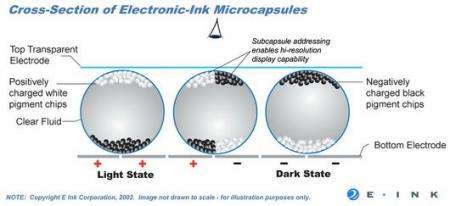
Enter eInk, the brainchild of eInk Corporation in Cambridge, Mass., and the technology that could change everything. Based on the idea of mimicking the physics of paper, eInk uses microscopic colored beads suspended in a clear liquid between layers of plastic that react to electrical charges.
These beads, which consist of positively charged white particles and negatively charged black particles, react to different electrical charges. Should a positive charge run through the circuitry, the black beads will move to the top of the layer and become visible. Should a negative charge run through the circuitry, the white beads will rise to the top and become visible. The overall effect, when put into motion, is that of a four-color grayscale screen that mimics the way light reflects on paper and allows for extended reading to take place at any angle via a technology that proves physically easier to read than the small, backlit LCD screen of an PDA device.
Once downloaded onto the device, the format of the text can also be searched through and adjusted to meet the reader's preferences such as larger text for senior readers.
The end result is that of a portable device that can potentially hold thousands of documents and display them at the same clarity, resolution and level of comfort provided by a traditional book. Where audio device manufacturers discovered that users were content to bring their entire audio library with them provided the user experience was convenient and enjoyable, firms such as Sony and iRex Technologies have begun developing and selling eBook readers for wider markets with educational institutions such as universities looking to digitize their text holdings.
"For the first time, consumers are actually doing a lot of reading online and onscreen through PDAs," said Keith Titan, vice president of New Media for publishing giant Random House. "It could be news articles, blogs, e-mail newsletters -- a tremendous amount of reading is being done and there's more sense in a dedicated device."
Like several other publishers, Random House has made an effort to move towards other forms of media including audio, video and eBooks. To date, Random House has translated more than 3,000 texts into downloadable eBooks and priced them approximately $7 lower than their $25 hardcover counterparts.
"It helps if you've got some strong brands. The technology, at $350 or more, depends on the content that's already out there." said Ross Rubin, an analyst for NPD Group, which focuses on consumer and retail trends, discussing the future eBook market.
"Paper is a very tough competitor. It's very inexpensive, it's relatively portable, it's got a lot of history behind it that's universally compatible. I think that's the challenge in trying to create an eBook market," said Rubin. "Things like magazines, textbooks, these are things people want to take with them and not necessarily lug along the weight as well."
Beyond developing markets, current efforts continue to make eBooks freely available for download from public domain works. Project Gutenberg, an Internet-based effort that utilizes thousands of writers and proofreaders to encode and enter existing works, has gained a following and posted more than 17,000 texts for download via their online catalog.
Perhaps it was inevitable. TiVo and MythTV have made digital libraries easy to collect and sort, the iPod has made audio simple to carry around, and a moderately priced eBook reader could put every text from "War and Peace" to your most recent casual novel in your back pocket to read on the way to work.
At least it'll be lighter.
Copyright 2006 by United Press International


