Frictionless motion observed in water
March 30th, 2006 Frictionless motion observed in water

Free rotation can occur in gases, where molecules are far apart, researchers said.

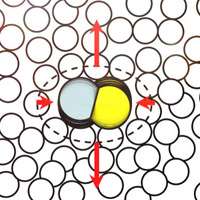
Researchers at the University of Southern California and Brown University say they have achieved near-frictionless motion in water by using lasers to spin a molecule like a propeller. Free rotation can occur in gases, where molecules are far apart. This is the first known demonstration of friction turning off in a room temperature liquid, the authors report in the Mar. 31 issue of Science.

Graduate student Amy Moskun and her advisor Stephen Bradforth, associate professor of chemistry in the USC College of Letters, Arts and Sciences, used ultra-short, high-energy laser pulses to spin a CN "diatomic" -- a simple molecular stick with a carbon at one end and a nitrogen at the other.

Within the first quarter-turn the molecular stick creates a shock wave, throwing back the water molecules that had been crowding it.

"If you give it enough spin, it pushes all the guys around it away," said Bradforth, "and it builds itself a little bubble. It's destroyed the friction in the liquid around it by completely reshaping its environment."

Bradforth likened the phenomenon to a passenger swinging a suitcase around in a crowded airport terminal, minus the real-life bruises and hurt feelings.

As with the airport analogy, after some time – about 10 complete rotations of the CN molecule – the shock dissipates and the water molecules rush back in.

Even so, said Bradforth, the length of friction-free spinning was far greater than expected.

"Everyone's prediction was that it wouldn't even complete a few degrees of free rotation," he said.

The discovery has no immediate practical use, but since 90 percent of reactions take place in liquid solutions, Bradforth said his group's study "impacts how we think about the vast majority of chemical reactions."

In chemistry, friction is a useful phenomenon that transfers energy between molecules and allows reactions to proceed. But what if a reaction needs to be stopped or delayed? Chemists have long sought to manipulate reactions, which usually yield useless byproducts along with the desired compound.

The Science paper provides a potential new tool, since one way to influence the progress of a reaction is to isolate a molecule from its surroundings.

"Most people thought this was hopeless in a liquid," Bradforth said.

It took the researchers more than a year to grasp the significance of their work. After Moskun and Bradforth figured out how to spin up CN molecules and to observe the rotation with a strobe-like apparatus, they sent their data to Richard Stratt, professor of chemistry at Brown University.

Stratt's group of theoretical chemists showed that the data represents a violation of linear response theory, a key model for liquid behavior that states the effects of friction and molecular energy are scalable. Under the theory, the rapidly spinning CN diatomic should not have caused a fundamental change in its environment.

"People have seen linear response theory fail in simulations before," Stratt wrote in a summary for the researchers' funding agency, the National Science Foundation. "I believe these studies represent the first time anyone has ever seen that a particular, well-defined, molecular event was responsible for suddenly turning off a liquid's linear response behavior."

The USC group then verified their collaborators' interpretation with a new round of experiments.

Said Bradforth: "The theory fails in this case, and we can see why it fails."

The theory's failure may be chemistry's gain.

Bradforth and Stratt were co-authors on the Science paper, along with graduate students Moskun and Askat Jailaubekov from USC, and Guohua Tao from Brown.

Source: University of Southern California


print this article email this article download pdf blog this article bookmark this article     Digg this Stumble it share on Facebook share on Reddit add to delicious save to Yahoo! bookmarks
4.6/5 after 35 votes


March 30th, 2006 all stories
Physics /

Comments: 0
Rank: 4.6/5 after 35 votes

  • Stumble this up

  • Digg this

  • Share it:
  • share on Facebook
  • share on MySpace
  • share on Slashdot
  • rss-newsfeed
  • share on Google
  • share on Reddit
  • add to delicious
  • save to Yahoo! bookmarks
  • share on Windows Live
  • Add to Mixx!
Rating: 4.6/5 after 35 votes

Tags


  • Physicists Demonstrate Quantum Memory with Matter Qubits
    Physicists Demonstrate Quantum Memory with Matter Qubits
    Physics / General Physics
    created Jul 03, 2009 | popularity 4.4 / 5 (17) | comments 1
  • 'Holey' Nanosheets for Wastewater Dye Removal
    Nanotechnology / Nanomaterials
    created Jul 01, 2009 | popularity 5 / 5 (5) | comments 1
  • Jellyfish Robot Swims Like its Biological Counterpart
    Jellyfish Robot Swims Like its Biological Counterpart
    Electronics / Robotics
    created Jun 26, 2009 | popularity 4.4 / 5 (8) | comments 1
  • Could Maxwell's Demon Exist in Nanoscale Systems?
    Could Maxwell's Demon Exist in Nanoscale Systems?
    Physics / General Physics
    created Jun 24, 2009 | popularity 4.4 / 5 (18) | comments 29
  • Living Safely with Robots, Beyond Asimov's Laws
    Living Safely with Robots, Beyond Asimov's Laws
    Electronics / Robotics
    created Jun 22, 2009 | popularity 4.6 / 5 (52) | comments 40
  • Other News

    Scientists create first electronic quantum processor

    Scientists create first electronic quantum processor

    Physics / General Physics

    created Jun 28, 2009 | popularity 4.8 / 5 (53) | comments 40

    A team led by Yale University researchers has created the first rudimentary solid-state quantum processor, taking another step toward the ultimate dream of building a quantum computer.


    Science journals

    How to Spot an Influential Paper Based on its Citations

    Physics / General Physics

    created Jul 04, 2009 | popularity 4 / 5 (9) | comments 6

    (PhysOrg.com) -- At first it may seem that the number of citations received by a published scientific paper is directly related to that paper's quality of content. The higher the quality, the more people read ...


    Fermilab's CDF observes Omega-sub-b baryon

    Fermilab's CDF observes Omega-sub-b baryon

    Physics / General Physics

    created Jun 29, 2009 | popularity 4.7 / 5 (17) | comments 7

    (PhysOrg.com) -- At a recent physics seminar at the Department of Energy’s Fermi National Accelerator Laboratory, Fermilab physicist Pat Lukens of the CDF experiment announced the observation of a new particle, ...


    New insights, and a new angle, on high-temperature superconductivity

    New insights, and a new angle, on high-temperature superconductivity

    Physics / Superconductivity

    created Jun 29, 2009 | popularity 4.8 / 5 (13) | comments 6

    (PhysOrg.com) -- A Princeton-led research team has revealed surprising information about how electron behavior influences the conduction of electricity in a class of high-temperature superconductors. An increased ...


    The art of invisibility and the perfect cat's eye

    The art of invisibility and the perfect cat's eye

    Physics / Optics & Photonics

    created Jun 30, 2009 | popularity 4 / 5 (8) | comments 6

    (PhysOrg.com) -- In recent years scientists have explored the impossible by developing invisibility or 'cloaking' devices, but can the same technology also help make things more visible?