Magnetism shepherds microlenses to excavate 'nanocavities'
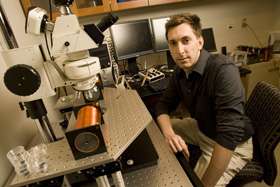
A Duke University engineer is "herding" tiny lenses with magnetic ferrofluids, precisely aligning them so that they focus bursts of light to excavate patterns of cavities on surfaces. Such photolithographically produced "nanocavities" -– each only billionths of a meter across – might serve as repositories for molecules engineered as chemical detectors, said Benjamin Yellen, an assistant professor of mechanical engineering and materials science at Duke's Pratt School of Engineering. Alternatively, he said, ringlike structures created via a similar technique might be useful for fabricating magnetic data storage elements.
Yellen will discuss his research progress on Thursday, March 30, 2006, during a national meeting of the American Chemical Society in Atlanta.
His experiments are an extension of National Science Foundation-supported work described in the June, 2005 issue of the Proceedings of the National Academy of Sciences, he said.
In that article, Yellen and his coauthors showed how to create networks of magnetic "traps" made of cobalt on silicon and glass wafers. Those traps were used to manipulate "ferrofluid" suspensions of magnetic iron oxide particles added above them.
With widths in the "nanometer" – billionths of a meter -- size range, the ferrofluid particles could either be held in place by the underlying magnetic traps, or moved from one trap to another via interactions with additional imposed magnetic fields.
The researchers thus used the magnetically-directed ferrofluid to "shepherd" around non-magnetic latex beads measuring between 90 and 5,000 nanometers. Those beads could even be assembled into complex patterns, according to the report.
At Duke, Yellen is expanding on that initial work by using ferrofluid to stretch molecules, to surround virus particles in order to enable their detection and identification and to assemble microparticles and nanoparticles into arrays on a surface.
His group's experiments with microscopic photolithography builds on work by Harvard University chemist George Whitesides, who developed a "nearfield lithography" technique that uses arrays of transparent microscopic spheres to focus light in order to build tiny patterns of holes.
"Any spherical structures that are transparent to light will act as little lenses that can focus light underneath themselves," Yellen said. "We're using ferrofluid to direct the assembly of these microlenses."
Conventional photolithographic techniques used to build computer chips involve laying down "photoresist" materials that render a surface potentially vulnerable to chemical etching upon exposure to light.
In their experiments, Yellen and his students are installing magnetic traps on surfaces, then coating those surfaces with photoresist. After adding quantities of ferrofluids and transparent microspheres, they use magnetic fields to induce the ferrofluids to maneuver the microspheres precisely above the magnetic traps.
They can then focus ultraviolet light through the microspheres to "expose" tiny dots of photoresist coating above those traps. Finally, they can chemically etch away the light-exposed dots, creating a pattern of tiny holes with a dot-wide trap surface exposed at each bottom.
"So we can form quasi-self-assembled holes that align directly on top of the cobalt magnetic traps," Yellen said. His group's goals include using magnetically directed ferrofluids to maneuver molecules into those holes. Once embedded inside, the molecules could then serve as tiny chemical detectors.
The Duke researchers also found that longer photoresist exposures to ultraviolet light, and a different use of the etching process, allow them to transform cobalt dots at the bottom of holes into "cobalt rings," he said. "Those may be useful as memory elements for data storage.
"Right now, this is just basic scientific inquiry," Yellen said. "There's not yet a clear-cut application for this technology. We're just trying to explore all the ways that these ferrofluids could be used."
Source: Duke University


