Probing Question: What heats the earth's core?
March 30, 2006
Courtesy Lawrence Livermore National Laboratory
Although we crust-dwellers walk on nice cool ground, underneath our feet the Earth is a pretty hot place. Enough heat emanates from the planet's interior to make 200 cups of piping hot coffee per hour for each of Earth's 6.2 billion inhabitants, says Chris Marone, Penn State professor of geosciences. At the very center, it is believed temperatures exceed 11,000 degrees Fahrenheit, hotter than the surface of the sun.
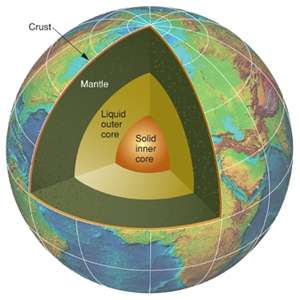
A cross-section of the Earth reveals three concentric layers. Around the outside, a thin, hard crust ranging from 10 to 100 kilometers thick. Under that, a donut-shaped mantle 2,900 kilometers thick. Instead of dough, it consists of viscous molten rock that flows very slowly, on a geological time scale. "It moves about as fast as your fingernails grow," Marone explains.
At the center of the Earth lies a two-part core. "The inner part is about the size of our moon," Marone says, "and has a density of essentially steel." The outer core surrounding it is an ocean of liquid metal 2,300 kilometers thick. The Earth's rotation makes this ocean flow and swirl, and the moving metal generates the planet's magnetic field.
Most of Earth's heat is stored in the mantle, Marone says, and there are four sources that keep it hot. First, there's the heat left over from when gravity first condensed a planet from the cloud of hot gases and particles in pre-Earth space. As the molten ball cooled, some 4 billion years ago, the outside hardened and formed a crust. The mantle is still cooling down.
"We don't think this original heat is a major part of the Earth's heat, though," Marone says. It only contributes 5 to 10 percent of the total, "about the same amount as gravitational heat."
To explain gravitational heat, Marone again evokes the image of the hot, freshly formed Earth, which was not of a consistent density. In a gravitational sorting process called differentiation, the denser, heavier parts were drawn to the center, and the less dense areas were displaced outwards. The friction created by this process generated considerable heat, which, like the original heat, still has not fully dissipated.
Then there's latent heat, Marone says. This type arises from the core's expanding as the Earth cools from the inside out. Just as freezing water turns to ice, that liquid metal is turning solid—and adding volume in the process. "The inner core is becoming larger by about a centimeter every thousand years," Marone says. The heat released by this expansion is seeping into the mantle.
For all this, however, Marone says, the vast majority of the heat in Earth's interior—up to 90 percent—is fueled by the decaying of radioactive isotopes like Potassium 40, Uranium 238, 235, and Thorium 232 contained within the mantle. These isotopes radiate heat as they shed excess energy and move toward stability. "The amount of heat caused by this radiation is almost the same as the total heat measured emanating from the Earth."
Radioactivity is present not only in the mantle, but in the rocks of Earth's crust. For example, Marone explains, a 1-kilogram block of granite on the surface emanates a tiny but measurable amount of heat (about as much as a .000000001 watt light bulb) through radioactive decay.
That may not seem like much. But considering the vastness of the mantle, it adds up, Marone says.
Sometime billions of years in the future, he predicts, the core and mantle could cool and solidify enough to meet the crust. If that happens, Earth will become a cold, dead planet like the moon.
Long before such an occurrence, however, the Sun will likely have evolved into a red-giant star, and grown large enough to engulf our fair planet. At that point, whatever heat is left in the mantle will hardly matter.
Source: Research/Penn State, By Joe Anuta
-
Earth's mantle: New numerical tool describes rock deformation
Jan 24, 2012 |
not rated yet |
0
-
Part of Earth's mantle shown to be conductive under high pressure and temperatures
Jan 20, 2012 |
4.9 / 5 (9) |
15
-
Flipped from head to toe: 100 years of continental drift theory
Jan 04, 2012 |
3.3 / 5 (3) |
2
-
Giant super-earths made of diamond are possible
Dec 05, 2011 |
3.8 / 5 (4) |
7
-
Lava fingerprinting reveals differences between Hawaii's twin volcanoes
Nov 30, 2011 |
3.5 / 5 (4) |
0
-
Engineers build first sub-10-nm carbon nanotube transistor
Feb 01, 2012 |
4.9 / 5 (29) |
30
-
Something old, something new: Evolution and the structural divergence of duplicate genes
Jan 31, 2012 |
4.6 / 5 (7) |
1
-
The hidden nanoworld of ice crystals: Revealing the dynamic behavior of quasi-liquid layers
Jan 30, 2012 |
5 / 5 (3) |
1
-
Stock market network reveals investor clustering
Jan 27, 2012 |
4 / 5 (22) |
8
-
Of microchemistry and molecules: Electronic microfluidic device synthesizes biocompatible probes
Jan 26, 2012 |
5 / 5 (1) |
0
More news stories
Study shows global glaciers, ice caps, shedding billions of tons of mass annually
Earth's glaciers and ice caps outside of the regions of Greenland and Antarctica are shedding roughly 150 billion tons of ice annually, according to a new study led by the University of Colorado Boulder.
Space & Earth / Earth Sciences
1 hour ago |
not rated yet |
1
|
Building mountains in a bottle
(PhysOrg.com) -- Scientists are preparing to launch a 10-year project to study water resources, gas exchange and carbon cycling in three man-made landscapes built in a half-acre laboratory at the University ...
6 hours ago |
4 / 5 (1) |
0
|
VLT takes most detailed infrared image of the Carina Nebula
(PhysOrg.com) -- ESO's Very Large Telescope has delivered the most detailed infrared image of the Carina Nebula stellar nursery taken so far. Many previously hidden features, scattered across a spectacular ...
6 hours ago |
5 / 5 (5) |
3
|
NASA looking for more space taxis
NASA is looking for more ways to get astronauts to the International Space Station. The space agency put out a call today for commercial space companies to submit bids as part of the latest round of the Commercial ...
Space & Earth / Space Exploration
4 hours ago |
4.3 / 5 (4) |
2
When stars play planetary pinball
Many of us remember playing pinball at the local arcade while growing up; it turns out that some stars like it as well. Binary stars can play tug-of-war with an unfortunate planet, flinging it into a wide ...
5 hours ago |
4 / 5 (1) |
0
Short fasting cycles work as well as chemotherapy in mice
Man may not live by bread alone, but cancer in animals appears less resilient, judging by a study that found chemotherapy drugs work better when combined with cycles of short, severe fasting.
Gene therapy for inherited blindness succeeds in patients' other eye
Gene therapy for congenital blindness has taken another step forward, as researchers further improved vision in three adult patients previously treated in one eye. After receiving the same treatment in their ...
Physicists build highly efficient 'no-waste' laser
A team of University of California, San Diego researchers has built the smallest room-temperature nanolaser to date, as well as an even more startling device: a highly efficient, "thresholdless" laser that ...
Study shows how DNA finds its match
It's been more than 50 years since James Watson and Francis Crick showed that DNA is a double helix of two strands that complement each other. But how does a short piece of DNA find its match, out of the millions ...
Transparent iron? For the first time, an experiment shows that atomic nuclei can become transparent
At the high-brilliance synchrotron light source PETRA III, a team of DESY scientists headed by Dr. Ralf Röhlsberger has succeeded in making atomic nuclei transparent with the help of X-ray light. At the ...
'Explorers,' who embrace the uncertainty of choices, use specific part of cortex
Life shrouds most choices in mystery. Some people inch toward a comfortable enough spot and stick close to that rewarding status quo. Out to dinner, they order the usual. Others consider their options systematically ...
Jul 27, 2008
Rank: not rated yet