Scientists to tackle illness with 'silver nanobullet'
March 31st, 2006 Scientists to tackle illness with 'silver bullet'

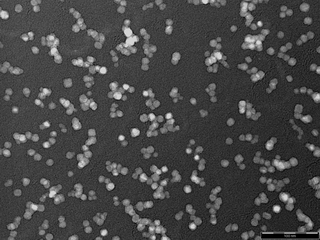
Transmission Electron Microscope (TEM) image of silver nanoparticles produced by the Leicester source with an average diameter of about 15nm (1,000 times smaller than the width of a human hair). The average size of the particles emerging from the machine can be controlled in the range 5nm - 20nm.

It has been known for some time that silver is highly toxic to a wide range of bacteria, and silver-based compounds have been used extensively in bactericidal applications. This property of silver has caused great interest especially as new resistant strains of bacteria have become a serious problem in public health.

For example MRSA bacteria kill 5,000 hospital patients a year in the UK alone and any method of attacking them, not involving normal antibiotics, is becoming increasingly important.

Silver in the form of nanoparticles is even more effective, partly because of the high surface/volume fraction so that a large proportion of silver atoms are in direct contact with their environment. In addition, nanoparticles are sufficiently small to pass through outer cell membranes and enter cells’ inner mechanisms.

A recent medical study showed that only silver nanoparticles with sizes less than 10 nm (1,000 times smaller than the width of a human hair) were able to enter cells and disrupt them. The same study showed that silver nanoparticles are highly toxic to the bacteria that colonise the lungs of cystic fibrosis sufferers often with fatal consequences.

Another study indicated that there may be a role for nanoparticles in the fight against AIDS by showing that silver nanoparticles of the same size attach themselves to structures on the surface of the HIV virus and prevent it from binding to host cells.

Professor of Nanoscience at the University of Leicester, Chris Binns, commented: “Clearly there are important medical treatments using silver nanoparticles and this is just one of the examples of how nanotechnology shows great promise in healthcare.

“One of the problems, however, is in getting assemblies of nanoparticles of the same size into the right environment, for example on the surface of a wound dressing or in a colloidal suspension that can either be turned into an aerosol or injected into the body.

“The medical studies carried out so far acknowledge that in existing commercially available nanoparticle suspensions, only 1% of the material consists of nanoparticles of the right size. The Condensed Matter Physics group in Leicester has many years’ experience in designing and building sources of size-selected metal nanoparticles.

“With support from the “Higher Education Reach –Out to Business and the Community Innovation and Regional Fund” (HIRF) this is now being put to good use to develop a machine specifically to produce nanoparticle assemblies for medical applications. The impressive uniformity of silver nanoparticles produced by the source is illustrated in the figure (available on request) and the design enables the nanoparticles to either be coated onto a solid surface or incorporated into a liquid suspension.”

Trials of the anti-microbial effectiveness of the nanoparticle suspensions will begin shortly.

Source: University of Leicester


print this article email this article download pdf blog this article bookmark this article     Digg this Stumble it share on Facebook share on Reddit add to delicious save to Yahoo! bookmarks
4.2/5 after 42 votes


March 31st, 2006 all stories
Nanotechnology /

Comments: 0
Rank: 4.2/5 after 42 votes

  • Stumble this up

  • Digg this

  • Share it:
  • share on Facebook
  • share on MySpace
  • share on Slashdot
  • rss-newsfeed
  • share on Google
  • share on Reddit
  • add to delicious
  • save to Yahoo! bookmarks
  • share on Windows Live
  • Add to Mixx!
Rating: 4.2/5 after 42 votes

  • Related Stories

  • Scientists harness nanoparticles to track cancer-cell changes
    created Apr 15, 2009 | popularity not rated yet | comments 0
  • Researchers to develop coatings that kill superbugs
    created Mar 19, 2009 | popularity not rated yet | comments 0
  • Gold nanostar shape of the future
    created Nov 06, 2008 | popularity not rated yet | comments 0
  • Nanoscale Dimensioning Is Fast, Cheap with New Optical Technique
    created Oct 29, 2008 | popularity not rated yet | comments 0
  • Golden Nanorods for Medical Applications
    created Sep 08, 2008 | popularity not rated yet | comments 0

Tags


  • Physicists Demonstrate Quantum Memory with Matter Qubits
    Physicists Demonstrate Quantum Memory with Matter Qubits
    Physics / General Physics
    created Jul 03, 2009 | popularity 4.4 / 5 (17) | comments 1
  • 'Holey' Nanosheets for Wastewater Dye Removal
    Nanotechnology / Nanomaterials
    created Jul 01, 2009 | popularity 5 / 5 (5) | comments 1
  • Jellyfish Robot Swims Like its Biological Counterpart
    Jellyfish Robot Swims Like its Biological Counterpart
    Electronics / Robotics
    created Jun 26, 2009 | popularity 4.4 / 5 (8) | comments 1
  • Could Maxwell's Demon Exist in Nanoscale Systems?
    Could Maxwell's Demon Exist in Nanoscale Systems?
    Physics / General Physics
    created Jun 24, 2009 | popularity 4.4 / 5 (18) | comments 29
  • Living Safely with Robots, Beyond Asimov's Laws
    Living Safely with Robots, Beyond Asimov's Laws
    Electronics / Robotics
    created Jun 22, 2009 | popularity 4.6 / 5 (52) | comments 40
  • Other News

    A 'quantum of sol' -- how nanotechnology could hold the key to a solar-powered future

    A 'quantum of sol' -- how nanotechnology could hold the key to a solar-powered future

    Nanotechnology / Nanomaterials

    created Jun 30, 2009 | popularity 3.8 / 5 (13) | comments 16

    (PhysOrg.com) -- A new generation of 'nano-structured' millimetre-sized solar cells that could convert the sun's energy to electricity more than twice as efficiently as current technology, is the subject of ...


    Australian researchers are set to begin human trials of a tiny nano-cell that acts as a "Trojan horse" against cancer

    Hi-tech 'Trojan horse' can kill cancer cells: researchers

    Nanotechnology / Bio & Medicine

    created Jun 29, 2009 | popularity 4.6 / 5 (11) | comments 7

    Australian researchers are set to begin human trials of a tiny nano-cell that acts as a "Trojan horse" against cancer cells, a breakthrough they say may curb the need for debilitating chemotherapy.


    Harnessing Nanoparticles To Track Cancer Cell Changes

    Nanotechnology / Bio & Medicine

    created Jul 03, 2009 | popularity not rated yet | comments 1

    The more dots there are, the more accurate a picture you get when you connect them. Cancer researchers adopting that philosophy have developed a new imaging technology that could give scientists the ability to simultaneously ...


    'Holey' Nanosheets for Wastewater Dye Removal

    Nanotechnology / Nanomaterials

    created Jul 01, 2009 | popularity 5 / 5 (5) | comments 1

    (PhysOrg.com) -- Researchers have discovered that extremely thin sheets of nickel oxide with hexagonally shaped holes can absorb hazardous dyes from wastewater nearly as well as the best traditional methods, but are recyclable. ...


    Computer-Guided Nanoparticle Therapy Destroys Tumors

    Nanotechnology / Bio & Medicine

    created Jun 29, 2009 | popularity 5 / 5 (11) | comments 0

    Gold nanoshells are among the most promising new nanoscale therapeutics being developed to kill tumors, acting as antennas that turn light energy into heat that cooks cancer to death. Now, a multi-institutional research team ...