Bose-Einstein condensate runs circles around magnetic trap
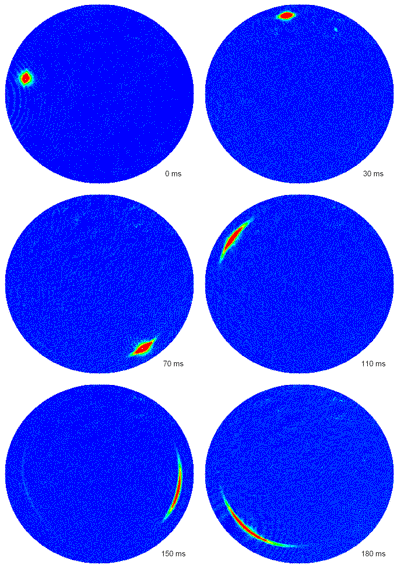
Physicists at the University of California, Berkeley, have the universe's coldest substance running in circles.
Image: This 180-millisecond time-lapse movie shows a Bose-Einstein condensate circling in a magnetic trap as the blob of supercold gas spreads out into a beam. (Deep Gupta/UC Berkeley)
The UC Berkeley team has created a Bose-Einstein condensate of rubidium atoms and nudged it into a circular racetrack 2 millimeters across, creating a particle storage ring analogous to the accelerator storage rings of high energy physics. This ring, the first to contain a Bose-Einstein gas, is full of cold particles at a temperature of only one-millionth of a degree above absolute zero, traveling with energies a billion trillion times less than the particles in a high-energy storage ring.
The creation of a Bose-Einstein condensate (BEC) in a storage ring is reported in a paper accepted last week by the journal Physical Review Letters.
Though such slow-moving rubidium atoms would be useless for producing the exotic collision particles that are the bread and butter of high-energy accelerators, cold collisions of such atoms might reveal new quantum physics, said Dan Stamper-Kurn, assistant professor of physics at UC Berkeley and leader of the study.
"This experiment was a very fortunate accident," Stamper-Kurn said. "Cold collisions could give very precise information about the quantum states of these cold particles and the potential between the particles."
Apart from basic physics, however, the millimeter storage rings could be used as sensitive gyroscopes to detect minute changes in rotation. If a ring could be created with two BECs traveling in opposite directions, the quantum interference pattern the two matter waves create would shift with rotation, allowing exquisitely sensitive detection of rotation for use in research or navigation systems for satellites or aircraft. Similar sensitive quantum rotation detectors were proposed several years ago by other UC Berkeley physicists using superfluid helium flowing in a ring.
Other possible areas of study include quantized circulation, which is seen in superfluids and superconductors, and fluid analogs of general relativity.
Stamper-Kurn and Subhadeep Gupta, a Miller post-doctoral fellow at UC Berkeley, got the idea for a cold storage ring while building a more elaborate device that would create supercold atoms inside a mirror cavity to study the interactions between light and BECs. The first BEC was generated only 10 years ago, and Stamper-Kurn was part of the Massachusetts Institute of Technology team that first created this new form of matter. That team's leader, Wolfgang Ketterle, shared the 2001 Nobel Prize in Physics.
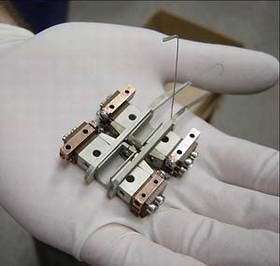
Image: A storage ring for Bose-Einstein condensates was created in a magnetic trap like this. (Credit: Stamper-Kurn lab)
As first proposed 80 years ago by Albert Einstein, based on previous work by Satyendra Nath Bose, if a gas of neutral atoms is cooled to a low enough temperature, all atoms of the gas would fall into the same quantum state. In other words, all of the million or billion atoms in the gas would end up in the same place at the same time, a weird quantum state dubbed a Bose-Einstein condensate.
The supercold atoms are created from a hot gas of neutral atoms that is laser cooled, collected in a magneto-optic trap, cooled further by evaporation, and then spun off into a magnetic trap for a few seconds of study before it warms up and dissipates. Like most such BEC refrigerators, the UC Berkeley device trapped about a million rubidium atoms in a microscopic nebula at the center of the magnetic trap.
Because of the UC Berkeley team's particular design, the researchers found it easy to magnetically push the clump of atoms into a circular trajectory inside the magnetic trap. Over the course of several circuits of the track, the clump tended to spread out into a beam analogous to the particle beams in accelerators, the first of which was created by Ernest O. Lawrence at UC Berkeley in 1931.
"The atoms fill the ring in a matter of seconds," said Gupta. Since photographing the BEC destroys it, Gupta and his team repeated the experiment every two minutes until they had captured every stage in the evolution of the circling beam of atoms.
The atoms circled the racetrack at a speed of about 50 to 150 millimeters per second, which is equal to an energy of about one nano-electron volt (eV) per atom, or one billionth of an electron volt. High-energy particle accelerators routinely bump particles to energies of a few tera-electron volts, or a trillion eV - a billion trillion times more energetic than the cold rubidium atoms.
The atoms made as many as 20 laps in the two seconds before dissipating - enough time for Gupta and graduate students Kater Murch, Kevin Moore and Tom Purdy to study them.
Stamper-Kurn and his colleagues are pursuing further experiments with the storage ring while continuing to build the originally planned device, which will be used to study cavity quantum electrodynamics and possible applications in quantum computers.
The work was sponsored by the National Science Foundation, the Defense Advanced Research Projects Agency, the David and Lucile Packard Foundation and the University of California.
Source: UC Berkeley


