Huge Solar Flare Spotted
September 8, 2005
Huge Solar Flare Spotted

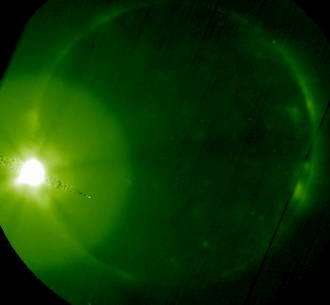
Scientists are currently tracking a very large flare that occurred on the Sun around 1:40 pm EDT (17:40 UT). The current estimate of the size of the explosion is X-17; that would place the flare as the fifth largest ever observed.

Image: Wednesday's solar flare is visible on the left side of this solar image taken by the Earth-orbiting GOES Solar X-Ray Imager (SXI). Credit: NOAA.

While the blast was not aimed at Earth, the event created a complete blackout of high frequency communications in North and South America. According to the NOAA Space Environment Center, communications used by emergency services along the Gulf Coast may have experienced problems due to this flare. Low frequency navigation systems may also have experienced a period of significant degradation. Further, they report that agencies impacted by space weather storms may experience disruptions over the next two weeks. These include spacecraft operators, electric power systems, high frequency communications, and low-frequency navigations systems.

The source of the explosion is probably the same sunspot group that erupted in mid-August. Over the past two weeks, this active region produced a series of significant solar eruptions as it made its way around the back side of the Sun (facing away from Earth). More eruptions are expected in the coming days as it rotates back into view.

Solar flares and coronal mass ejections (CMEs) -- associated giant clouds of plasma in space -- are the largest explosions in the solar system and can pack the force of a billion megaton nuclear bombs. They are caused by the buildup and sudden release of magnetic stress in the solar atmosphere above the giant magnetic poles we see as sunspots.

The NASA/ESA SOlar and Heliospheric Observatory (SOHO), missed the event due to routine orbit maneuvers and instrument maintenance. Its coronagraphs will be back in operation Friday morning.

Source: NASA


Rank 4 /5 (1 vote)
Tags

Related Stories
Relevant PhysicsForums posts

More news stories

Black holes and star formation

(PhysOrg.com) -- It has long been recognized that galaxy mergers or even close interactions can play a vital role in shaping the morphology of galaxies. One way they can do so, it is thought, is by triggering ...

Space & Earth / Astronomy

created 56 minutes ago | popularity not rated yet | comments 0 | with audio podcast

Infrared sounder on NASA's suomi NPP starts its mission

(PhysOrg.com) -- A powerful new infrared instrument, flying on NASA's newest polar-orbiting satellite, designed to give scientists more refined information about Earth's atmosphere and improve weather forecasts ...

Space & Earth / Space Exploration

created 56 minutes ago | popularity not rated yet | comments 0

Young stars at home in ancient cluster

(PhysOrg.com) -- Looking like a hoard of gems fit for an emperor's collection, this deep sky object called NGC 6752 is in fact far more worthy of admiration. It is a globular cluster, and at over 10 billion ...

Space & Earth / Astronomy

created 36 minutes ago | popularity not rated yet | comments 0

NASA small explorer mission celebrates ten years and forty thousand X-ray flares

(PhysOrg.com) -- On February 5, 2002, NASA launched what was then called the High Energy Solar Spectroscopic Imager (HESSI) into orbit. Renamed within months as the Ramaty High Energy Solar Spectroscopic Imager ...

Space & Earth / Space Exploration

created 34 minutes ago | popularity 5 / 5 (1) | comments 0

Antarctic lake could reveal evolution, new life: scientists

Russian scientists said Thursday a probe to a pristine lake deep under the ice of Antarctica could bring revelations on the planet's evolution and possibly even new life forms.

Space & Earth / Earth Sciences

created 19 minutes ago | popularity not rated yet | comments 0


New Zealand team finds early plant arrivers dominated landscape

(PhysOrg.com) -- It seems intuitive that not all plant species could have taken a foothold on land at the same time all those millions of years ago as conditions on Earth evolved to the point where they could survive; some ...

Deciding to go left or right: Researchers use device to determine that lower animals can navigate too

For decades, scientists have associated binary decision making — opting to go left or right — with higher-ranking animals, including humans. A team of Harvard researchers, however, is rewriting that ...

New target for Alzheimer's drugs

(Medical Xpress) -- Biomedical scientists at the University of California, Riverside have identified a new link between a protein called beta-arrestin and short-term memory that could open new doors for the ...

Chemists harvest light to create 'green' tool for pharmaceuticals

(PhysOrg.com) -- A team of University of Arkansas researchers, including an Honors College undergraduate student, has created a new, "green" method for developing medicines. The researchers used energy from ...

Researchers develop gene therapy to boost brain repair for demyelinating diseases

(Medical Xpress) -- Our bodies are full of tiny superheroes—antibodies that fight foreign invaders, cells that regenerate, and structures that ensure our systems run smoothly. One such structure is myelin—a ...

Google launches Chrome browser for Android smartphones

With more and more people connecting to the Internet through a phone or a tablet instead of a PC, Google Inc. is bringing its fast-growing browser, Chrome, to the newest Android-powered mobile devices.