Researchers: even at rest, men's and women's brains behave differently
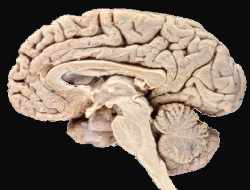
A key part of the brain involved in processing emotionally influenced memories acts differently in men and women, even in the absence of stimuli, UC Irvine researchers have found.
Larry Cahill, an associate professor of neurobiology and behavior, and Lisa Kilpatrick, a former postdoctoral fellow in his laboratory, have found that the amygdala, an almond-shaped structure found on both sides of the brain, behaves very differently in males and females while the subjects are at rest. In men, the right amygdala is more active and shows more connections with other regions of the brain, even when there is no outside stimulus. Conversely, in women, the left amygdala is more connected with other regions of the brain. In addition, the regions of the brain with which the amygdala communicates while a subject is at rest are different in men and women.
The finding could be key to determining why gender-related differences exist in certain psychiatric disorders and how to treat a variety of illnesses.
The study appears in this week’s issue of NeuroImage.
“These findings are intriguing because they provide the first hint of what could be a fundamental difference in how the brain is wired in men and women,” said Cahill, a fellow at UCI’s Center for the Neurobiology of Learning and Memory. “If, even in a resting state, the brain shows such differences between the sexes, it could have far-reaching implications for our study of certain psychiatric and medical disorders.”
The researchers used Positron Emission Tomography (PET) scans to analyze the brains of 72 healthy, right-handed adults (36 men and 36 women). The subjects were instructed to relax with their eyes closed while being scanned. When the scans were later studied, researchers found that not only was there a difference between the men and women as to which hemisphere's amygdala was more active, but also that the regions of the brain that the amygdala “talked” with were also quite different. In men, the right-hemisphere amygdala showed more connectivity with brain regions such as the visual cortex and the striatum. In contrast, the left amygdala in women was more connected to regions such as the insular cortex and the hypothalamus.
The finding led to an unexpected discovery: Many brain areas communicating with the amygdala in men are engaged with and responding to the external environment. For example, the visual cortex is responsible for vision, while the striatum coordinates motor actions. Conversely, many regions connected to the left-hemisphere amygdala in women control aspects of the environment within the body. Both the insular cortex and the hypothalamus, for example, receive strong input from the sensors inside the body.
“Throughout evolution, women have had to deal with a number of internal stressors, such as childbirth, that men haven’t had to experience,” Cahill said. “What is fascinating about this is the brain seems to have evolved to be in tune with those different stressors.”
Cahill believes this study could be the basis for a fuller understanding and treatment of a number of disorders that affect one gender or the other. For example, in the study, one of the brain areas communicating with the amygdala in women is implicated in disorders such as depression and irritable bowel syndrome, which predominantly affect women.
Cahill has led the way in exploring gender-related differences in the brain. In a 2001 study, he showed that the sexes use different sides of their brains to process and store long-term memories. In another study in 2002, he demonstrated how a particular drug, propranolol, can block memory differently in men and women.
Source: University of California, Irvine


