Creating exotic oxide-based spintronic devices
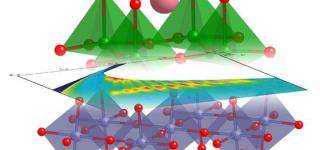
Physicist Jak Tchakhalian studies what occurs in the interface of two incompatible nanomaterials made of complex oxides that are produced by laser pulses. In the process, what emerges is an extremely exotic set of nanostructures that in theory should not exist.
In some cases, when these structures are stimulated by light, electricity or a magnetic field, a response of up to 1,000 orders of magnitude stronger than the energy applied may be triggered - suggesting that someday, they could be used to develop much faster and smaller transistors and other spintronic devices.
An article detailing the results of his novel research, "Magnetism at the Interface between Superconducting and Feromagnetic Oxides," will be published in the April issue of Nature Physics.
Tchakhalian is the lead researcher and spokesman on a team that includes J. W. Freeland and G. Srajer of Argonne National Laboratory; J. Strempfer, G. Khaliullin, C. Bernhard, G. Christiani, H.U. Habermeier and B. Keimer of the Max Planck Institute for Solid State Research in Germany; J.C. Cezar of the European Synchrotron Radiation Facility in France; and T. Charlton from Rutherford Appleton Laboratory in England.
For the past two decades, the unusual quantum states found in certain metal oxides have been at the forefront of research in solid state physics. Tchakhalian, an associate professor in the J. William Fulbright College of Arts and Sciences, is particularly intrigued by how such newly forged materials could be used to create oxide-based spintronic devices.
"This is one of the most intense areas of research in physics today," said Tchakhalian. "The Japanese are investing billions in the promise this technology holds. The only true change in electronics has always come from understanding how various materials work and how they can be combined in new ways."
While the properties of common metals such as copper, nickel and silicon are well understood, a whole class of other materials known as complex transition metal oxides is not. For example, scientists do not clearly understand why some classes of metal oxides such as hematite, or iron oxide, are non-conductive.
"Copper oxides or manganese oxides are not conventional materials. They possess spectacular features. Their response to external stimuli such as light or a magnetic field can trigger a colossal response that cannot be found in conventional materials. Those features, multiplied by the nanoscale, make the whole subject truly fascinating," said Tchakhalian.
The first task scientists face in nanoscience is to learn how to produce high-quality nanostructures. To fabricate crystallized materials into superlattices, scientists use extremely powerful lasers to heat the material, producing a plume of new material that is then deposited in a substrate, or sheet of base material.
Because such materials don't exist in nature, the first task of scientists is to characterize their properties and try to discover how they have become compatible. Then they must find the rules that can predict the properties of tailor-made superlattices.
"Sometimes working with nanoscale structures becomes more like black magic than anything," said Tchakhalian. "But if we are successful in controlling the spin of electrons, we can conceivably also create phenomenally faster nanodevices."
Source: University of Arkansas


