Lobster telescope has an eye for X-rays
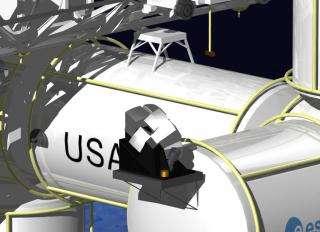
UK astronomers have been at the forefront of designing a revolutionary new X-ray telescope that is based on the eyes of a lobster. By replicating the crustacean’s ability to observe objects all around it without turning its head, scientists are confident that the Lobster instrument will enable a major breakthrough in X-ray astronomy.
The sky viewed at X-ray wavelengths is a violent and unpredictable place. Many sources brighten without warning, then vanish just as suddenly. Others vary cyclically over a period that can range from minutes to years.
The ideal X-ray telescope, therefore, would observe “all the sky, all of the time” – an ideal which might seem unattainable, but which is approached by the Lobster concept, to be described by Dr. Nigel Bannister (University of Leicester) at the RAS National Astronomy Meeting, University of Leicester, on 4 April.
“The great advantage of the Lobster design is an almost unlimited field of view,” said Dr. Bannister. “This makes it ideal for use as an all-sky X-ray monitor.”
In the 1970s, lobsters and some other crustacea were found to view the world through remarkable eyes which focus light over a very wide field of view by means of reflection, rather than by refraction or bending of light, as in the human eye.
The lobster eye – essentially an array of tube-like channels with a square cross-section – was proposed as the basis of an X-ray “all-sky monitor” by Roger Angel of the University of Arizona in 1977. However, it has taken almost 30 years – and nearly 15 years from the first successful X-ray measurements with such structures in 1992 - to perfect the optic technology.
Only now is it possible to consider the space missions described by Nigel Bannister as practical propositions, with the Lobster All-Sky X-ray Monitor successfully completing a detailed European Space Agency (ESA) Phase-A study in 2005.
“The studies of Lobster conducted with ESA since 2001 suggest that the instrument will have an impact on almost every area of astrophysics,” said Professor George Fraser, Director of the University of Leicester Space Research Centre and leader of the international team which has been studying Lobster.
“Originally, these studies concentrated on mounting the Lobster telescope modules on the International Space Station (ISS), but more recently we’ve been looking at a free-flying satellite platform provided by the Russians.”
Fraser points out that it has not been easy as a British scientist leading a study for an ISS attached payload, since the UK does not contribute to the ISS programme. There has also been some scepticism regarding a collaboration with Russia since the failure of the Russian Spectrum X - Gamma project in the 1980s and 1990s.
“Nevertheless, I am confident that the Lobster concept will eventually make its impact on astrophysics,” he said.
“The scientific impact of Lobster will span all of astronomy - from studies of the X-ray emission of comets to stars and quasars, from regular X-ray binaries to the catastrophic events of supernovæ and the enigmatic gamma-ray bursts.
“Through frequent re-observation of each point in the sky during the lifetime of the mission, Lobster offers the opportunity to perform deep, sensitive surveys of both galactic and extra-galactic sources.
“This will lead to the collation of a “Lobster All-Sky Catalogue” containing hundreds of thousands of sources, including a significant population of objects for which photometry on approximately 1 day timescales will be available.
“Such a rich catalogue of sources offers an unprecedented opportunity to study the large-scale distribution of matter in the Universe, probing possible links between supercluster filamentary structures and the purported existence of dark matter in the cosmos.”
Source: Royal Astronomical Society


