The Universe trapped in its own web
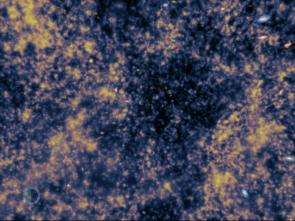
Astronomers from the University of Nottingham, UK, and the Instituto de Astrofisica de Canarias (Spain), have found the first observational evidence that galaxies are not randomly oriented. Instead, they are aligned following a characteristic pattern dictated by the large-scale structure of the invisible dark matter that surrounds them.
This discovery confirms one of the fundamental aspects of galaxy formation theory and implies a direct link between the global properties of the Universe and the individual properties of galaxies.
Galaxy formation theories predicted such an effect, but its empirical verification has remained elusive until now. The results of this work were published the 1 April issue of Astrophysical Journal Letters.
Nowadays, matter is not distributed uniformly throughout space but is instead arranged in an intricate “cosmic web” of filaments and walls surrounding bubble-like voids. Regions with high galaxy concentrations are known as galaxy clusters whereas low density regions are termed voids.
This inhomogeneous distribution of matter is called the “Large-scale distribution of the Universe.” When the Universe is considered as whole, this distribution has a similar appearance to a spider’s web or the neural network of the brain. But it was not always like this.
After the Big Bang, when the Universe was much younger, matter was distributed homogeneously. As the Universe was evolving, gravitational pulls began to compress the matter in certain regions of space, forming the large-scale structure that we currently observe.
According to these models and theories a direct consequence of this process is that galaxies should be preferentially oriented perpendicularly to the direction of the linear filaments.
Several observational studies have looked for a preferential spatial orientation (or alignment) of galaxy rotation axes with respect to their surrounding large-scale structures. However, none of them have been successful, due to the difficulties associated with trying to characterise the filaments.
The research conducted by the astrophysical group formed by Ignacio Trujillo (University of Nottingham, UK), Conrado Carretero and Santiago G. Patiri, (both from the Instituto de Astrofisica de Canarias, Spain) has been able to measure this effect, confirming theoretical predictions.
To achieve this goal, they used a new technique based on the analysis of the huge voids that are found in the large-scale structure of the Universe. These voids have been detected by searching for large regions of space depleted of bright galaxies.
In addition, they took advantage of information provided by the two largest sky surveys yet undertaken: the Sloan Digital Sky Survey and the Two Degree Field Survey. These surveys contain positional information for more than half a million galaxies located within a distance of one billion light-years of the Earth.
Other parameters provided by the surveys, such as the position angle and the ellipticity of the objects, were used to estimate the orientation of the disk galaxies.
“We found that there is an excess of disk galaxies that are highly inclined relative to the plane defined by the large-scale structure surrounding them,” explained Dr. Trujillo. “Their rotation axes are mainly oriented in the direction of the filaments.
“Our work provides important confirmation of the tidal torque theory which explains how galaxies have acquired their current spin,” said Trujillo.
“The spin of the galaxies is believed to be intrinsically linked to their morphological shapes. So, this work is a step forward on our understanding of how galaxies have reached their current shapes.”
Source: Royal Astronomical Society


