Chaos=Order: Physicists make baffling discovery
"Da police are not here to create disorder; dere here to preserve disorder." -Richard J. Daley, Chicago mayor, explaining to the media the role of the police during the riotous 1968 Democratic National Convention.
Police keep order. That's why, for example, they issue tickets for "disturbing the peace." Thus the only logical conclusion to Mayor Daley's famous quote above – other than dismissing it as the result of a tangled tongue – is sometimes disorder spawns order. Sounds impossible, right? Wrong.
According to a computational study conducted by a group of physicists at Washington University in St. Louis, one may create order by introducing disorder.
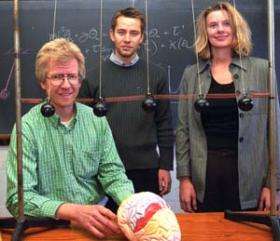
While working on their model – a network of interconnected pendulums, or "oscillators" – the researchers noticed that when driven by ordered forces the various pendulums behaved chaotically and swung out of sync like a group of intoxicated synchronized swimmers. This was unexpected – shouldn't synchronized forces yield synchronized pendulums?
But then came the real surprise: When they introduced disorder – forces were applied at random to each oscillator – the system became ordered and synchronized.
"The thing that is counterintuitive is that when you introduce disorder into the system – when the [forces on the pendulums] act at random – the chaos that was present before disappears and there is order," said Sebastian F. Brandt, physics graduate student and lead author of the study which appeared in the January 2006 edition of Physical Review Letters.
Insights into other realms
The physicists' research is not only hard to grasp for non-physicists, but puzzling for physicists, too. As supervisor Ralf Wessel, Ph.D., Washington University associate professor of physics in Arts & Sciences said, "Every physicist who hears this is surprised."
Research on the role of disorder in complex systems is quite new and not well understood. Wessel hopes that one day its theoretical understanding will be better than it is today.
Nevertheless, the researchers believe the model could provide insights outside the realm of theoretical physics.
Neurons, for example, have been modeled as interconnected, or "coupled", oscillators because of the way they interact with one another. In the model, coupled oscillators can be imagined as being tethered to their nearest neighbor, thus influencing their movement. Neurons, on the other hand, may display repetitive electrical activity that can be influenced by the activity of neighboring neurons.
Though it's a bit of a stretch, admits Babette K. Dellen, Ph.D, the study may help to solve previously unexplained observations. Dellen first studied the model system in a neurological context. She set the project aside and then Brandt joined the research group and became intrigued with the concept of disorder-induced synchronization and delved more deeply. Finally, the three put the paper together.
Dellen explains that neurons can exhibit synchronous activity in response to a stimulus. To this point, she said, nobody has come up with an adequate explanation. And Wessel said, "Maybe the details of the neurons are completely irrelevant. Maybe it is only a property of oscillators."
Oscillators like a child on a swing
A vital similarity between the model system and neurons is that they are both "nonlinear" – meaning that there is not a linear, or straight-ahead, correlation between the applied force and displacement. In other words, the oscillators in the model may be likened to a child on a swing. Within a mall range, the child will move in constant proportion to how hard you push them – if you push twice as hard, they will go twice as far. But nearly all complex systems in nature, like the physicists' model, are nonlinear. Once the child gets to a certain height, pushing twice as hard will not make the child go twice as far.
Neurons are composed of many elements and are typically nonlinear.
"When you hear your favorite music twice as loud you don't double the pleasure," mused Brandt, explaining how one aspect of the brain – hearing – is nonlinear.
While other research has shown that disorder can create order, these studies often involved manipulating parameters within the systems such as changing pendulum length. The researchers say that their work is novel because it involves changing externally applied forces. Thus, they believe, their findings might have potential in the real world, where it would be more difficult to change parameters within the system – neurons, for example – but relatively simple to apply an external forcing.
"This is of course basic research," said Brandt. "But what you can learn from this is that complex systems... sometimes behave in a very unexpected way, completely opposite to your intuition or expectation. … It will be interesting to see if the mechanism that we have found can actually be put to some use."
Source: Washington University in St. Louis, By Douglas M. Main


