'Picture positive': Lost photos confirm fossil find
April 4, 2006
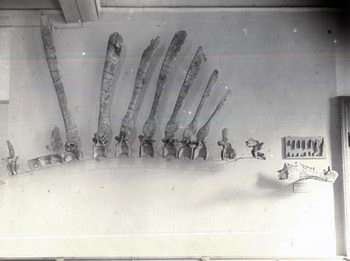
This photograph of Spinosaurus dinosaur bones that Josh Smith found in a German museum is the only photographic proof of German researcher Ernst Stromer´s discovery of Spinosaurus, a dinosaur similar in size to the famed Tyranosaurus rex. All but Stromer´s drawings of his find were lost when the Allies bombed out the Munich museum where the materials were held. The photo is significantly historically but also as a comparison of Stromer´s drawing for a bettter understanding of the species´ skeleton.
The researcher who discovered Paralititan stromeri, one of the most massive animals ever to walk the Earth, now is "picture-positive" about another dinosaur fossil find by a famous German researcher, Ernst Stromer.
In the early 20th century, Stromer discovered four new species of dinosaurs, including the predator Spinosaurus, similar in size to the famed Tyrannosaurus rex. Stromer returned to Munich with the fossils, maps and details of his discovery, but all was lost in 1944 when the Allies bombed out the museum where the materials were held.
Enter Josh Smith, Ph.D., assistant professor of earth and planetary sciences in Arts & Sciences at Washington University in St. Louis. Writing in a recent issue of the Journal of Paleontology, Smith reports the rediscovery of two photographs of the holotype of Spinosaurus aegyptiacus as it was reposited in the Palaontologische Staatssammlung Munchen prior to 1944, and later presumably lost in the Allied bombing.
In June, 2000, while researching in Germany, Smith happened upon the photographs in the Palaontologische archives of the Museum, after Ernst Stromer's son, Wolfgang Stromer, donated them to the museum in 1995.
"These are, to our knowledge, the only surviving photographs of this, the one irrefutable specimen of S. aegyptiacus, which, prior to the initial print releases, has only been represented by Stromer's drawings," said Smith. "This is a significant find from the perspective of the history of paleontology."
Aside from their historical significance, Smith said that the images are important because they permit a direct comparison of several of Stromer's 1915 illustrations with actual photographs of Spinosaurus aegyptiacus, providing new insight into the skeleton.
"It's great to be able to determine how closely these illustrations correspond to the actual anatomy of the dinosaur as reproduced by the photographs," Smith said. "This has implications for the use of published drawings as sources of systematic information."
Serendipity in the desert
It was Stromer who indirectly led to Smith's discovery in 1999. Smith and his wife, Jennifer R. Smith, Ph.D., Washington University assistant professor of earth and planetary sciences, then both graduate students at the University of Pennsylvania, were retracing Stromer's steps on a trip to Egypt's Bahariya Oasis in the Sahara in 1999. Smith and his collaborators not only uncovered Stromer's original site, but they also discovered an entirely new genus of dinosaur, Paralititan stromeri, the second most massive dinosaur ever to walk the Earth.
A year earlier, Josh Smith and fellow University of Pennsylvania geology graduate student Matt Lamanna hatched a scheme to see if they could come up with a Ph.D. project for Lamanna, who knew that nobody was working in the area that Stromer had found so rich earlier in the century, and the two tried to find a way to get to Egypt. Jennifer Smith was going to Egypt on another project in January 1999 and asked her then boyfriend Josh Smith if he'd like to hire on as a field assistant. He accepted on the condition that he'd be allowed some time to research Stromer's general area. In just two days of searching, Smith came up with some dinosaur bone fragments to confirm that he had found the area and that showed there very likely could be more to be discovered.
Eventually Smith, through a close friend, Scott Winters, convinced a Los Angeles film company to fund the 2000 expedition as long as Smith's team would agree to be the subjects of their documentary. It was on this trip that Josh Smith made the big discovery.
Smith and the team published their results in the June 1, 2001, issue of Science and immediately became famous, with stories appearing in the New York Times, USA Today, Newsweek, Scientific American and a host of other publications and TV interviews that went worldwide.
Josh Smith co-authored The Lost Dinosaurs of Egypt (Random House), a book about his remarkable research expedition, and published in the fall of 2003. The documentary originally aired Oct. 8, 2003, when A&E Network showed a two-hour documentary of the book's contents.
Source: Washington University in St. Louis, By Tony Fitzpatrick
-
INFLUENCE GAME: Online companies win piracy fight
Jan 22, 2012 |
4.3 / 5 (6) |
3
-
Bonding out: Making companies pay up front for potential environmental disasters
8 hours ago |
not rated yet |
2
-
Dignity, sense of control keys to quality of life for disabled elderly, study finds
7 hours ago |
not rated yet |
0
-
Integrated weed management best response to herbicide resistance
56 minutes ago |
not rated yet |
0
-
Thomson Reuters posts loss on $3 bn writedown
2 minutes ago |
not rated yet |
0
-
Engineers build first sub-10-nm carbon nanotube transistor
Feb 01, 2012 |
4.9 / 5 (31) |
30
-
Something old, something new: Evolution and the structural divergence of duplicate genes
Jan 31, 2012 |
4.6 / 5 (7) |
1
-
The hidden nanoworld of ice crystals: Revealing the dynamic behavior of quasi-liquid layers
Jan 30, 2012 |
5 / 5 (3) |
1
-
Stock market network reveals investor clustering
Jan 27, 2012 |
3.9 / 5 (23) |
8
-
Of microchemistry and molecules: Electronic microfluidic device synthesizes biocompatible probes
Jan 26, 2012 |
5 / 5 (1) |
0
More news stories
A frank discussion of the power law and linking correlation to causation
(PhysOrg.com) -- Michael Stumpf a mathematics professor at Imperial College in London, and Mason Porter a lecturer at Oxford have teamed together to write and publish a perspective piece in Science regarding the in ...
Employers feel no love for unscrupulous practice of 'service sweethearting'
A new study led by two Florida State University marketing professors finds that some frontline service employees who are rewarded for hikes in customer loyalty and satisfaction also may engage in "service ...
Other Sciences / Economics & Business
2 hours ago |
not rated yet |
3
The question of life in the ancient world
Theres a general feeling that we dont get the Greeks ancient or modern. Many, including heads of state like Angela Merkel, visibly shake their head in exasperation, rightly or wrongly, at ...
Other Sciences / Archaeology & Fossils
7 hours ago |
1 / 5 (1) |
3
Sonic Cradle lands spot in TED exhibition
A Simon Fraser University graduate student project that melds music, meditation and modern technology has landed a rare spot as an exhibit at TEDActive 2012 in Palm Springs, California this month.
4 hours ago |
not rated yet |
0
Chilean miners' rescue capsule on show in London
The capsule used to rescue Chilean miners trapped underground for two months goes on display Saturday at the Science Museum in London -- the first time it has been seen in Europe.
6 hours ago |
not rated yet |
0
Complex wiring of the nervous system may rely on a just a handful of genes and proteins
Researchers at the Salk Institute have discovered a startling feature of early brain development that helps to explain how complex neuron wiring patterns are programmed using just a handful of critical genes. ...
CIA website offline, Anonymous takes credit
The website of the Central Intelligence Agency was unresponsive on Friday after the hacker group Anonymous claimed to have knocked it offline.
Q&A: Obama and the birth control controversy
(AP) -- What birth control debate? A half-century after the introduction of the pill, acceptance of birth control by American women is virtually universal.
The power of estrogen -- male snakes attract other males
A new study has shown that boosting the estrogen levels of male garter snakes causes them to secrete the same pheromones that females use to attract suitors, and turned the males into just about the sexiest ...
Human cognitive performance suffers following natural disasters, researchers find
Not surprisingly, victims of a natural disaster can experience stress and anxiety, but a new study indicates that it might also cause them to make more errors - some serious - in their daily lives. In their upcoming Human Fa ...
New error-correcting codes guarantee the fastest possible rate of data transmission
Error-correcting codes are one of the triumphs of the digital age. Theyre a way of encoding information so that it can be transmitted across a communication channel such as an optical fiber o ...