Scientists Develop Switchable Focus Eyeglass Lenses
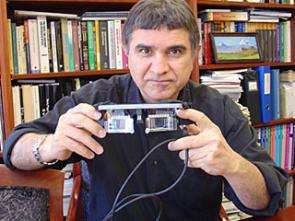
Optical scientists have developed eyeglass lenses that switch focus in a blink of an eye. Optical scientists at The University of Arizona have developed new switchable, flat, liquid crystal diffractive lenses that can adaptively change their focusing power. That's great news for those old enough to wear bifocals.
And it's great news for anyone with imperfect vision, for it opens the way for next-generation "smart" eyeglasses -- glasses with built-in automatic focus.
In the foreseeable future, for example, you won't change prescription eyeglasses -- your eye doctor will just tweak a new prescription into the specs you already own.
You could even program your glasses for better than 20-20 vision.
"Right now, in our prototype, you switch the lenses on or off to change focus," said Nasser Peyghambarian, chair of photonics and lasers in UA's College of Optical Sciences and professor of optical sciences, materials science and engineering. "But ultimately this will act just like your automatic camera: Eyeglass lenses will know where to focus just like your auto-focusing camera does."

Peyghambarian is part of the team that began developing the focus-changing lenses in 2001 under an agreement between the university and private industry. The UA licensed three patents from the work to the Johnson and Johnson Development Corp., which sponsored the research. A firm called Pixel Optics has since purchased the patent licenses from Johnson and Johnson to commercialize the innovative technology.
Ten UA scientists and two colleagues now at the Georgia Institute of Technology are publishing their first science paper about the switchable-focus lenses this week in an article online at the Proceedings of the National Academy of Sciences website.
The novel lenses focus electroactively, said Guoqiang Li, UA optical sciences assistant research professor and lead author on the scientific paper.
They are basically two pieces of flat glass spaced five microns apart. Five microns is an incredibly small space -- roughly one-twentieth the diameter of a human hair. The space is filled with liquid crystal -- the same kind of stuff in your laptop's liquid crystal display.
The flat glass is coated with an even thinner layer (one-tenth micron) of indium tin oxide, or ITO, which is a transparent electrode. Unlike electrodes made of aluminum or gold, ITO transmits most of the light that hits it.
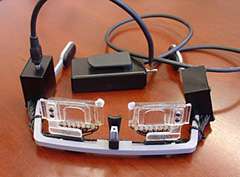
The transparent electrodes are patterned in a circular array over the area of the lens. The circular pattern is created through photolithography, an extremely precise technique that processes with light and chemicals.
Applying less than two volts to the circuit changes the orientation of the liquid crystal molecules, and that changes the optical path length through the lens. It takes only about 1.8 volts to change the index of refraction so that light refocuses, Peyghambarian and Li explained. The result is a flat piece of glass that acts like a lens.
The scientists first tested the imaging properties of the lens on a model human eye, then built prototype eyeglasses that real humans tested. The clinical results agreed with the model eye test.
Their tests showed that distance vision was no way impaired when the glasses were switched off and enabled close-up vision when switched on.
"We have demonstrated switchable liquid crystal diffractive lenses with high diffraction efficiency, high optical quality, rapid response time, and diffraction limited performance," they reported in the PNAS article. "These flat lenses are highly promising to replace conventional area division refractive, multi-focal spectacle lenses used by presbyopes," they wrote.
Estimates are that 93 percent of the world's population over age 45 have the condition called "presbyopia," where an aging person's eye lens loses flexibility and therefore, its ability to shift focus from distant to near objects.
Presbyopes will be some of the first to benefit from the UA research.
Electroactively focusing eyeglasses will revolutionize the $50 billion worldwide vision care industry, backers said at the outset of the UA research project.
Their major step in creating state-of-the-art liquid crystal diffractive lenses will have applications beyond vision care, the scientists predict. Tools with switchable lens elements would be valuable in dentistry, for example.
"It's great to see our new concept materialize and be validated after all these years of continuous efforts," said Bernard Kippelen. Kippelen, who helped start the project when he was at the UA, is now a professor of electrical and computer engineering at Georgia Tech.
"People don't often recognize that university scientists make prototypes," Peyghambarin said. "People think of us as just generating science papers. But when we actually make something like this, in house, people begin to realize we have real expertise that's applicable to everyday problems."
In addition to Li and Peyghambarian, UA optical scientists who collaborated in the research are David L. Mathine, Pouria Valley, Pekka Ayras, M. S. Giridhar, Gregory Williby, James Schwiegerling (who also is on the faculty in UA's department of ophthalmology and vision sciences), Gerald R. Meredith, and Seppo Honkanen. Bernard Kippelen and Joshua N. Haddock of the Georgia Institute Technology also collaborated.
Source: University of Arizona, By Lori Stiles


