How much radiation awaits lunar colonists? A new NASA mission aims to find out
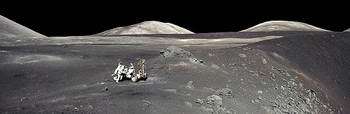
On the Moon, many of the things that can kill you are invisible: breathtaking vacuum, extreme temperatures and space radiation top the list. Vacuum and temperature NASA can handle; spacesuits and habitats provide plenty of air and insulation. Radiation, though, is trickier.
The surface of the Moon is baldly exposed to cosmic rays and solar flares, and some of that radiation is very hard to stop with shielding. Furthermore, when cosmic rays hit the ground, they produce a dangerous spray of secondary particles right at your feet. All this radiation penetrating human flesh can damage DNA, boosting the risk of cancer and other maladies.
According to the Vision for Space Exploration, NASA plans to send astronauts back to the Moon by 2020 and, eventually, to set up an outpost. For people to live and work on the Moon safely, the radiation problem must be solved.
"We really need to know more about the radiation environment on the Moon, especially if people will be staying there for more than just a few days," says Harlan Spence, a professor of astronomy at Boston University.
To carefully measure and map the Moon's radiation environment, NASA is developing a robotic probe to orbit the Moon beginning in 2008. Called the Lunar Reconnaissance Orbiter (LRO), this scout will pave the way for future human missions not only by measuring space radiation, but also by hunting for frozen water and mapping the Moon's surface in unprecedented detail. LRO is a key part of NASA's Robotic Lunar Exploration Program, managed by the Goddard Space Flight Center.
One of the instruments onboard LRO is the Cosmic Ray Telescope for the Effects of Radiation (CRaTER).
"Not only will we measure the radiation, we will use plastics that mimic human tissue to look at how these highly energetic particles penetrate and interact with the human body," says Spence, who is the Principal Investigator for CRaTER.
By placing the radiation detectors in CRaTER behind various thicknesses of a special plastic that has similar density and composition to human tissue, Spence and his colleagues will provide much-needed data: Except for quick trips to the Moon during the Apollo program, most human spaceflight has occurred near Earth where our planet's magnetic field provides a natural shield.
In low-Earth orbit, the most dangerous forms of space radiation are relatively rare. That's good for astronauts, but it leaves researchers with many unanswered questions about what radiation does to human tissue. CRaTER will help fill in the gaps.
Out in deep space, radiation comes from all directions. On the Moon, you might expect the ground, at least, to provide some relief, with the solid body of the Moon blocking radiation from below. Not so.
When galactic cosmic rays collide with particles in the lunar surface, they trigger little nuclear reactions that release yet more radiation in the form of neutrons. The lunar surface itself is radioactive!
So which is worse for astronauts: cosmic rays from above or neutrons from below? Igor Mitrofanov, a scientist at the Institute for Space Research and the Russian Federal Space Agency, Moscow, offers a grim answer: "Both are worse."
Mitrofanov is Principle Investigator for the other radiation-sensing instrument on LRO, the Lunar Exploration Neutron Detector (LEND), which is partially funded by the Russian Federal Space Agency. By using an isotope of helium that's missing one neutron, LEND will be able to detect neutron radiation emanating from the lunar surface and measure how energetic those neutrons are.
The first global mapping of neutron radiation from the Moon was performed by NASA's Lunar Prospector probe in 1998-99. LEND will improve on the Lunar Prospector data by profiling the energies of these neutrons, showing what fraction are of high energy (i.e., the most damaging to people) and what fraction are of lower energies.
With such knowledge in hand, scientists can begin designing spacesuits, lunar habitats, Moon vehicles, and other equipment for NASA's return to the Moon knowing exactly how much radiation shielding this equipment must have to keep humans safe.
Source: Science@NASA (by Patrick L. Barry)


