Building-block process in evolution of massive galaxy clusters revealed
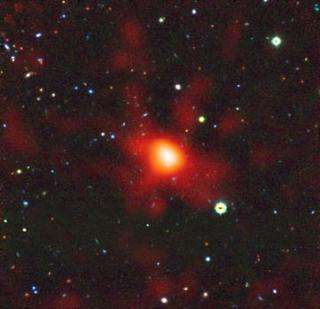
A study of the Universe’s most massive galaxy clusters has shown that mergers play a vital role in their evolution.
Astronomers at Oxford University and the Gemini Observatory used a combination of data from the twin Gemini Telescopes, located in Hawaii and Chile, and the Hubble Space Telescope (HST) to study populations of stars in the Universe’s most massive galaxy clusters over a range of epochs – the earliest being half the age of the Universe. The HST images were used to map the light distribution of the galaxies in the cluster. Data from the Gemini Multi-Object Spectrograph allowed the team to analyse the light from galaxies to determine their masses, ages and chemical compositions.
“We still don’t have a clear picture of how galaxies develop over the history of the Universe. The strength of this study is that we are able to look at galaxy clusters over a range of epochs,” said Dr Jordi Barr of Oxford University, who is presenting some of the first results of the Gemini/HST Galaxy Cluster Project at the RAS National Astronomy Meeting on 5th April.
Galaxy clusters contain the most massive galaxies in the Universe. Until recently, astronomers believed that all galaxies in the centres of clusters formed rapidly and then aged without any further changes to their structure in a process known as “Passive Evolution”. Results from the Gemini/HST Galaxy Cluster Project now show that this cannot be the case.
Dr Barr explained, “When we’re looking at the most distant galaxy clusters, we are looking back in time to clusters that are in early stages of their formation. The young galaxies in distant clusters appear to be very different from those in the mature clusters that we see in the local Universe. We found the earliest galaxy clusters have a huge variation in the abundances of elements such as oxygen and magnesium, whereas the chemistry of galaxies in the sample of closer clusters appears to be much more homogenous. This difference in chemistry proves that the clusters must actively change over time. If the galaxies in the old clusters have acquired a complete ‘set’ of elements, it’s most likely that they have formed from the mergers of several young galaxies”.
The group found that the star-formation in galaxies is dependent on mass and that in lower mass galaxies star-formation continues for longer. The most massive galaxies in clusters appear to have formed all their stars by the time the universe is just over a billion years old, whereas the lower mass galaxies finish forming their stars some 4 billion years later.
“We see the effects of star-formation in low mass galaxies but are unsure about why it’s happening. It’s possible that star-formation can be shut down very rapidly in dense environments and that the lower mass galaxies are recent arrivals that are forming stars over a longer period outside the cluster, then falling in. But we are still speculating...” said Dr Barr.
The group’s observations of merging galaxy clusters showed that a large proportion of the galaxies in those clusters have undergone recent bursts of star formation. This indicates that star formation may be triggered if galaxies are thrown, during the course of a merger, into contact with the gaseous medium pervading the cluster.
Future observations are planned at X-ray wavelengths to study the interactions between galaxies and the distribution and temperature of the surrounding gas.
Source: Royal Astronomical Society


