Mercury's formation impact splattered Earth with material
New computer simulations of Mercury’s formation show the fate of material blasted out into space when a large proto-planet collided with a giant asteroid 4.5 billion years ago. The simulations, which track the material over several million years, shed light on why Mercury is denser than expected and show that some of the ejected material would have found its way to the Earth and Venus.
“Mercury is an unusually dense planet, which suggests that it contains far more metal than would be expected for a planet of its size. We think that Mercury was created from a larger parent body that was involved in a catastrophic collision, but until these simulations we were not sure why so little of the planet’s outer layers were reaccreted following the impact,” said Dr Jonti Horner, who is presenting results at the Royal Astronomical Society’s National Astronomy Meeting on 5th April.
To solve this problem, Dr Horner and his colleagues from the University of Bern ran two sets of large-scale computer simulations. The first examined the behaviour of the material in both the proto-planet and the incoming projectile; these simulations were among the most detailed to date, following a huge number of particles and realistically modelling the behaviour of different materials inside the two bodies. At the end of the first simulations, a dense Mercury-like body remained along with a large swathe of rapidly escaping debris. The trajectories of the ejected particles were then fed in to a second set of simulations that followed the motion of the debris for several million years. Ejected particles were tracked until either they landed on a planet, were thrown into interstellar space, or fell into the Sun. The results allowed the group to work out how much material would have fallen back onto Mercury and investigate other ways in which debris is cleared up in the Solar System.
The group found that the fate of the debris depended on whereabouts Mercury was hit, both in terms of its orbital position and in terms of the angle of the collision.
Whilst purely gravitational theory suggested that a large fraction of the debris would eventually fall back onto Mercury, the simulations showed that it would take up to 4 million years for 50% of the particles to land back on the planet and in this time many would be carried away by solar radiation. This explains why Mercury retained a much smaller proportion than expected of the material in its outer layers.
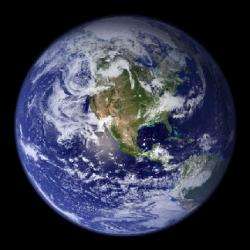
The simulations also showed that some of the ejected material made its way to Venus and the Earth. While this is only a small fraction, it illustrates that material can be transferred between the inner planets relatively easily. Given the amount of material that would have been ejected in such a catastrophe, it is likely that there is a reasonable amount (possibly as much as 16 million billion tonnes [1.65x10^19 kg]) of proto-Mercury in the Earth.
Source: Royal Astronomical Society


