'Scent of a woman' tells male redback spiders to find a mate
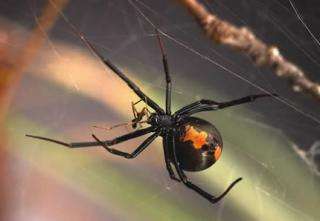
If men think finding a nice partner to settle down and raise children with is tough, consider the plight of the male Australian redback spider. Instead of personality conflicts, spats over in-laws and financial worries, imagine that immediately after the first time you have sex, your partner — who is 100 to 200 times your body weight — will eat you alive.
Not the ideal honeymoon, perhaps. But redback males, who get only one mating opportunity — an uncommon occurrence in nature — have a few tricks up their (eight) sleeves. A new study by researchers at the University of Toronto at Scarborough has identified developmental adaptations in male Australian redback spiders (Latrodectus hasselti) that give these guys an edge in their deadly dating game. The study in the April 4 issue of Current Biology reports that males develop faster based on the population density of males and females around them — the first time such a phenomenon has been shown in any animal.
“It shows that males are really tracking the selection pressures that they’re facing in an environment — they’re aware of male density and the amount of competition they’re going to be facing,” says Michael Kasumovic, a PhD candidate in the UTSC laboratory of Professor Maydianne Andrade. “It’s the first time that it’s been shown that males are actually changing their development in response to both sexual and natural selection.”
Redback spiders are relatives of black widow spiders and the marble-sized female redbacks dwarf the males, who are about the size of a grain of rice. While the females can live for up to two years, males live for only four to eight weeks. Initially, they remain on the web where they were born, but soon disperse when wind conditions are appropriate. Once they settle on their own web they begin molting and building up fat reserves, but once they reach sexual maturity, they cease eating and focus solely on finding a mate. If they are lucky enough to find a female, they put all of their resources — including their life — into it. In the process, they deposit a sperm plug — a small part of their copulatory organ that stays inside the female — that prevents any future males from successfully fertilizing her eggs, meaning that males have to mate with a virgin to maximize their reproductive success.
“On the one hand, they want to provision themselves to survive this trip,” says Andrade. “On the other hand, they have to develop quickly so that they become sexually mature in time to mate with these virgin females before the females mate with someone else.” These are opposing pressures, and the researchers found that males are able to gauge which issue is most pressing in their particular situation while they are still juvenile and use that information to maintain or speed up how quickly they develop.
“We call it ‘scent of a woman,’” Andrade laughs. “They do this without contact — they smell how many females are around them.”
Kasumovic reared males in either the presence or absence of females that the males couldn’t see or touch, meaning that the males were responding to female pheromones. “What we were mimicking there was a situation where a male is developing as a juvenile in a habitat with lots of females close by — in other words, he doesn’t need to be well provisioned—versus a situation where female webs are very far away and he would need to be well-provisioned to survive the trip to find her.”
When males can smell females, they develop rapidly, trading a smaller body size and less fat reserves against getting to virgin females sooner. The competition is tough — you’ll often find up to eight males on a female’s web, says Andrade. The density of males is also critical — in areas with many males, the researchers found that the males were smaller but had more fat on their body. They suspect that these males need the extra fat for the extended courtship rituals preferred by females — males are supposed to pluck and vibrate a female’s web strings for up to eight hours — and displeased females will flick males away or even off the web.
The female, who produces a batch of 100 to 300 eggs every month, will mate with only one or two males, and the first male will get up to 90 to 100 per cent of the fertilization for that female. “This provides a really good explanation for why there is so much size variation [among males] in the wild,” says Kasumovic. “Everybody always states that the small males are a by-product of them not being able to get enough resources, but we’re showing that they’re intentionally developing that way.”
Source: University of Toronto


