Dusty Old Star Offers Window to Our Future, Astronomers Report
Astronomers have glimpsed dusty debris around an essentially dead star where gravity and radiation should have long ago removed any sign of dust — a discovery that may provide insights into our own solar system's eventual demise several billion years from now.
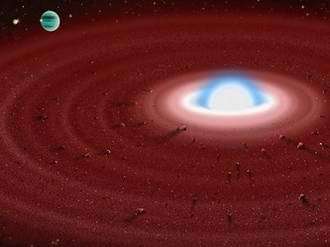
Image: An artist's rendering of what a dust disk might look like around the white dwarf GD 362. A more distant planet (upper left) may be responsible for "shepherding" the dust ring and promoting ongoing collisions.
The results are based on mid-infrared observations made with the Gemini 8-meter Frederick C. Gillett Telescope (Gemini North) on Hawaii's Mauna Kea. The Gemini observations reveal a surprisingly high abundance of dust orbiting an ancient stellar ember named GD 362.
"This is not an easy one to explain," said Eric Becklin, UCLA astronomer and principle investigator for the Gemini observations. "Our best guess is that something similar to an asteroid or possibly even a planet around this long-dead star is being ground up and pulverized to feed the star with dust. The parallel to our own solar system's eventual demise is chilling."
"We now have a window to the future of our own planetary system," said Benjamin Zuckerman, UCLA professor of physics and astronomy, member of NASA's Astrobiology Institute, and a co-author on the Gemini-based paper. "For perhaps the first time, we have a glimpse into how planetary systems like our own might behave billions of years from now."
"The reason why this is so interesting is that this particular white dwarf has by far the most metals in its atmosphere of any known white dwarf," Zuckerman added. "This white dwarf is as rich in calcium, magnesium and iron as our own sun, and you would expect none of these heavier elements. This is a complete surprise. While we have made a substantial advance, significant mysteries remain."
The research team includes scientists from UCLA, Carnegie Institution and Gemini Observatory. The results are scheduled for publication in an upcoming issue of the Astrophysical Journal. The results will be published concurrently with complementary near-infrared observations made by a University of Texas team led by Mukremin Kilic at the NASA Infrared Telescope Facility, also on Mauna Kea.
"We have confirmed beyond any doubt that dust never does sleep!" quips Gemini Observatory's Inseok Song, a co-author of the paper. "This dust should only exist for hundreds of years before it is swept into the star by gravity and vaporized by high temperatures in the star's atmosphere. Something is keeping this star well stocked with dust for us to detect it this long after the star's death."
"There are just precious few scenarios that can explain so much dust around an ancient star like this," said UCLA professor of physics and astronomy Michael Jura, who led the effort to model the dust environment around the star. "We estimate that GD 362 has been cooling now for as long as five billion years since the star's death-throes began and in that time any dust should have been entirely eliminated."
Jura likens the disk to the familiar rings of Saturn and thinks that the dust around GD 362 could be the consequence of the relatively recent gravitational destruction of a large "parent body" that got too close to the dead star.
GD 362 is a white dwarf star. It represents the end-state of stellar evolution for stars like the sun and more massive stars like this one's progenitor, which had an original mass about seven times the sun's. After undergoing nuclear reactions for millions of years, GD 362's core ran out of fuel and could no longer create enough heat to counterbalance the inward push of gravity. After a short period of instability and mass loss, the star collapsed into a white-hot corpse. The remains are cooling slowly over many billions of years as the dying ember makes its slow journey into oblivion.
Based on its cooling rate, astronomers estimate that between two billion to five billion years have passed since the death of GD 362.
"This long time frame would explain why there is no sign of a shell of glowing gas known as a planetary nebula from the expulsion of material as the star died," said team member and Gemini astronomer Jay Farihi.
During its thermonuclear decline, GD 362 went through an extensive period of mass loss, going from a mass of about seven times that of the sun to a smaller, one-solar-mass shadow of its former self.
Although about one-quarter of all white dwarfs contain elements heaver than hydrogen in their atmospheres, only one other white dwarf is known to contain dust. The other dusty white dwarf, designated G29-38, has about 100 times less dust density than GD 362.
The Gemini observations were made with the MICHELLE mid-infrared spectrograph on the Gemini North telescope on Mauna Kea, Hawaii.
"These data are phenomenal," said Alycia Weinberger of the Carnegie Institution. "Observing this star was a thrill! We were able to find the remnants of a planetary system around this star only because of Gemini's tremendous sensitivity in the mid-infrared. Usually you need a spacecraft to do this well."
The Gemini mid-infrared observations were unique in their ability to confirm the properties of the dust responsible for the "infrared excess" around GD 362. The complementary Infrared Telescope Facility near-infrared observations and paper by the University of Texas team provided key constraints on the environment around the star.
University of Texas astronomer and co-author Ted von Hippel describes how the Infrared Telescope Facility (IRTF) observations complement the Gemini results: "The IRTF spectrum rules out the possibility that this star could be a brown dwarf as the source of the 'infrared excess,'" von Hippel said. "The combination of the two data sets provides a convincing case for a dust disk around GD 362."
The Gemini observations included time made available as part of an exchange of instrument time with the W.M. Keck Observatory.
Source: UCLA/Gemini Observatory


