Proto supermassive binary black hole detected in X-rays

April 6, 2006

An international team of astronomers led by D. Hudson from the University of Bonn has detected a proto supermassive binary black hole in images of NASA's Chandra X-ray observatory. They found that these two black holes are gravitationally bound and orbit each other. Their results will be published in an upcoming issue of Astronomy & Astrophysics.

An international team of astrophysicists, led by D. Hudson from the University of Bonn and including the U.S. Naval Research Laboratory and the University of Virginia, presents their X-ray detection of a proto supermassive binary black hole. Their results will be published in an upcoming issue of Astronomy & Astrophysics. The image of this proto binary black hole was obtained with NASA's Chandra X-ray Observatory. The two black holes have already been seen in radio images. The new X-ray images provide unique evidence that these two black holes are in the process of forming a binary system; that is, they are gravitationally bound and orbit each other.
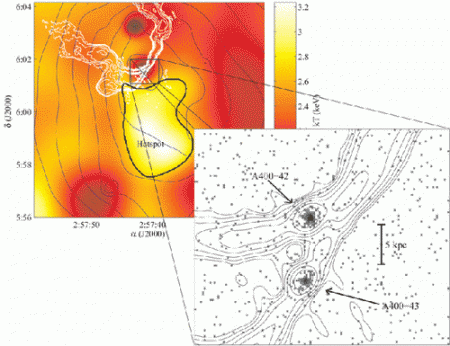
Proto supermassive binary black hole detected in X-rays
Enlarge

This image shows the central region of the galaxy cluster Abell 400. The colour coding gives the temperature of the X-ray emitting gas trapped in the cluster: black-cold (18 million degrees Celsius) to white-hot (38 million degrees Celsius). The contours show the radio emission from the jets of plasma being expelled by the black holes. As the two black holes stream through the gas at supersonic velocities, the jets are bent toward the top of the image. The gas in front of the black holes is compressed and heated, as seen by the hotspot below them. The inset shows a blow up of the central regions. Each dot represents a position where an X-ray photon has struck Chandra´s X-ray camera. The two black holes are seen as bright regions where as many as 250 X-ray photons struck the camera. The contours again show the radio emission from the black holes and the jets of plasma being ejected from them.

The two black holes are located in the nearby galaxy cluster Abell 400. With high-resolution Chandra data, the team was able to spatially resolve the two supermassive black holes (separated by 15") at the centre of the cluster. Each black hole is located at the centre of its respective host galaxy and the host galaxies appear to be merging. It is not, however, just the two host galaxies that are colliding - the whole cluster in which they live is merging into another neighbouring galaxy cluster.

Using these new data, the team show that the two black holes are moving through the intracluster medium at the supersonic speed of about 1200 km/s. The wind from such a motion would cause the radio plasma emitted from these two black holes to bend backwards. Although this bending had been observed previously, the cause of it was still being debated. Since the bending of the jets due to this motion is in the same direction, it suggests that the two black holes are travelling along the same path within the cluster and are therefore gravitationally bound.

These two black holes became gravitationally bound when their host galaxies collided. In several million years, the two black holes will probably coalesce causing a burst of gravitational waves, as predicted by Einstein's theory of relativity. This event will produce one of the brightest sources of gravitational radiation in the Universe. Although we will not be around to see this particular one, the observations provide additional evidence that such bound systems exist and are currently merging. The gravitational waves produced by these mergers are believed to be the biggest source of gravitational waves to be detected by the future Laser Interferometer Space Antenna (LISA).

Source: Journal Astronomy and Astrophysics


print this article email this article download pdf blog this article bookmark this article     Stumble it Digg this share on Facebook retweet share on Reddit add to delicious
Rate this story - 4.8 /5 (25 votes)


April 6, 2006 all stories

Comments: 0

4.8 /5 (25 votes)
  • Stumble this up

  • Digg this

  • share this

  • hide
  • Related Stories

  • Physical scientists will apply laws of physics in cancer fight
    created Oct 26, 2009 | popularity not rated yet | comments 0
  • Researchers explain the activity of black holes at the centre of galaxy clusters
    created Sep 04, 2009 | popularity not rated yet | comments 0
  • Mystery Source of Solar Wind Heating Identified
    created Jul 17, 2009 | popularity not rated yet | comments 0
  • Turbulence responsible for black holes' balancing act
    created Jul 14, 2009 | popularity not rated yet | comments 0
  • Living fossils hold record of 'supermassive' kick
    created Jul 09, 2009 | popularity not rated yet | comments 0


Other News

Past regional cold and warm periods linked to natural climate drivers

Space & Earth / Earth Sciences

created 6 hours ago | popularity 3.7 / 5 (6) | comments 6

Intervals of regional warmth and cold in the past are linked to the El Niņo phenomenon and the so-called "North Atlantic Oscillation" in the Northern hemisphere's jet stream, according to a team of climate scientists. These ...


Russia: no space for space tourists (AP)

Russia: no space for space tourists

Space & Earth / Space Exploration

created 14 hours ago | popularity 2.7 / 5 (3) | comments 2

(AP) -- A top Russian space official says there is no space for tourists wishing to fly to the International Space Station.


Astronauts surprised by holiday turkey dinners (AP)

Astronauts surprised by holiday turkey dinners

Space & Earth / Space Exploration

created 9 hours ago | popularity not rated yet | comments 0

(AP) -- Space shuttle Atlantis' astronauts thought they were going to give thanks with pantry leftovers Thursday as their mission drew to a close, but found turkey dinners awaiting them.


Gullies and Flow Features on Crater Wall

Gullies and Flow Features on Crater Wall

Space & Earth / Space Exploration

created 10 hours ago | popularity 5 / 5 (1) | comments 0

(PhysOrg.com) -- This image from the High Resolution Imaging Science Experiment (HiRISE) camera on NASA's Mars Reconnaissance Orbiter shows a sample of the variety and complexity of processes that may occur ...


Thanksgiving last full day in space for shuttle (AP)

Thanksgiving last full day in space for shuttle

Space & Earth / Space Exploration

created 13 hours ago | popularity not rated yet | comments 0

(AP) -- Space shuttle Atlantis' astronauts will spend Thanksgiving checking their ship for the ride home.