New Cassini image shows "A" ring contains more debris than once thought
April 6, 2006
Star-Crossed Rings

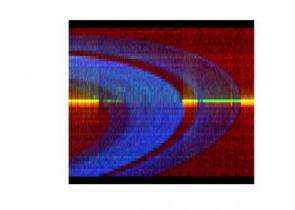
The image is a false-color ultraviolet view of Saturn's B ring (center) and A ring (right), separated by a large gap known as the Cassini Division and showing a bright horizontal streak created by a series of time-lapse images involving the star, 26 Taurus. The image was made over a nine-hour period as the star drifted behind the rings. The opacity of the outer A ring is most pronounced on its inner edge, indicating more ring debris is present there. The Encke Gap, much smaller than the Cassini Division, is visible near the outer edge of the A ring. The B ring is significantly more opaque than the A ring, indicating a greater density of ring material when imaged from above. The sky behind the rings glows red in the UV wavelengths from the hydrogen gas that fills the solar system. The images were processed by a CU-Boulder team from data taken by the UVIS instrument aboard the Cassini spacecraft in May 2005. Credit: NASA/JPL/University of Colorado

Views of Saturn's stunning ring system from above by the Cassini-Huygens spacecraft now orbiting the planet indicate the prominent A ring contains more debris than once thought, according to a new University of Colorado at Boulder study.

Previous observations with the Voyager spacecraft in the early 1980s found the ring was more transparent, indicating less material, said Joshua Colwell of CU-Boulder's Laboratory for Atmospheric and Space Physics. But new calculations based on May 2005 observations with Cassini's Ultraviolet Imaging Spectrograph, or UVIS, indicates the opacity of the ring is up to 35 percent higher than previously reported.

Because of the uneven distribution of the ring particles - which range in size from dust grains to school buses - the transparency of the rings depends on the angle from which they are viewed, he said. The particles are arranged essentially parallel in long stringy clumps as large as 60 feet across, 16 feet thick and 160 feet long, according to models produced from observation data, said Colwell.

A paper on the subject by Colwell, Larry Esposito and Miodrag Sremcevic of CU-Boulder's LASP appears in the April 1 issue of Geophysical Research Letters, or GRL. Esposito is science team leader for UVIS, a $12.5 million instrument designed and built at CU-Boulder by LASP that is riding on the Cassini spacecraft.

A new image released by the team in conjunction with the GRL paper shows the distribution of the ring material. The opaque B ring has more material than the A ring, located just outside it, and the A ring is densest near its inner edge, according to the team. The new clumps observed by Cassini mean a larger amount of material overall said Colwell, a LASP research associate and UVIS science team member.

The particles are trapped in ever-changing clusters of debris that are regularly torn apart and reassembled by gravitational forces from the planet, Colwell said. The size and behavior of the clusters were deduced by observing flickering light as the ring passed in front of a star in a process known as stellar occultation, he said.

"The flickers are like a time-lapse movie of a car's headlights taken from the other side of a picket fence," said Colwell. "The flickering would provide us details about the pickets."

The observations of the particle clusters indicate the A ring is primarily empty space. A close-up view of the rings would show as "short, flattened strands of spiral arms with very few particles between them," he said.

Source: University of Colorado at Boulder

4.8 /5 (6 votes)  

Rank 4.8 /5 (6 votes)
Tags

Related Stories
Relevant PhysicsForums posts

More news stories

Humans may have helped the decline of African rainforests 3000 years ago

(PhysOrg.com) -- Large areas of rainforests in Central Africa mysteriously disappeared over three thousand years ago, to be replaced by savannas. The prevailing theory has been that the cause was a change ...

Space & Earth / Environment

created 23 hours ago | popularity 4.3 / 5 (13) | comments 13 | with audio podcast report

Could Venus be shifting gear?

(PhysOrg.com) -- ESA’s Venus Express spacecraft has discovered that our cloud-covered neighbour spins a little slower than previously measured. Peering through the dense atmosphere in the infrared, the ...

Space & Earth / Space Exploration

created 19 hours ago | popularity 5 / 5 (7) | comments 8 | with audio podcast

NASA budget will axe Mars deal with Europe: scientists

US President Barack Obama's budget proposal to be submitted next week for 2013 will cut NASA's budget by 20 percent and eliminate a major partnership with Europe on Mars exploration, scientists said Thursday.

Space & Earth / Space Exploration

created 22 hours ago | popularity 5 / 5 (2) | comments 19

Mars Science Laboratory computer issue resolved

(PhysOrg.com) -- Engineers have found the root cause of a computer reset that occurred two months ago on NASA's Mars Science Laboratory and have determined how to correct it.

Space & Earth / Space Exploration

created 20 hours ago | popularity 4.7 / 5 (6) | comments 4 | with audio podcast

Two new moons for Jupiter

Advances in technology have lead to the discovery of new planets outside of our Solar System, and now even new moons in our own backyard.

Space & Earth / Space Exploration

created 19 hours ago | popularity 4 / 5 (1) | comments 7


Anonymous knocks CIA website offline (Update)

The website of the Central Intelligence Agency was inaccessible on Friday after the hacker group Anonymous claimed to have knocked it offline.

New error-correcting codes guarantee the fastest possible rate of data transmission

Error-correcting codes are one of the triumphs of the digital age. They’re a way of encoding information so that it can be transmitted across a communication channel — such as an optical fiber o ...

Small modular reactor design could be a 'SUPERSTAR'

(PhysOrg.com) -- Though most of today's nuclear reactors are cooled by water, we've long known that there are alternatives; in fact, the world's first nuclear-powered electricity in 1951 came from a reactor ...

New power source discovered

(PhysOrg.com) -- Researchers at the Massachusetts Institute of Technology (MIT) and RMIT University have made a breakthrough in energy storage and power generation.

The power of estrogen -- male snakes attract other males

A new study has shown that boosting the estrogen levels of male garter snakes causes them to secrete the same pheromones that females use to attract suitors, and turned the males into just about the sexiest ...

Google users warned of threat to smartphone wallets

Users of Google smartphone wallets were being warned on Friday that there is a way to crack pass codes intended to thwart thieves from going on illicit shopping sprees.