LLNL scientists simulate 1906 earthquake and possible future tremblors along local faults
April 6, 2006 LLNL scientists simulate 1906 earthquake and possible future tremblors along local faults

Enlarge

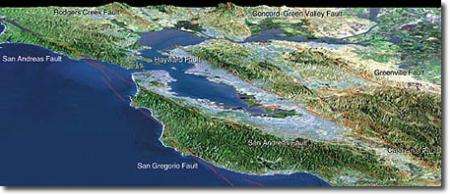
There are seven major earthquake faults in the San Francisco Bay area: the San Gregorio, San Andreas, Hayward, Calaveras, Rodgers Creek, Concord–Green Valley, and Greenville faults.

Lawrence Livermore National Laboratory scientists today unveiled detailed computerized recreations of the 1906 San Francisco earthquake, as well as simulations of temblors along other local faults that could have devastating effects on the Bay Area, Central Valley and Delta region.

Working with the U.S. Geological Survey, Livermore scientists worked for two years on the 1906 simulations, which show that the magnitude 7.8 earthquake that struck San Francisco on April 18, 1906 was centered off the coast and caused severe damage along more than 300 miles of the San Andreas Fault.

The 1906 simulations show how the waves spread as far south as San Juan Bautista and as far north as Cape Mendocino. Santa Rosa in the north was severely damaged. Livermore researchers used a three-dimensional model and a seismic velocity model to assess the damage.

Using supercomputers at the Laboratory that are capable of calculating a magnitude 7.0 or greater earthquake on any given fault, seismologists and engineers can assess the potential damage that lies in its wake.

“By recreating the 1906 earthquake, we can get a closer look at how the ground responds. It gives us insight into what might happen along other faults in the area,” said Arthur Rodgers, leader for Livermore’s seismology group. “One thing we have to keep in mind is that earthquakes don’t rupture uniformly.”

In addition to the 1906 recreation, the scientists created simulations of earthquakes along other faults such as the Hayward Fault, which show severe damage to major transportation corridors, power lines and water pipelines. Impacts in the Delta region include possible damage to levees, buildings and bridges.

The simulations are part of the Laboratory’s seismology program, which combines physics and engineering with high-performance computing to assess local, state, national and global effects from earthquakes and national security threats.

Source: Lawrence Livermore National Laboratory


print this article email this article download pdf blog this article bookmark this article     Stumble it Digg this share on Facebook retweet share on Reddit add to delicious
Rate this story - 4.3 /5 (6 votes)


April 6, 2006 all stories

Comments: 0

4.3 /5 (6 votes)
  • Stumble this up

  • Digg this

  • share this

  • hide
  • Related Stories


Other News

Baby can wait as expectant dad finishes spacewalk (AP)

Baby can wait as expectant dad finishes spacewalk

Space & Earth / Space Exploration

created 18 hours ago | popularity 3 / 5 (2) | comments 0

(AP) -- A spacewalking astronaut put aside the impending birth of his daughter and blazed through his first-ever venture outside the International Space Station on Saturday.


Commuters wait on the platform shrouded by fog in London

Climate change not man-made, say majority of Britons: poll

Space & Earth / Environment

created Nov 15, 2009 | popularity 3.3 / 5 (15) | comments 46

Less than half of Britons believes that human activity is to blame for global warming, according to a poll carried out for The Times newspaper and published on Saturday.


Mysteriously warm times in Antarctica

Mysteriously warm times in Antarctica

Space & Earth / Earth Sciences

created Nov 18, 2009 | popularity 4.2 / 5 (21) | comments 28

(PhysOrg.com) -- A new study of Antarctica's past climate reveals that temperatures during the warm periods between ice ages (interglacials) may have been higher than previously thought. The latest analysis ...


UN: Fight climate change with free condoms (AP)

UN: Fight climate change with free condoms

Space & Earth / Environment

created Nov 18, 2009 | popularity 3.1 / 5 (11) | comments 29

(AP) -- The battle against global warming could be helped if the world slowed population growth by making free condoms and family planning advice more widely available, the U.N. Population Fund said Wednesday.


Mystery of the Solar Tsunami -- Solved

Mystery of the Solar Tsunami -- Solved (w/ Video)

Space & Earth / Astronomy

created Nov 19, 2009 | popularity 4.9 / 5 (24) | comments 8

(PhysOrg.com) -- Sometimes you really can believe your eyes. That's what NASA's Solar Terrestrial Relations Observatory (STEREO) is telling researchers about a controversial phenomenon on the sun known as ...