Nanopore Method Could Revolutionize Genome Sequencing
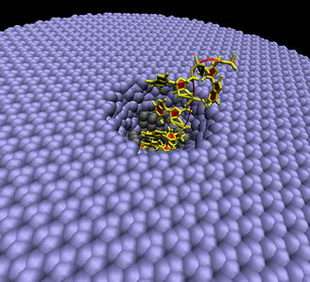
A team led by physicists at the University of California, San Diego has shown the feasibility of a fast, inexpensive technique to sequence DNA as it passes through tiny pores. The advance brings personalized, genome-based medicine closer to reality.
The paper, published in the April issue of the journal Nano Letters, describes a method to sequence a human genome in a matter of hours at a potentially low cost, by measuring the electrical perturbations generated by a single strand of DNA as it passes through a pore more than a thousand times smaller than the diameter of a human hair. Because sequencing a person’s genome would take several months and millions of dollars with current DNA sequencing technology, the researchers say that the new method has the potential to usher in a revolution in medicine.
“Current DNA sequencing methods are too slow and expensive for it to be realistic to sequence people’s genomes to tailor medical treatments for each individual,” said Massimiliano Di Ventra, an associate professor of physics at UCSD who directed the project. “The practical implementation of our approach could make the dream of personalizing medicine according to a person’s unique genetic makeup a reality.”
The physicists used mathematical calculations and computer modeling of the motions and electrical fluctuations of DNA molecules to determine how to distinguish each of the four different bases (A, G, C, T) that constitute a strand of DNA. They based their calculations on a pore about a nanometer in diameter made from silicon nitride—a material that is easy to work with and commonly used in nanostructures—surrounded by two pairs of tiny gold electrodes. The electrodes would record the electrical current perpendicular to the DNA strand as the DNA passed through the pore. Because each DNA base is structurally and chemically different, each base creates its own distinct electronic signature.
Previous attempts to sequence DNA using nanopores were not successful because the twisting and turning of the DNA strand introduced too much noise into the signal being recorded. The new idea takes advantage of the electric field that drives the current perpendicular to the DNA strand to reduce the structural fluctuations of DNA while it moves through the pore, thus minimizing the noise.
“If nature was very unkind, then the DNA would always fluctuate so much as it passes through the nanopore that measuring the current would not give us any information about what base is present at a particular location,” explained Michael Zwolak, a graduate student in physics at the California Institute of Technology who contributed to the study. “However, we have identified a particular way to operate the nanopore/electrode system that suppresses some of the fluctuations so they aren't so great as to destroy the distinguishability of the bases.”
The researchers caution that there are still hurdles to overcome because no one has yet made a nanopore with the required configuration of electrodes, but they think it is only a matter of time before someone successfully assembles the device. The nanopore and the electrodes have been made separately, and although it is technically challenging to bring them together, the field is advancing so rapidly that they think it should be possible in the near future.
In addition to the speed and low cost of the nanopore method, the researchers calculate that it will ultimately be significantly less error-prone than current methods.
“The DNA sequencing method we propose has the potential of having fewer errors than the present method, which is based on the Sanger method,” said Johan Lagerqvist, a graduate student in physics at UCSD and the lead author on the paper. “It should be possible to sequence strands of DNA that are tens of thousands of base pairs in length, possibly as long as an entire gene, in one pass through the nanopore. With the Sanger method it is necessary to chop the DNA into smaller pieces, copy the DNA and use multiple sequencing machines, which introduces additional sources of error.”
The study was funded by the National Science Foundation and by the National Human Genome Research Institute at the National Institutes of Health. The NIH funds are from a program launched in 2004 to encourage researchers to pursue a wide range of ideas to sequence a mammal-sized genome for $1,000. The researchers say that as physicists they take a unique approach to the problem.
“We don’t think of it as DNA, we view it as a bunch of atoms and electrons that behave in ways we can predict and manipulate,” said Di Ventra.
Source: University of California, San Diego


