The Einstein Emitter: single photon computer system
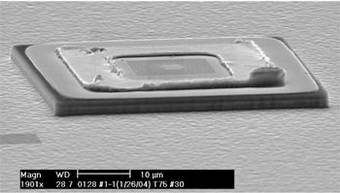
One single photon. One solitary quantum pulse of electromagnetic radiation, no more, no less, produced by one single electron, will be the product of a new device under construction by nanotechnologists at the USC Viterbi School of Engineering.
Image: Quantum emitter under electron microsope
Colleagues at the University of Texas/Austin will build the USC device’s counterpart, a detector for that single pulse, as their part of a joint $1.3 million study just funded by the National Science Foundation. The interdisciplinary team includes three members of the National Academy of Engineering.
John D. O’Brien of the Viterbi School’s electrical engineering department, principal investigator in the project, says the ultimate goal is to use such singleton photons in cryptographic devices and, ultimately,
general purpose computers, as part of the continuing search for smaller, faster, and more efficient information processing devices.
The award is part a new NSF progam encouraging Nanoscale Interdisciplinary Research Teams (NIRTs), which is part of of NSF's Nanoscale Science and Engineering programs.
"This is an ambitious project that requires an exceptionally broad range of expertise in numerous electrical engineering disciplines," says Viterbi School Dean Yannis Yortsos. "Swift success in a project this bold is never guaranteed, but I am extremely proud we have been able to assemble an in-house team that has the background to even attempt it."
O'Brien says that theory, and particularly a classic paper by mathematician Peter Shor, indicate that a computational device using quantum phenomena to represent information should be able to perform certain tasks, particularly securely encrypting and decrypting messages, far faster than traditional chips. A 2001 paper by Emanuel Knill, Raymond Laflamme and Gerard Milburn suggested that such a machine could be made using devices that created (and detected) single photons.
But realizing the real-world photon machine has proved a forbiddingly difficult task. As O'Brien's detailed paper describing the project notes, "to work, these systems must be isolated from noise to an almost unheard of degree."
Fittingly, the USC/UT effort begins in the centenary year of Albert Einstein’s classic 1905 paper explaining the photoelectric effect, the paper that laid the foundations for quantum understandings of mass and energy.
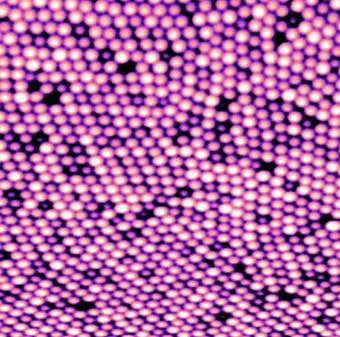
The “quantum dots” that the USC team will use to generate single photons, one at a time, are ultra-small (“nanoscale”) devices that perform the photoelectric process Einstein explained in reverse. The dots are minute particles of a highly engineered semiconductor material. Classic photoelectric materials produce electric current — electrons — when struck by sufficiently energetic photons, in a mechanism Einstein explained. The same mechanism, working in reverse, sends out a single photon when energized by an electron.
While single photon emitters have been built before, the USC model is designed as a model of Einsteinian economy. The excitation will come from one single electron.
The USC group will use expertise accumulated over decades in the Compound Semiconductor Laboratory of USC National Academy of Engineering member P. Daniel Dapkus. Dapkus, who holds W.M. Keck chair in the Viterbi School department of electrical engineering, decades ago pioneered the creation of the quantum well laser devices, considered tiny at the time
He subsequently moved on to nanotechnology and with collaborators including O'Brien learned to grow extremely regular arrays of quantum dots, looking in electron microscope photos like a field of seedling trees, using a variation of the lithographic processes now used to create chips.
To turn a mesa containing an array of such dots into a single photon signal device, an array of microscopic photonic crystal resonant cavities is built in the mesa. Each resonance cavity will contain a single quantum dot.
Creating the crystal is only the first step. To activate it in a useful way, an elaborate electronic control system is needed, which will feed a single electron of precisely the correct electric potential into the system at precisely the right time. This potential is so minute that, to avoid introduction of potentially stray electrons into the system, the electronics will function at extremely low temperature -- 10 Kelvin, (-441 Fahrenheit, -263 Celsius).
Using resonance effects, the group hopes to speed up the rate of production of single photons, so that the process happens in 100 picoseconds -- ten times faster than existing devices. (100 picoseconds are to one second what one second is to 317 years).
The interface to classical electronics will be designed by Anthony F.J. Levi, who has joint appointments in the Viterbi School and the USC College of Letters, Arts, and Science. He specializes in Adaptive Quantum Design -- that is, creating systems that can work at the quantum, nanoscale level, as well as in nanoscale manufacturing. Levi’s systems will process the single photon signals using beam splitters and wave guides that will be able to verify which of the photons detected are signals, and which are noise.
Viterbi School electrical engineer Alan Wilner is an expert on photonic transfer of information. He will be studying how far single photon quantum information can be transmitted, how it happens, and what can be done to protect it: "I want to enable the information to be transmitted over longer distances in as pristine a state as possible."
National Academy of Engineering member William Lindsey will also contribute his communications expertise to the project, investigating how the classic insights of Claude Shannon apply when information is coded not as electronic bits but rather as "qubits" — quantum bits. Specifically, "I am specifying the Shannon-equivalent communications capacity that defines limits on the number of classical information bit per qubit that can be sent error free through a communications channel disturbed by thermal noise." Lindsey and his students are also developing single photon synchronization requirements and achievable performance from a systems perspective.
Another Viterbi EE department faculty member, Todd Brun, provides the theoretical support for the project. An expert in quantum information processing, he will develop theoretical models of the single photon sources and detectors, assess their properties, and develop designs for quantum gates, circuits, and communication channels, in collaboration with the experimenters. Brun was the first of several theorists in quantum information processing to be hired recently by USC.
The detectors themselves will be created in the University of Texas/Austin Microelectronics Research Laboratory by a group led by National Academy of Engineering member Joseph Campbell, who holds a Cockrell Family Regents chair in Engineering.
Source: University of Southern California


