Next phase reached in definition of Mars Sample Return mission
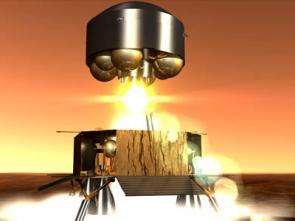
ESA has taken a further step in preparing for participation in Mars Sample Return (MSR), the landmark mission to return samples from the Red Planet, with the announcement of the next phase of industrial activity. The Phase A2 activity will address many critical issues and identify key areas in which Europe can participate in this flagship of the Aurora Programme.
The search for evidence of life outside the Earth is one of the fundamental goals of space exploration, and has been one of the driving forces behind the efforts to explore the planet Mars. This investigation, key to unlocking the 'big' question regarding life in the universe, is increasing in pace and is already beginning to provide answers. This is also one of the leading scientific threads of ESA's Aurora Space Exploration Programme that was approved at the ESA Council meeting at Ministerial level held in Berlin last December.
Currently four orbiting explorers are scanning the surface of Mars in ever more detail, including Europe's own Mars Express, while on the Red Planet itself two NASA rovers are due to be joined in 2013 by ESA's ExoMars rover. The ExoMars mission will take Mars exploration and the search for life to a new level, with an advanced set of life detection instruments as well as the capability to drill into the Martian surface to search for signs of life, a first for Mars. These missions, while providing a wealth of data, are however somewhat limited in that they must take the laboratory to Mars, facing restrictions on power, mass and having to carry out scientific operations in a very harsh environment. The obvious question then arises; why not bring Mars to the laboratory? Hence, the Mars Sample Return (MSR) mission.
The MSR mission has been recognised by European and International scientists as one of the next major milestones in the exploration of the Red Planet, and would represent a quantum leap in the study of possible life there with scientists able to use the full range of Earth based facilities and laboratories. This mission also represents a critical step on the path to the ultimate goal of performing a human mission to Mars, since it involves the full sequence of landing, operating, launching from Mars and returning back to Earth. The technology developments required to enable a MSR mission are also to some extent common to future lunar exploration missions.
ESA recognises the importance of this mission in the frame of the European Aurora Programme, and is now embarking on a twelve month Mars Sample Return Systems Study. This work, which builds on a first study step initiated in 2003, will prepare the way for Europe to play a key role in an international MSR mission. Past ESA work has already defined as a starting point an MSR mission launched in two parts. The first consists of a Mars orbiter and an Earth return capsule, while the second carries the surface lander and the Mars ascent vehicle which will launch the sample into Mars orbit ready for return to Earth. The new 'MSR Phase A2 Systems Study', which will be undertaken by European industry in close coordination with ESA, will be performed in two main steps.
The first step will address the remaining options still to be assessed and choices to be made with respect to the overall mission design. This includes the option of having the orbiter 'capture' the sample container in Mars orbit, or having the ascent vehicle perform a docking manoeuvre. This trade-off, as with much of the work to be performed in this first step, will draw upon the technology development and experience gained during the initial phases of the Aurora Programme.
The refinement of the mission architecture will also include interaction with international partners, in order to prepare for future cooperation on the MSR mission. Additional work will also be performed to assess the impact of features such as surface mobility on the MSR mission, i.e. what is the cost of being able to move around and select specific samples. Having refined the mission design, development paths will be identified for each of the critical capabilities involved in the mission.
The second step of the Phase A2 work will identify within the capability development paths, steps which might be accomplished through precursor missions. Such missions would include the demonstration of critical technologies associated with, for example, soft-precision landing. As an outcome of this, a shortlist of candidate precursor mission concepts will be made.
Both of these steps will be performed in close interaction with the scientific community, in particular through science workshops both covering the requirements and objectives of the MSR mission itself, but also the possible scientific elements of potential precursor missions. The details of these science workshops will be made available in the near future.
Through the MSR Phase A2 System Study, Europe not only aims to play a key role in this landmark mission, but is also pro-actively addressing the necessary steps to take in order to achieve its ambitious goals. These steps have already been initiated in the frame of ongoing technology development within the Aurora Programme, and may be continued through the possibility of intermediate precursor missions to both demonstrate the technologies associated with Mars Sample Return, while also advancing our scientific understanding of the Moon and Mars.
Further steps in the definition of a Mars Sample Return mission, building upon the outcomes of the Phase A2 work, will be implemented in the frame of the Exploration Core Programme the element within the Aurora Programme which covers activities for the preparation of the future exploration of the Moon and Mars, both robotically and ultimately with humans.
Source: ESA


