Cosmic spider is good mother
April 7, 2006 Cosmic spider is good mother

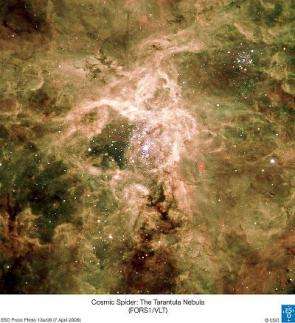
Three-colour image of the Tarantula Nebula in the Large Magellanic Cloud. The image is based on observations made on 10 February 2002 and 22 March 2003 with the FORS1 multi-mode instrument on Eso's Very Large Telescope in three different narrow-band filters (centred on 485 nm, 503 nm, and 657 nm), for a total exposure time slightly above 3 minutes only. The data were extracted from the Eso Science Archive and processed by Henri Boffin (ESO).

Hanging above the Large Magellanic Cloud (LMC) – one of our closest galaxies – in what some describe as a frightening sight, the Tarantula nebula is worth looking at in detail. Also designated 30 Doradus or NGC 2070, the nebula owes its name to the arrangement of its brightest patches of nebulosity that somewhat resemble the legs of a spider. This name, of the biggest spiders on the Earth, is also very fit-ting in view of the gigantic proportions of the celestial nebula - it measures nearly 1,000 light years across!

The Tarantula nebula is the largest emission nebula in the sky and also one of the largest known star-forming regions in all the Milky Way's neighbouring galaxies. Located about 170,000 light-years away, in the southern constellation Dorado (The Swordfish), it can be seen with the unaided eye.

As shown in this image obtained with the FORS1 multi-mode instrument on Eso's Very Large Tele-scope, its structure is fascinatingly complex, with a large number of bright arcs and apparently dark areas in between. Inside the giant emission nebula lies a cluster of young, massive and hot stars, denoted R 136, whose intense radiation and strong winds make the nebula glow, shaping it into the form of a giant arachnid. The cluster is about 2 to 3 million years old, that is, almost from 'yesterday' in the 13.7 billion year history of the Universe.

Several of the brighter members in the immediate surroundings of the dense cluster are among the most massive stars known, with masses well above 50 times the mass of our Sun. The cluster itself contains more than 200 massive stars.

In the upper right of the image, another cluster of bright, massive stars is seen. Known to astronomers as Hodge 301, it is about 20 million years old, or about 10 times older than R136. The more massive stars of Hodge 301 have therefore already exploded as supernovae, blasting material away at tremendous speed and creating a web of entangled filaments. More explosions will come soon – in astronomical terms – as three red supergiants are indeed present in Hodge 301 that will end their life in the gigantic firework of a supernova within the next million years.

While some stars are dying in this spidery cosmic inferno, others are yet to be born. Some structures, seen in the lower part of the image, have the appearance of elephant trunks, not unlike the famous and fertile "Pillars of Creation" at the top of which stars are forming. In fact, it seems that stars form all over the place in this gigantic stellar nursery and in all possible masses, at least down to the mass of our Sun. In some places, in a marvellous recycling process, it is the extreme radiation from the hot and massive stars and the shocks created by the supernova explosions that has compressed the gas to such extent to allow stars to form.

To the right and slightly below the central cluster, a red bubble is visible. The star that blows the mate-rial making this bubble is thought to be 20 times more massive, 130 000 times more luminous, 10 times larger and 6 times hotter than our Sun. A fainter example of such a bubble is also visible just above the large red bubble in the image.

Source: ESO


print this article email this article download pdf blog this article bookmark this article     Stumble it Digg this share on Facebook retweet share on Reddit add to delicious
Rate this story - 4.8 /5 (11 votes)


April 7, 2006 all stories

Comments: 0

4.8 /5 (11 votes)
  • Stumble this up

  • Digg this

  • share this

  • hide
  • Related Stories

  • Infrared Image of Circumstellar Disk Illuminates Massive Star Formation Process
    created Nov 24, 2009 | popularity not rated yet | comments 0
  • Close-up movie shows hidden details in the birth of super-suns (w/ Video)
    created Nov 16, 2009 | popularity not rated yet | comments 0
  • The Explosive Disintegration of a Young Stellar System in Orion
    created Oct 23, 2009 | popularity not rated yet | comments 0
  • The Milky Way's tiny but tough galactic neighbor
    created Oct 14, 2009 | popularity not rated yet | comments 0
  • Trifid triple threat
    created Aug 26, 2009 | popularity not rated yet | comments 0


Other News

Superior Super Earths

Superior Super Earths

Space & Earth / Space Exploration

created 19 hours ago | popularity 4.8 / 5 (36) | comments 10

Super Earths are named for their size, but these planets - which range from about 2 to 10 Earth masses - could be superior to the Earth when it comes to sustaining life. They could also provide an answer to ...


First comprehensive review of the state of Antarctica's climate

Space & Earth / Earth Sciences

created 5 hours ago | popularity 2.3 / 5 (3) | comments 2

The first comprehensive review of the state of Antarctica's climate and its relationship to the global climate system is published this week by the Scientific Committee on Antarctic Research (SCAR). The review - Antarctic ...


Big freeze plunged Europe into ice age in months

Space & Earth / Earth Sciences

created 23 hours ago | popularity 4.1 / 5 (14) | comments 6

In the film, 'The Day After Tomorrow' the world enters the icy grip of a new glacial period within the space of just a few weeks. Now new research shows that this scenario may not be so far from the truth after all.


Winds drive icebergs away from New Zealand

Space & Earth / Earth Sciences

created 6 hours ago | popularity 5 / 5 (1) | comments 0

(AP) -- Strong westerly winds in the southern Pacific Ocean have driven scores of icebergs originally headed toward New Zealand to the east, away from the country, an oceanographer said Tuesday.


ISS astronauts land safely in Kazakhstan

Space & Earth / Space Exploration

created 5 hours ago | popularity 5 / 5 (1) | comments 0

A space capsule carrying a Belgian, a Canadian and a Russian landed safely in the steppes of Kazakhstan on Tuesday after the trio spent half a year on the International Space Station (ISS).