Ancient Ants Arose 140-168 Million Years Ago
April 7th, 2006 Ancient Ants Arose 140-168 Million Years Ago

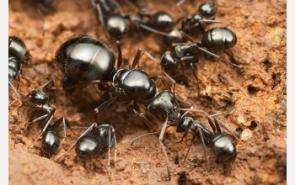
The ant group formicoide, which includes pavement and carpenter ants, is among the most ancient. Credit: Photo © Alex Wild 2004

Ants are considerably older than previously believed, having originated 140 to 168 million years ago, according to new research on the cover of this week's issue of the journal Science.

But these resilient insects, now found in terrestrial ecosystems the world over, apparently began to diversify only about 100 million years ago in concert with the flowering plants, the scientists say.

"This study integrates numerous fossil records and a large molecular data set to infer the evolutionary radiation of ants, which have deeper roots than we thought," said Chuck Lydeard, program director in NSF's Division of Environmental Biology, which funded the research.

Led by biologists Corrie Moreau and Naomi Pierce of Harvard University, the researchers reconstructed the ant family tree using DNA sequencing of six genes from 139 representative ant genera, encompassing 19 of 20 ant subfamilies around the world.

"Ants are a dominant feature of nearly all terrestrial ecosystems, and yet we know surprisingly little about their evolutionary history: the major groupings of ants, how they are related to each other, and when and how they arose," said Moreau. "We now have a clear picture of how this extraordinarily dominant - in ecological terms - and successful - in evolutionary terms - group of insects originated and diversified."

Moreau, Pierce and colleagues used a "molecular clock" calibrated with 43 fossils distributed throughout the ant family tree to date key events in the evolution of ants, providing a well-supported estimate for the age of modern lineages. Their conclusion that modern-day ants arose 140 to 168 million years ago pushes back the origin of ants at least 40 million years earlier than had previously been believed based on estimates from the fossil record.

"Our results support the hypothesis that ants were able to capitalize on the ecological opportunities provided by flowering plants and the herbivorous insects that co-evolved with them," said Pierce. The herbivorous insects that evolved alongside flowering plants provided food for the ants.

The researchers found that the poorly known ant subfamily Leptanillinae is the most ancient, followed by two broad groups known as the poneroids (predatory hunting ants) and the formicoids (more familiar species such as pavement ants and carpenter ants).

Other co-authors of the Science paper are Charles Bell at Florida State University and Roger Vila and S. Bruce Archibald in Harvard's Museum of Comparative Zoology.

The study was also supported by the Green Fund.

Source: NSF


print this article email this article download pdf blog this article bookmark this article     Digg this Stumble it share on Facebook share on Reddit add to delicious save to Yahoo! bookmarks
4.1/5 after 14 votes


April 7th, 2006 all stories
Other Sciences /

Comments: 0
Rank: 4.1/5 after 14 votes

  • Stumble this up

  • Digg this

  • Share it:
  • share on Facebook
  • share on MySpace
  • share on Slashdot
  • rss-newsfeed
  • share on Google
  • share on Reddit
  • add to delicious
  • save to Yahoo! bookmarks
  • share on Windows Live
  • Add to Mixx!
Rating: 4.1/5 after 14 votes


Tags


  • Transform a ball into a rock -- or make it invisible -- using transformation optics
    Transform a ball into a rock -- or make it invisible -- using transformation optics
    Physics / General Physics
    created 10 hours ago | popularity 3.7 / 5 (3) | comments 0
  • Could a quantum motor do work?
    Physics / General Physics
    created Jul 07, 2009 | popularity 4 / 5 (12) | comments 0
  • Physicists Demonstrate Quantum Memory with Matter Qubits
    Physicists Demonstrate Quantum Memory with Matter Qubits
    Physics / General Physics
    created Jul 03, 2009 | popularity 4.3 / 5 (21) | comments 1
  • 'Holey' Nanosheets for Wastewater Dye Removal
    Nanotechnology / Nanomaterials
    created Jul 01, 2009 | popularity 5 / 5 (5) | comments 1
  • Jellyfish Robot Swims Like its Biological Counterpart
    Jellyfish Robot Swims Like its Biological Counterpart
    Electronics / Robotics
    created Jun 26, 2009 | popularity 4.4 / 5 (9) | comments 1
  • Other News

    A woman works on an exhibit at a mammoth show

    Steppe change: Mammoths roamed southern Spain

    Other Sciences / Archaeology & Fossils

    created 5 hours ago | popularity 4.3 / 5 (3) | comments 0

    Remains of woolly mammoths have been found in southern Spain, proving that the chilly grip of the last Ice Age extended farther south than thought, palaeontologists said on Thursday.


    Experts call for local and regional control of sites for radioactive waste

    Other Sciences / Other

    created 6 hours ago | popularity not rated yet | comments 1

    The withdrawal of Nevada's Yucca Mountain as a potential nuclear waste repository has reopened the debate over how and where to dispose of spent nuclear fuel and high-level nuclear waste.


    Study: Restoring lost privileges an overlooked key to discipline

    Other Sciences / Social Sciences

    created 9 hours ago | popularity not rated yet | comments 0

    Managers who dole out discipline by taking away privileges - without considering the implications of restoring them - are missing a key in their bid to improve performance and behavior, a new University of Illinois study ...


    Scientific achievements less prominent than a decade ago

    Other Sciences / Other

    created 8 hours ago | popularity not rated yet | comments 1

    A new report by the Pew Research Center for the People & the Press finds that overwhelming majorities of Americans believe that science has had a positive effect on society and that science has made life easier for most people. ...


    What On Earth Is Driving the Melodramatic, Histrionic Michael Jackson Coverage?

    Other Sciences / Social Sciences

    created Jul 07, 2009 | popularity 3.9 / 5 (8) | comments 8

    The 24-7, wall-to-wall press coverage of the life, death, music, clothing, vitiligo, sex life, "dearest friends" and plastic surgeries of musician Michael Jackson raises the question, "What the heck is going on?"