Rumblings on the moon could be problematic for lunar base
April 7th, 2006 Earth\'s Moon

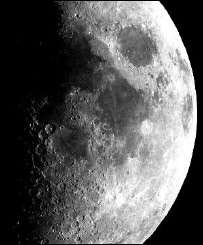
As NASA envisions it, astronauts will return to the moon within the next decade or so. Unlike in the earlier, quick, Apollo visits, these astronauts will build a permanent base and prepare for an historic undertaking that will send explorers to Mars. As Clive Neal, associate professor of civil engineering and geological sciences at the University of Notre Dame, envisions it, these same astronauts may be in for a shocking — and rocking — surprise.

Neal and a team of 15 other planetary geologists have reexamined data from seismometers placed by Apollo astronauts at lunar landing sites from 1969 to 1972. They found that instruments from Apollo missions 12, 14, 15 and 16 consistently radioed back seismic data to Earth until they were turned off in 1977 in a NASA cost-cutting measure.

Neal and his colleagues discovered a surprising number of relatively large “moonquakes,” including some that lasted a remarkably long time.

“The moon is seismically active,” Neal said. “When a quake occurs, the moon rings like a bell.”

There are four different types of moonquakes. Deep moonquakes, occurring at roughly 700 kilometers below the surface, were most likely caused by lunar forces triggered by the effect of Earth’s gravity. Other quakes were caused by vibrations from the impact of meteorites, and “thermal quakes” were caused when the frigid crust of the moon expanded when struck by the morning sun after two weeks of deep-freeze lunar night. The first three classes of moonquakes were generally mild.

However, shallow quakes, which occurred only 20 or 30 kilometers below the surface, were another story. They were powerful and long-lasting.

“Between 1972 and 1977, the Apollo seismic data detected 28 shallow quakes,” Neal said. “A few of the shallow quakes registered up to 5.5 on the Richter scale. A magnitude 5 quake on Earth can move heavy furniture and crack plaster.”

Neal points out that vibrations from most earthquakes cease in less than a minute. The biggest earthquakes stop shaking in less than two minutes. The shallow quakes on the moon produced movement that continued for more than 10 minutes.

Neal and other scientists aren’t exactly sure what causes the shallow moonquakes, although they suspect that the rims of large and relatively young moon craters may slump and cause them.

They also aren’t sure precisely where the quakes are occurring.

“The Apollo seismometers were all in one relatively small region on the front side of the moon, so we can’t pinpoint the exact location of these shallow quakes,” Neal said.

Although he isn’t sure of the precise location of the shallow quakes, Neal is convinced that NASA needs additional analysis and data before proceeding with construction of a permanent lunar base. In the corner of his office is a floor-to-ceiling bookshelf containing binders of data from the Apollo missions, which he continues to analyze and which, he feels, will offer important guidance for the planned return to the moon.

He notes that we know relatively little about the lunar poles, which is critical given that one suggested location for a lunar base is a region on the rim of Shackleton Crater at the south pole of the moon that is permanently sunlit.

NASA planners also will need to develop building materials that are flexible enough to withstand the stress of shaking and bending from these long-lived shallow moonquakes.

Neal also believes that the moon can offer critical data that will potentially impact the planned missions to Mars.

“The moon is a technology test bed for establishing such networks on Mars and beyond,” he said.

Source: University of Notre Dame, by William G. Gilroy


print this article email this article download pdf blog this article bookmark this article     Digg this Stumble it share on Facebook share on Reddit add to delicious save to Yahoo! bookmarks
4.6/5 after 59 votes


April 7th, 2006 all stories
Space & Earth /

Comments: 0
Rank: 4.6/5 after 59 votes

  • Stumble this up

  • Digg this

  • Share it:
  • share on Facebook
  • share on MySpace
  • share on Slashdot
  • rss-newsfeed
  • share on Google
  • share on Reddit
  • add to delicious
  • save to Yahoo! bookmarks
  • share on Windows Live
  • Add to Mixx!
Rating: 4.6/5 after 59 votes

  • Related Stories

  • Cassini Provides Virtual Flyover of Saturn's Moon Titan
    created Mar 24, 2009 | popularity not rated yet | comments 0
  • Lunar rock-like material may someday house moon colonies
    created Jan 05, 2009 | popularity not rated yet | comments 0
  • Four Out of Six Apollos
    created Dec 24, 2008 | popularity not rated yet | comments 0
  • Liquid Mirror Telescopes on the Moon
    created Oct 09, 2008 | popularity not rated yet | comments 0
  • Exploiting space with low-cost satellites
    created Jan 26, 2007 | popularity not rated yet | comments 0

Tags


  • Physicists Demonstrate Quantum Memory with Matter Qubits
    Physicists Demonstrate Quantum Memory with Matter Qubits
    Physics / General Physics
    created Jul 03, 2009 | popularity 4.4 / 5 (16) | comments 1
  • 'Holey' Nanosheets for Wastewater Dye Removal
    Nanotechnology / Nanomaterials
    created Jul 01, 2009 | popularity 5 / 5 (5) | comments 1
  • Jellyfish Robot Swims Like its Biological Counterpart
    Jellyfish Robot Swims Like its Biological Counterpart
    Electronics / Robotics
    created Jun 26, 2009 | popularity 4.4 / 5 (7) | comments 1
  • Could Maxwell's Demon Exist in Nanoscale Systems?
    Could Maxwell's Demon Exist in Nanoscale Systems?
    Physics / General Physics
    created Jun 24, 2009 | popularity 4.4 / 5 (18) | comments 29
  • Living Safely with Robots, Beyond Asimov's Laws
    Living Safely with Robots, Beyond Asimov's Laws
    Electronics / Robotics
    created Jun 22, 2009 | popularity 4.6 / 5 (52) | comments 40
  • Other News

    Forty years ago man first walked on the moon

    Space & Earth / Space Exploration

    created 3 hours ago | popularity 5 / 5 (2) | comments 0

    Forty years ago on July 20, 1969, American astronaut Neil Armstrong realized the oldest dream of human civilizations when he became the first man to walk on the moon.


    The least sea ice in 800 years

    The least sea ice in 800 years

    Space & Earth / Earth Sciences

    created Jul 01, 2009 | popularity 4.3 / 5 (59) | comments 52

    New research, which reconstructs the extent of ice in the sea between Greenland and Svalbard from the 13th century to the present indicates that there has never been so little sea ice as there is now. The ...


    Gas around young galaxy

    Intense heat killed the Universe's would-be galaxies, researchers say

    Space & Earth / Astronomy

    created Jul 01, 2009 | popularity 3.2 / 5 (19) | comments 25

    (PhysOrg.com) -- Our Milky Way galaxy only survived because it was already immersed in a large clump of dark matter which trapped gases inside it, scientists led by Durham University's Institute for Computational ...


    Scientists' Drill Hits Magma: Only Third Time on Record

    Scientists' Drill Hits Magma: Only Third Time on Record

    Space & Earth / Earth Sciences

    created Jun 29, 2009 | popularity 4.7 / 5 (20) | comments 19

    (PhysOrg.com) -- Scientists drilling a borehole deep into Iceland’s rocky crust to explore new methods of using geothermal energy hit a major roadblock on Thursday: Their drill ran into molten rock at a depth ...


    NASA manager pitches a cheaper return-to-moon plan

    Space & Earth / Space Exploration

    created Jun 30, 2009 | popularity 4 / 5 (7) | comments 18

    (AP) -- Like a car salesman pushing a luxury vehicle that the customer no longer can afford, NASA has pulled out of its back pocket a deal for a cheaper ride to the moon.