'Happy face' crater on Mars
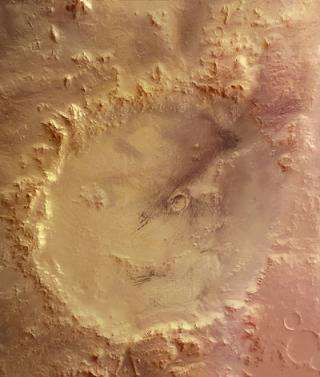
April 10, 2006 'Happy face' crater on Mars

These images, taken by the High Resolution Stereo Camera (HRSC) on board ESA's Mars Express spacecraft, show the Galle Crater, an impact crater located on the eastern rim of the Argyre Planitia impact basin on Mars.

The HRSC obtained these images during orbits 445, 2383, 2438, 2460 and 2493 with a ground resolution ranging between 10-20 metres per pixel, depending on location within the image strip. The images show Crater Galle lying to the east of the Argyre Planitia impact basin and south west of the Wirtz and Helmholtz craters, at 51° South and 329° East.

The images of the 230 km diameter impact crater are mosaics created from five individual HRSC nadir and colour strips, each tens of kilometres wide.

A large stack of layered sediments forms an outcrop in the southern part of the crater. Several parallel gullies, possible evidence for liquid water on the Martian surface, originate at the inner crater walls of the southern rim.

Crater Galle, named after the German astronomer J.G. Galle (1812-1910), is informally known as the 'happy face' crater.

The 'face' was first pointed out in images taken during NASA's Viking Orbiter 1 mission.

Its interior shows a surface which is shaped by 'aeolian' (wind-caused) activity as seen in numerous dunes and dark dust devil tracks which removed the bright dusty surface coating.

The colour scenes, false-colour and near true-colour, have been derived from three HRSC colour and nadir channels gathered during five overlapping orbits. The perspective views have been calculated from a mosaic of digital terrain models derived from the stereo channels.

The black-and-white high-resolution image mosaic was derived from the nadir channel which provides the highest detail of all channels. The resolution has been decreased for use on the Internet, to around 50 m per pixel.

Source: ESA


print this article email this article download pdf blog this article bookmark this article     Stumble it Digg this share on Facebook retweet share on Reddit add to delicious
Rate this story - 4.3 /5 (17 votes)


April 10, 2006 all stories

Comments: 0

4.3 /5 (17 votes)
  • Stumble this up

  • Digg this

  • share this

  • hide
  • Related Stories


Other News

Free Spirit: Third Extrication Drive Ends With Wheel Stall

Free Spirit: Third Extrication Drive Ends With Wheel Stall

Space & Earth / Space Exploration

created 50 minutes ago | popularity not rated yet | comments 0

(PhysOrg.com) -- Spirit experienced a wheel stall with the right-rear wheel during the second step of a two-step drive on Sol 2092 (Saturday, Nov. 21). This is not the same wheel that stalled on Sol 1899 (May ...


Cassini Sends Back Images of Enceladus as Winter Nears

Cassini Sends Back Images of Enceladus as Winter Nears

Space & Earth / Space Exploration

created 10 minutes ago | popularity 5 / 5 (1) | comments 0

(PhysOrg.com) -- NASA's Cassini spacecraft has sailed seamlessly through the Nov. 21 flyby of Saturn's moon Enceladus and started transmitting uncalibrated temperature data and images of the rippling terrain. ...


3 Questions: Sara Seager on searching for Earth-like planets

3 Questions: Sara Seager on searching for Earth-like planets

Space & Earth / Astronomy

created 50 minutes ago | popularity 1 / 5 (1) | comments 0

(PhysOrg.com) -- MIT planetary scientist Sara Seager has been studying exoplanets — planets circling stars other than the sun — for many years.


Spitzer Telescope Observes Baby Brown Dwarf

Spitzer Telescope Observes Baby Brown Dwarf

Space & Earth / Astronomy

created 1hour ago | popularity 5 / 5 (4) | comments 0

(PhysOrg.com) -- NASA's Spitzer Space Telescope has contributed to the discovery of the youngest brown dwarf ever observed -- a finding that, if confirmed, may solve an astronomical mystery about how these ...


New computer-developed map shows more extensive valley network on Mars

New computer-developed map shows more extensive valley network on Mars

Space & Earth / Space Exploration

created 2 hours ago | popularity 4.7 / 5 (3) | comments 0

New research adds to the growing body of evidence suggesting the Red Planet once had an ocean.