NASA To Crash Impactor into Moon in Water Search
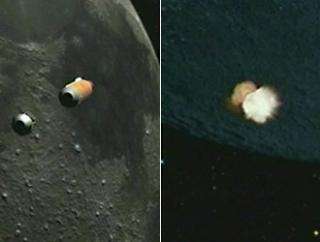
NASA will send a second impactor spacecraft to the moon with the launch of the Lunar Reconnaissance Orbiter, scheduled for October 2008. The Lunar Crater Observation and Sensing Satellite will travel independent of the orbiter to search for water ice.
The spacecraft, proposed by NASA's Ames Research Center, Moffett Field, Calif., will fly as a secondary payload on the Evolved Expendable Launch Vehicle that will launch the orbiter from NASA's Kennedy Space Center, Fla.
First, the craft will direct the upper stage used to leave Earth orbit to crash into a permanently-shadowed crater at the lunar south pole, creating a plume visible to Earth-based observatories. Next, the satellite will observe the plume and fly through it using several instruments to look for water. Then the satellite will itself become an impactor, creating a second plume visible to lunar-orbiting spacecraft and Earth-based observatories.
"This type of payload is not new to NASA," said Associate Administrator for the Exploration Systems Mission Directorate Scott Horowitz, who made the selection. "We are taking advantage of the payload capability of the launch vehicle to conduct additional high risk/high payoff science to meet Vision for Space Exploration goals. It also signals to our workforce that innovative and competitive, low-cost approaches will be rewarded," he said.
The Lunar Reconnaissance Orbiter is the first of many robotic missions NASA will conduct between 2008 and 2016 to study, map, and learn about the lunar surface to prepare for the return of astronauts to the moon. These early missions will help determine lunar landing sites and whether resources, such as oxygen, hydrogen, and metals, are available for use in NASA's long-term lunar exploration objectives.
NASA's requirements for the secondary payload were that it benefits the robotic lunar program, cost no more than $80 million and not exceed 2,205 pounds (1000 kilograms).
On January 10, 2006, NASA issued a request for information to industry to allow businesses to provide secondary payload concepts to NASA. NASA encouraged its field centers to team with industry to develop proposals. Each NASA center reviewed ideas from industry, as well as secondary payload concepts developed internally. Several proposers, such as the winning spacecraft, took advantage of a new secondary payload adapter developed by the Air Force Research Laboratory, Kirkland Air Force Base, N.M.
NASA asked that the concepts advance the Vision for Space Exploration by advancing lunar science, characterizing the lunar environment, and identifying of sites for future human missions NASA was also looking for missions that would advance commercial opportunities and collect engineering data to support the Constellation program, which is developing NASA's new spaceship, the Crew Exploration Vehicle.
Source: NASA


