Nanoparticles armed to combat cancer
April 10th, 2006 Nanoparticles armed to combat cancer

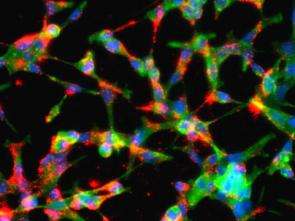
This image shows prostate cancer cells that have taken up fluorescently labeled nanoparticles (shown in red). The cells' nuclei and cytoskeletons are stained blue and green, respectively. Similarly designed targeted nanoparticles are capable of getting inside cancer cells and releasing lethal doses of chemotherapeutic drugs to eradicate tumors. Image courtesy / Benjamin A. Teply

Ultra-small particles loaded with medicine - and aimed with the precision of a rifle - are offering a promising new way to strike at cancer, according to researchers working at MIT and Brigham and Women's Hospital.

In a paper to appear the week of April 10 in the online edition of the Proceedings of the National Academy of Sciences, the team reports a way to custom design nanoparticles so they home in on dangerous cancer cells, then enter the cells to deliver lethal doses of chemotherapy. Normal, healthy cells remain unscathed.

The team conducted experiments first on cells growing in laboratory dishes, and then on mice bearing human prostate tumors. The tumors shrank dramatically, and all of the treated mice survived the study; the untreated control animals did not.

"A single injection of our nanoparticles completely eradicated the tumors in five of the seven treated animals, and the remaining animals also had significant tumor reduction, compared to the controls," said Dr. Omid C. Farokhzad, an assistant professor at Brigham and Women's Hospital and Harvard Medical School.

Farokhzad and MIT Institute Professor Robert Langer led the team of eight researchers.

The scientists said that further testing is needed. Although all the parts and pieces of their new system are known to be safe, the system itself must yet be proven safe and effective in humans. This means thorough testing must be done in larger animals, and eventually in humans.

"We're most interested in developing a system that ends up in the clinic helping patients," Farokhzad said. To make that happen, he added, "we brought in cancer specialists and urologists to collaborate with us."

Further, he said, from an engineering perspective "we wanted to develop a broadly applicable system, one that other investigators can alter for their own purposes."

For example, Langer said, researchers "can put different things inside, or other things on the outside, of the nanoparticles. In fact, this technology could be applied to almost any disease" by re-engineering the nanoparticles' properties. The nanoparticles work like a bus that can safely carry different passengers to different destinations.

In the study, Farokhzad, Langer and colleagues tailor-made tiny sponge-like nanoparticles laced with the drug docetaxel. The particles are specifically designed to dissolve in a cell's internal fluids, releasing the anti-cancer drug either rapidly or slowly, depending on what is needed. These nanoparticles were purposely made from materials that are familiar and approved for medical applications by the U.S. Food and Drug Administration. Thus all of the ingredients are known to be safe.

Also, to make sure only the correct cells are hit, the nanoparticles are "decorated" on the outside with targeting molecules called aptamers, tiny chunks of genetic material. Like homing devices, the aptamers specifically recognize the surface molecules on cancer cells, while avoiding normal cells. In other words, the bus is driven to the correct depot.

In addition, the nanoparticles also display polyethylene glycol molecules, which keep them from being rapidly destroyed by macrophages, cells that guard against foreign substances entering the body.

The team chose nanoparticles as drug-delivery vehicles because they are so small that living cells readily swallow them when they arrive at the cell's surface. Langer said that particles larger than 200 nanometers are less likely to get through a cell's membrane. A nanometer is one-billionth of a meter.

The Farokhzad-Langer team created particles that are about 150 nanometers in size: a thousand sitting side by side might equal the width of a human hair.

Additional authors of the new paper are Jianjun Cheng, a former postdoctoral fellow with Langer now at the University of Illinois; Benjamin A. Teply of Brigham and Women's Hospital (BWH) and Harvard; Ines Sherifi, also at BWH and Harvard; Sangyong Jon, a former postdoctoral fellow with Langer now at the Gwangju Institute of Science and Technology in South Korea; Dr. Philip W. Kantoff of the Dana Farber Cancer Institute; and Dr. Jerome P. Richie of BWH and Harvard.

Source: MIT


print this article email this article download pdf blog this article bookmark this article     Digg this Stumble it share on Facebook share on Reddit add to delicious save to Yahoo! bookmarks
4.4/5 after 39 votes


April 10th, 2006 all stories
Nanotechnology /

Comments: 0
Rank: 4.4/5 after 39 votes

  • Stumble this up

  • Digg this

  • Share it:
  • share on Facebook
  • share on MySpace
  • share on Slashdot
  • rss-newsfeed
  • share on Google
  • share on Reddit
  • add to delicious
  • save to Yahoo! bookmarks
  • share on Windows Live
  • Add to Mixx!
Rating: 4.4/5 after 39 votes

  • Related Stories

  • Implant monitors tumors
    created May 13, 2009 | popularity not rated yet | comments 0
  • Team develops safe, effective RNA interference technique
    created Apr 28, 2008 | popularity not rated yet | comments 0
  • New Nanoparticles for Targeting Tumors
    created Mar 27, 2008 | popularity not rated yet | comments 0
  • Nanoparticles Delivery of 'Suicide DNA' Kills Prostate Tumors
    created May 22, 2007 | popularity not rated yet | comments 0
  • Preclinical Tests Show Acid-Sensitive Nanoparticles Treat Ovarian Cancers with Little Toxicity
    created Aug 28, 2006 | popularity not rated yet | comments 0

Tags


  • Physicists Demonstrate Quantum Memory with Matter Qubits
    Physicists Demonstrate Quantum Memory with Matter Qubits
    Physics / General Physics
    created Jul 03, 2009 | popularity 4.4 / 5 (17) | comments 1
  • 'Holey' Nanosheets for Wastewater Dye Removal
    Nanotechnology / Nanomaterials
    created Jul 01, 2009 | popularity 5 / 5 (5) | comments 1
  • Jellyfish Robot Swims Like its Biological Counterpart
    Jellyfish Robot Swims Like its Biological Counterpart
    Electronics / Robotics
    created Jun 26, 2009 | popularity 4.4 / 5 (8) | comments 1
  • Could Maxwell's Demon Exist in Nanoscale Systems?
    Could Maxwell's Demon Exist in Nanoscale Systems?
    Physics / General Physics
    created Jun 24, 2009 | popularity 4.4 / 5 (18) | comments 29
  • Living Safely with Robots, Beyond Asimov's Laws
    Living Safely with Robots, Beyond Asimov's Laws
    Electronics / Robotics
    created Jun 22, 2009 | popularity 4.6 / 5 (52) | comments 40
  • Other News

    A 'quantum of sol' -- how nanotechnology could hold the key to a solar-powered future

    A 'quantum of sol' -- how nanotechnology could hold the key to a solar-powered future

    Nanotechnology / Nanomaterials

    created Jun 30, 2009 | popularity 3.8 / 5 (13) | comments 16

    (PhysOrg.com) -- A new generation of 'nano-structured' millimetre-sized solar cells that could convert the sun's energy to electricity more than twice as efficiently as current technology, is the subject of ...


    Australian researchers are set to begin human trials of a tiny nano-cell that acts as a "Trojan horse" against cancer

    Hi-tech 'Trojan horse' can kill cancer cells: researchers

    Nanotechnology / Bio & Medicine

    created Jun 29, 2009 | popularity 4.6 / 5 (11) | comments 7

    Australian researchers are set to begin human trials of a tiny nano-cell that acts as a "Trojan horse" against cancer cells, a breakthrough they say may curb the need for debilitating chemotherapy.


    Harnessing Nanoparticles To Track Cancer Cell Changes

    Nanotechnology / Bio & Medicine

    created Jul 03, 2009 | popularity not rated yet | comments 1

    The more dots there are, the more accurate a picture you get when you connect them. Cancer researchers adopting that philosophy have developed a new imaging technology that could give scientists the ability to simultaneously ...


    'Holey' Nanosheets for Wastewater Dye Removal

    Nanotechnology / Nanomaterials

    created Jul 01, 2009 | popularity 5 / 5 (5) | comments 1

    (PhysOrg.com) -- Researchers have discovered that extremely thin sheets of nickel oxide with hexagonally shaped holes can absorb hazardous dyes from wastewater nearly as well as the best traditional methods, but are recyclable. ...


    Computer-Guided Nanoparticle Therapy Destroys Tumors

    Nanotechnology / Bio & Medicine

    created Jun 29, 2009 | popularity 5 / 5 (11) | comments 0

    Gold nanoshells are among the most promising new nanoscale therapeutics being developed to kill tumors, acting as antennas that turn light energy into heat that cooks cancer to death. Now, a multi-institutional research team ...