Scientists present a precision measurement of a subtle dance between matter and antimatter
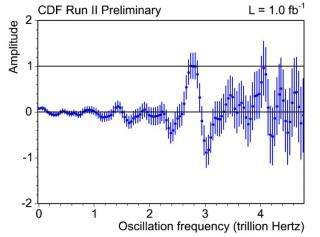
Scientists of the CDF collaboration at the DOE's Fermi National Accelerator Laboratory announced today the precision measurement of extremely rapid transitions between matter and antimatter.
As amazing as it may seem, it has been known for 50 years that very special species of subatomic particles can make spontaneous transitions between matter and antimatter. In this exciting new result, CDF physicists measured the rate of the matter-antimatter transitions for the Bs (pronounced "B sub s") meson, which consists of the heavy bottom quark bound by the strong nuclear interaction to a strange anti-quark, a staggering rate that challenges the imagination - 3 trillion times per second.
Dr. Raymond Orbach, Director of the DOE Office of Science, congratulated the CDF collaboration on "this important and fascinating new result" from the experiment.
"Exploration of the anti-world's mysteries is a crucial step towards our understanding of the early universe, and how we came to be," Orbach said. "Discoveries as important as oscillations to and from the antiworld have been made possible by the remarkable, record-breaking Run II luminosity of the Tevatron, a tribute to the skill of the Fermilab family. We look forward to continuing world leadership in high energy physics at this wonderful laboratory."
Over the last 20 years, a large number of experiments worldwide have participated in a program to perform high precision measurements of the behavior of matter and antimatter, especially as it pertains to strange, charm and bottom quarks. The physics of particles containing bottom quarks is so exciting that two accelerator complexes, one in Stanford California and the other in Tsukuba Japan, were constructed to study these particles. Scientists hope that by assembling a large number of precise measurements involving the exotic behavior of these particles, they can begin to understand why they exist, how they interact with one another and what role they played in the development of the early universe. Although none of them exists in nature today, these particles were present in great abundance in the early universe. Scientists can only study them at large particle accelerators.
With a talk at Fermilab on Monday afternoon, the CDF collaboration presented to the scientific community the first measurement of this Bs matter-antimatter transition rate of about 3 trillion times per second, measured to a precision of 2 percent. They reported on data acquired by the CDF detector between February 2002 and January 2006, a running period known as "Tevatron Run II," where tens of trillions of proton-antiproton collisions were produced at the Tevatron. There have been many attempts to measure this rate. The most recent result comes from the DØ collaboration (CDF's sister experiment at the Tevatron) where they announced upper and lower bounds on the oscillation frequency. (See the DØ announcement here).
"If you think of matter and antimatter as performing a dance with each other, then we have measured the incredibly rapid tempo of that dance," said CDF cospokesperson Jacobo Konigsberg. "The Tevatron physics program has offered the promise of making such a precision measurement, and it has delivered on that promise. The collaboration was intensely focused on mining this measurement away from Nature."
Within the 700-member CDF collaboration, a team of 80 scientists from 27 institutions performed the data analysis leading to the precision measurement just one month after the data-taking was completed.
"After four years of intense effort with a spectacular team we spent some exciting weeks when we started to see the oscillation signal emerge from the data," said analysis team leader Christoph Paus, professor at the Massachusetts Institute of Technology.
Experiment cospokesperson Rob Roser said the work was integrated within a relentlessly thorough confirmation process involving the entire CDF collaboration and all segments of the 4,000-ton collider detector.
"We've had many collaborators, each with a different background, examining this result from different angles," Roser said. "They've worked through many sleepless nights, especially our graduate students and postdocs, to ensure that we have not overlooked something."
Luciano Ristori, an Italian scientist and CDF collaborator with INFN in Pisa (National Institute for Nuclear Physics), is one of the primary architects of the novel electronics required to identify events with B mesons from the billions that collided. He looked upon this result with great pride.
"This is a very important result that required many years of hard work by a large number of very talented people," Ristori said. "It is a great achievement that the CDF Collaboration and the Lab can be proud of."
At Tsukuba University in Japan, CDF collaborator Prof. Shinhon Kim pointed to the future.
"This great result shows that the CDF experiment will continue to make important contributions to B physics study. This also gives a great example that international collaboration has been successful in high energy physics."
Another CDF collaborator, Joseph Kroll, a professor at the University of Pennsylvania echoed his comments.
"Many of the upgrades to the CDF detector for Run II were aimed at increasing our sensitivity to observing Bs oscillations," Kroll said. "Every collaborator contributed in some way to this measurement. It is very exciting to finally achieve this goal."
Fermilab Director Pier Oddone cited the focus by accelerator and detector teams to achieve the new result.
"It is one of the signature measurements for Run II," Oddone said. "As we collect several times the data already on hand, I have great expectations for future discoveries."
Marvin Goldberg, Division of Physics program director, congratulated the collaboration.
"In the NSF Division of Physics, we call university groups our 'Great Discovery Machine,'" Goldberg said. "These very important results from CDF required a remarkable synergy between the university groups and Fermilab, as well as major advances in all sectors of the Fermilab program."
These sentiments are echoed by DØ cospokepeople Gerald Blazey and Terrence Wyatt.
"Bs mixing is an important result for the Tevatron, and we would like to congratulate CDF on this beautiful result," they wrote. "The DØ result last month generated a great deal of excitement. This new result will generate further interest in Bs oscillations and demonstrates the vitality of the full Tevatron program."
Within the high energy physics community, this CDF precision measurement will immediately be interpreted within different theoretical models of how the universe is assembled. One popular and well motivated theory is supersymmetry, in which each known particle has its own "super" partner particle. Fermilab theoretical physicist Marcela Carena noted that general versions of supersymmetry predict an even faster transition rate than was actually measured, so some of those theories can be ruled out based upon this result.
"At the Tevatron," Carena said, "important information on the nature of supersymmetric models will be obtained from the combination of precise measurements of Bs matter-antimatter transitions and the search for the rare decay of Bs mesons into muon pairs. It is even possible that an indirect indication for supersymmetry would show up in these measurements before the Large Hadron Collider turns on at CERN." Both DØ and CDF experiments expect to achieve improved results in these areas in the near future.
Scientists always hope for results that are surprising, and that contradict the conventional wisdom and predictions. The CDF scientists are no different. Their Bs precision measurement is squarely in accord with predictions of the Standard Model, but they view the agreement as another challenge in their quest for New Phenomena during Collider Run II of the Tevatron.
"It just means that Nature is tough on us as we try to learn its secrets," said the outgoing CDF cospokesperson Young-Kee Kim, who will become Fermilab's deputy director in July. "But we don't give up, because we're pretty tough, too. Although the standard model lives to fight another day, the broad physics program at the Tevatron still has many opportunities to open a window for new physics."
Source: Fermi National Accelerator Laboratory


