Nature's strongest glue could be used as a medical adhesive
April 11, 2006 Nature's strongest glue could be used as a medical adhesive

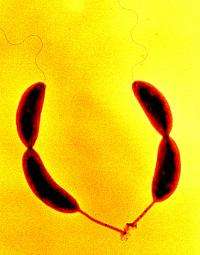
Caulobacter crescentus affixes itself to solid objects with its stalk and holdfast. Here, two sessile "stalk" cells (bottom) spawn mobile "swarmer" clones of themselves (top).

A bacterium that lives in rivers, streams and human aqueducts uses nature's strongest glue to stay in one place, according to new research by Indiana University Bloomington and Brown University scientists reported in next week's Proceedings of the National Academy of Sciences.

The scientists found they had to apply a force of about 1 micronewton to remove a single Caulobacter crescentus from a glass pipette. Because C. crescentus is so small, the pulling force of 1 micronewton generates a huge stress of 70 newtons per square millimeter. That stress, which the bacterial adhesions could sometimes withstand, is equivalent to five tons per square inch -- three or four cars balanced atop a quarter. By contrast, commercial "super" glue breaks when a shear force of 18 to 28 newtons per square millimeter is applied.

Hypothetically, C. crescentus's glue could be mass produced and used to coat surfaces for medical and engineering purposes.

"There are obvious applications since this adhesive works on wet surfaces," said IU Bloomington bacteriologist Yves Brun, who co-led the study with Brown University physicist Jay Tang. "One possibility would be as a biodegradable surgical adhesive."

C. crescentus affixes itself to rocks and the insides of water pipes via a long, slender stalk. At the end of the stalk is a holdfast dotted with polysaccharides (chains of sugar molecules). The scientists show in the PNAS paper that these sugars are the source of C. crescentus's tenacity. It is presumed these sugars are attached to holdfast proteins, but this has not yet been confirmed. One thing is certain -- the polysaccharides are sticky.

"The challenge will be to produce large quantities of this glue without it sticking to everything that is used to produce it," Brun said. "Using special mutants, we can isolate the glue on glass surfaces. We tried washing the glue off. It didn't work."

The scientists allowed C. crescentus to attach itself to the side of a thin, flexible glass pipette. They used a micromanipulator to trap the cell portion of the bacterium and pull it directly away from the pipette, measuring the force of strain. In 14 trials, the scientists found they had to apply a force of 0.11 to 2.26 micronewtons per cell before the bacterium detached.

C. crescentus has evolved an ability to live in extremely nutrient-poor conditions, which explains its existence as a common fixture in tap water. Because it exists in tap water at low concentrations and produces no human toxins, C. crescentus poses no threat to human health.

Engineer L. Ben Freund wrote the model used to perform complex mathematical analyses of experimental forces. Peter Tsang and Guanglai Li of Brown University performed experiments and analyzed data. The research was funded by grants from the National Science Foundation and the National Institute of General Medical Sciences (National Institutes of Health).

Source: Indiana University


print this article email this article download pdf blog this article bookmark this article     Stumble it Digg this share on Facebook retweet share on Reddit add to delicious
Rate this story - 4.6 /5 (21 votes)


April 11, 2006 all stories

Comments: 0

4.6 /5 (21 votes)
  • Stumble this up

  • Digg this

  • share this

  • hide
  • Related Stories

  • Novel connector uses magnets for leak-free microfluidic devices
    created Nov 18, 2009 | popularity not rated yet | comments 0
  • Super sticky barnacle glue cures like blood clots
    created Oct 16, 2009 | popularity not rated yet | comments 0
  • Dividing cells 'feel' their way out of warp
    created Sep 10, 2009 | popularity not rated yet | comments 0
  • Building better bone replacements with bacteria
    created Sep 07, 2009 | popularity not rated yet | comments 0
  • Robot's gentle touch aids delicate cancer surgery
    created Aug 21, 2009 | popularity not rated yet | comments 0


Other News

Living buildings could mop up carbon dioxide

Living buildings could mop up carbon dioxide

Other Sciences / Other

created 1hour ago | popularity not rated yet | comments 0

(PhysOrg.com) -- Architecture could help us tackle climate change, if we start to design our buildings with 'living' materials, according to Dr Rachel Armstrong, UCL Bartlett School of Architecture.


Message gone viral? Blame it on altruistic, yet image-conscious Internet  'e-mavens'

Message gone viral? Blame it on altruistic, yet image-conscious Internet 'e-mavens'

Other Sciences / Economics

created 23 hours ago | popularity 3.5 / 5 (2) | comments 0

(PhysOrg.com) -- Why do some online ad campaigns go viral while other online marketing messages gather "cyber-dust" on the information superhighway? The key may lie in the motivation of Internet users to email ...


The skyline of Tokyo in Japan, where scientists have criticised the new government for plans to slash research budgets

Japan scientists attack govt research cut plans

Other Sciences / Other

created 16 hours ago | popularity 5 / 5 (2) | comments 0

Top Japanese scientists, including four Nobel laureates, have criticised the new government for plans to slash research budgets, warning the country will loose its high-tech edge.


Researcher: Faint writing seen on Shroud of Turin (AP)

Researcher: Faint writing seen on Shroud of Turin (Update)

Other Sciences / Archaeology & Fossils

created Nov 20, 2009 | popularity 2.3 / 5 (31) | comments 45

(AP) -- A Vatican researcher has rekindled the age-old debate over the Shroud of Turin, saying that faint writing on the linen proves it was the burial cloth of Jesus. Experts say the historian may be reading ...


Explained: The Discrete Fourier Transform

Explained: The Discrete Fourier Transform

Other Sciences / Mathematics

created Nov 25, 2009 | popularity 4.3 / 5 (26) | comments 8

(PhysOrg.com) -- In 1811, Joseph Fourier, the 43-year-old prefect of the French district of Isčre, entered a competition in heat research sponsored by the French Academy of Sciences. The paper he submitted ...