Ukrainian scientists provide a new look at Time
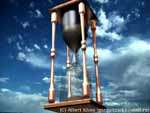
Ukrainian physicists made a remarkable discovery capable of changing that our perception of Time.
Scientists of Kiev"s Institute of quantum physics Dmitro Stary and Irina Soldatenko began their experiment in the early 70s. Since then, it"s been going on for more than 30 years, despite all the difficulties such lack of resources, power outages and no monthly salaries. Their longstanding scientific exploit has finally paid off; it has lead to a real scientific breakthrough, which could only be compared to Einstein"s relativity theory.
Their unprecedented experiment, which was originated by famous Soviet physicist Anastas Korzh, entails measurement of the Universe"s expansion. Their technique however differs from the one commonly used these days. Usually, scientists measure the distance between galaxies or rather those oblique "evidences" like the Doppler Effect for instance.
Anastas in turn suggested the young specialists, graduates of the University of Physics, to precisely measure the most ordinary distance such as the length of iridium standard meter, accessible for scientists, using modern high-precision quantum devices. After all, if the Universe does expand, the process does not only affect the edges, but its entirety.
The iridium standard meter rod will also have to become longer after some time.
Dmitro developed a unique computer program (BESM-4) which enabled the scientist to compensate and correct mistakes of his electronic devices.
In the end, after such tedious and lengthy research work, Ukrainian scientists managed to calculate more accurately the exact number of years of our Universe as well as to acquire other significant data. Practical advantages of such research appear to be significant as well. For instance, nowadays all leading airlines of the world take into account the so-called Stary-Soldatenko factor for calculating the amount of over-expenditure of aviation fuel.
The major outcome however, which was never intended by the scientists, became obvious only during the final stages of the experiment. After conducting thorough analysis of acquired data, they discovered that not only does the Universe expand, but Time tends to accelerate as well!
Actually, we have been following this effect for quite some time now. However, those physicists who measured Time by means of various electronic devices, which in turn also accelerated, did not lead us to believe in it.
The results of Stary and Soldatenko turn our preconceived notions of the Universe upside down. Today, they haven"t been totally accepted in the scientific world. In the meantime, the results are being tested in many laboratories worldwide. Perhaps, it will take additional 30 years for the scientific world to repeat the experiment.
Today, many researchers undoubtedly agree that this is a fundamentally new physical phenomenon, which will trigger new breakthroughs in the world of science.


