New satellite system will use GPS signals to track hurricanes, climate change
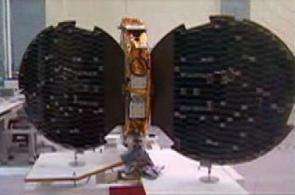
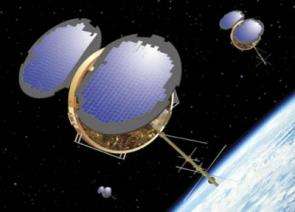
A globe-spanning constellation of six satellites expected to improve weather forecasts, monitor climate change, and enhance space weather research will head into orbit on April 14. A Minotaur rocket is scheduled to launch the array at 5:10 p.m. Pacific Daylight Time from Vandenberg Air Force Base.
The low-orbiting satellites will be the first to provide atmospheric data daily in real time over thousands of points on Earth for both research and operational weather forecasting by measuring the bending of radio signals from the U.S. Global Positioning System (GPS) as the signals pass through Earth's atmosphere.
Called COSMIC (Constellation Observing System for Meteorology, Ionosphere and Climate) in the United States and FORMOSAT-3 in Taiwan, the $100 million satellite network is the product of an agreement between the American Institute in Taiwan and the Taipei Economic and Cultural Representative Office in the United States. The array is based on a system design provided by the University Corporation for Atmospheric Research (UCAR).
Temperature and water vapor profiles derived from the GPS data will help meteorologists observe, research, and forecast hurricanes, typhoons, and other storm patterns over the oceans and improve many areas of weather prediction. The stability, consistency, and accuracy of the measurements should be a boon to scientists quantifying long-term climate change trends.
COSMIC's measurements of electron density in the ionosphere are expected to improve analysis and forecasting of space weather, including geomagnetic storms that can interrupt sensitive satellite and communications systems and affect power grids on the ground.
COSMIC relies on a technology known as radio occultation. Just as the water molecules in a glass change the path of visible light waves so that a pencil appears bent, molecules in the air bend GPS radio signals as they pass through (are occulted by) the atmosphere. By measuring the amount of this bending, scientists can determine underlying atmospheric conditions, such as air density, temperature, and moisture, and electron density.
"This is the first time the technique of radio occultation has been used on a large scale in real time to provide nearly continuous measurements of worldwide atmospheric conditions at all altitudes," says William Kuo, director of the UCAR COSMIC office.
While several single-satellite systems have used GPS signals experimentally over the past decade, COSMIC's unique six-satellite array is the first to provide the high-density global coverage required for both research and operational forecasting. Its radio occultation technique leverages significant investments by the United States, Europe, and Russia in the Global Navigation Satellite Systems.
"Centers around the world will have access to this new information for both research and operational forecasting," says UCAR president Richard Anthes. "User-friendly versions of the data will enable those with less sophisticated systems to benefit as well," he adds.
Orbiting at an altitude of 500 miles (800 kilometers), COSMIC satellites will take approximately 2,500 measurements every 24 hours in a nearly uniform distribution around the globe. The system will provide novel and independent data over vast stretches of the oceans where there are no weather balloon observations. The data's high vertical resolution will complement the high horizontal resolution of other weather satellite measurements.
"COSMIC/FORMOSAT-3 scientists and engineers have built a system that cleverly measures the atmospheric bending of radio signals from the U.S. Global Positioning System (GPS) and then converts these measurements into a remarkably precise worldwide set of weather, climate, and space weather data," says NSF program manager Jay Fein. "This new information will have a tremendous impact on geosciences research and operational weather prediction and will be an important contribution to the Global Earth Observation System of Systems, a program led by the National Oceanic and Atmospheric Administration."
Because radio signals pierce thick cloud cover and precipitation, weather conditions will not interfere with data gathering, as is often the case with remote sensing platforms. The satellites will not need to be recalibrated and the instruments' accuracy and sensitivity will not drift during the five-year mission--common problems with Earth-observing satellites over their lifetime. The data will be available to researchers and forecasters within a few hours of the observations, making them a potential boon to everyday forecast operations.
"The COSMIC mission would not have been possible without the broad support of U.S. sponsors and the partnership with Taiwan," says Fein.
You can check www.cosmic.ucar.edu/launch/ for launch status.
Source: University Corporation for Atmospheric Research


