Ethiopian fossils link ape-men with earlier hominids
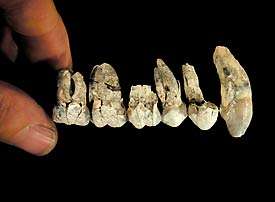
New fossils discovered in the Afar desert of eastern Ethiopia are a missing link between our ape-man ancestors some 3.5 million years ago and more primitive hominids a million years older, according to an international team led by the University of California, Berkeley, and Los Alamos National Laboratory in New Mexico.
The fossils are from the most primitive species of Australopithecus, known as Au. anamensis, and date from about 4.1 million years ago, said Tim White, a UC Berkeley professor of integrative biology and one of the team's leaders. The hominid Australopithecus has often been called an ape-man because, though short-statured, small-brained and big-toothed, it walked on two legs unlike the great apes.
More primitive hominids in the genus Ardipithecus date from between 4.4 million and 7 million years ago and were much more ape-like, though they, too, walked on two legs.
"This new discovery closes the gap between the fully blown Australopithecines and earlier forms we call Ardipithecus," White said. "We now know where Australopithecus came from before 4 million years ago."
The fossil finds and an analysis of the hominid's habitat and evolutionary position are reported by White and co-authors from Ethiopia, Japan, France and the United States in the April 13 issue of Nature.
Since the first Australopithecus skull, the famous Taung child, was discovered in South Africa 82 years ago by Raymond Dart, fossils of this hominid have been found all over eastern Africa spanning a 3-million-year time period. Seven separate species have been named, including the most primitive, Au. anamensis, which dates from 4.2 million years ago, and Au. africanus, Dart's find. The most specialized species, Au. boisei, died out about 1.2 million years ago, long after the genus Homo had spread throughout the Old World.
The most famous of the Australopithecine fossils was "Lucy," a 3.5-foot adult skeleton discovered in the Afar depression in 1974. Her analytical team included White. Subsequently named Au. afarensis, this hominid, which lived between 3.6 and 3 million years ago, was also discovered in the Middle Awash study area, where the new Au. anamensis fossils were found.
Ardipithecus, on the other hand, was discovered by White and his team in 1992, based on fossils from Aramis, a village in the Awash Valley of Ethiopia's Afar rift. White and his team named the 4.4 million-year-old fossils Ardipithecus ramidus.
The relationship between Australopithecus and Ardipithecus remained unclear, however, because of a million-year gap between these two genera. The new fossil finds, jawbones and teeth from each of two localities, bridge that gap. With Ardipithecus in older rocks and Au. afarensis in overlying rocks, the newly announced fossils are intermediate in time and anatomy.
The teeth tell a story about the organism's diet, White said. Australopithecus's large cheek teeth - anthropologists refer to the hominid as a megadont, meaning large-toothed - allowed it to subsist on a broader diet of tough, fibrous plants. The teeth of Ardipithecus were smaller, restricting it to a diet of softer, less abrasive food, White said.
"Australopithecus became a superior omnivore, able to eat tubers and roots with more fiber and grit, adapting it better to times of scarcity during periods of extended drought," he said. "They may have been small brained, but they stuck around a long time, fully half of our zoological family's 6-million-year existence on the planet."
White and his Middle Awash team are cautious about claiming that the new fossils are closely related to the most recent member of the genus Ardipithecus, Ar. ramidus, since the two are separated by only 300,000 years. While Au. anamensis could have rapidly evolved from Ar. ramidus, contemporary fossils may yet be found. Nevertheless, White said, the new fossils show clear descent from the genus Ardipithecus, two species of which have been identified over the genus's 2 million years of existence. The fact that fossils of Ar. ramidus, Au. anamensis and Au. afarensis have been found in successive sediment layers in the same area of the Middle Awash site also indicates an evolutionary sequence, said White.
"It is fair to say that some species of Ardipithecus gave rise to Australopithecus," he said.
The first of the newly reported fossils, an upper jawbone with teeth, was discovered in November 1994 at Aramis, the site of earlier fossil finds of Au. anamensis. In 2000, 2003 and again in both January and December 2005, the team found additional teeth and jaw fragments at Asa Issie, about 10 kilometers west of Aramis. Many of the teeth were completely shattered, but by water-sieving the surface sediments, they were able to collect nearly all the fragments, which White painstakingly reassembled.
In all, teeth and jawbones of eight individuals were found at Asa Issie, all from about 4.1 million years ago as dated by paleomagnetic and argon-argon methods by a team led by geologist Paul Renne, UC Berkeley adjunct professor of earth and planetary science and director of the independent Berkeley Geochronology Center. A partial thigh bone and hand and foot bones were very similar to the Lucy bones found 60 kilometers away in Hadar and dating from 3 million to 3.4 million years ago. The large, thick-enameled teeth were judged by the research team to be closest to Au. anamensis, and ancestral to Au. afarensis.
Hundreds of mammal fossils also were found, allowing the team to reconstruct the habitat as closed woodland with lots of colobus monkeys, kudus, pigs, birds and rodents, as well as a collection of carnivores, primarily hyenas and big cats.
"The abundance of monkeys, kudus and other mammals, and petrified wood found both at Aramis and Asa Issie shows that a closed, wooded habitat type persisted over a long period in this part of the Afar and was favored by early hominids between 4 and 6 million years ago," said Giday WoldeGabriel of Los Alamos National Laboratory, a geologist and co-leader of the Middle Awash project.
The Middle Awash team, consisting of 60 scientists from 17 countries, brings expertise in geology, archaeology, paleontology and evolutionary biology to the study of fossils unearthed in Ethiopia spanning nearly 6 million years of evolution - from the first hominids that split from chimpanzees to modern humans, Homo sapiens sapiens. The team continues to unearth fossils from what White describes as "the world's best window on human evolution."
Source: UC Berkeley


