Vega: the star with comets?
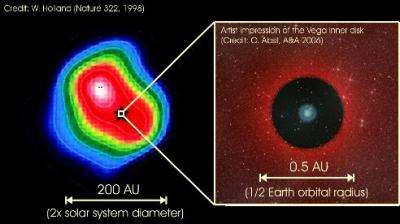
The observation of the immediate vicinity of a star other than the Sun has just been carried out for the first time. A debris disc made up of hot (1300 degrees) dust grains, residues of comet evaporation and collisions between asteroids, was indeed detected for the first time around Vega.
This discovery is the work of an international team, which includes researchers of Paris Observatory (LESIA).
Vega is an important star in astronomy in more than one way: the fifth brightest star of the night sky, one of the three "beauties of summer" (with Deneb and Altair) which forms a large triangle at the zenith of our latitudes on estival evenings; it was a long time considered as a reference star, to which is compared the brightness of all the other stars. Located at 25 light-years, therefore relatively near the Sun, it is approximately three times larger and more massive, and 60 times more luminous than the Sun, and much younger (350 million years against 4,5 billion).
An international team detected in the vicinity of Vega a weak infra-red flux (78 times less important than that of the star) which would come from particles heated by the star to temperatures close to 1300 degrees C. It seems that these particles have a chemical composition different from those of the solar system, with a dominant carbonaceous material (like graphite), whereas our zodiacal cloud contains essentially silicates. They would be also on average smaller (of a diameter lower than the micron, equivalent to particles constituting cigarette smoke). Such small grains should normally be driven out by the pressure created by the intense radiation of Vega. Their abundance thus proves that they are produced in permanence, probably in a phase of intense meteoritic and cometary bombardment like those experienced by the Earth at the origins of the solar system. The dust production rate would correspond in the daily passing of 13 large comets in the environment of Vega.
The presence of cold dust around Vega (-190°C), located at a distance three times larger than the orbit of Pluto, was known for a long time. This phenomenon is found also around a large number on stars similar to Vega. However, nothing was known on the internal part of these debris discs, where planets similar to the Earth are supposed to be formed. The observation of the internal part of the disc of Vega was made possible thanks to the array of CHARA (Center for High Angular Resolution Astronomy) of the State University of Georgia, which allows, from six telescopes of 1 meter distributed on Mount Wilson in California, to simulate a giant telescope of almost 330 m, and thus to distinguish details of only 200 microseconds of arc, hardly larger than a soccer ball seen from the Moon! The light collected by CHARA is recombined by the instrument FLUOR (Fiber Linked Unit for Optical Recombination), developed by the LESIA.
This device also allowed to observe the atmosphere of Vega, and to confirm some astonishing properties of the star: its high speed of rotation on itself (12.5 hours) indeed confers it a lenticular form, flattened at the poles, the latter being brighter and hotter by 2300°C than the equator.
Source: Observatoire de Paris, LESIA


