Massive German floods monitored from space
April 13, 2006
Massive German floods monitored from space

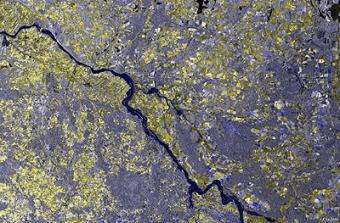
An ERS-2 radar image showing the flood extent of the Elbe River in the area around Hitzacker in Lower Saxony, Germany. This is a multitemporal image composed of an ERS-2 image acquired before flooding (1 July 2005) and an ERS-2 image acquired during flooding (7 April 2006). Credits: ESA

Torrential rain and melting snow caused Germany’s Elbe River to rise to a record high level in northern parts of the country over the weekend, flooding cities and damaging historic town centres. ESA’s ERS-2 satellite has been monitoring the situation from space.

The medieval city of Hitzacker, located in Lower Saxony about 100 kilometres from the Baltic Sea, was one of the hardest-hit areas with the Elbe reaching 7.63 metres – almost three times its normal level – on Sunday, threatening severe damage to 16th and 17th century houses.

Flooding is estimated to be the world's most costly kind of natural disaster. With inundated areas typically visible from orbit, Earth Observation (EO) is increasingly being used for flood response and mitigation.

In October 2000, the International Charter on Space and Major Disasters was initiated representing a joint effort by global space agency members to provide resources to rescue authorities responding to major natural or man-made disasters. ESA is a founder member of the Charter.

Under the umbrella of the Charter, the German Joint Information and Situation Centre (GMLZ) requested maps of Germany’s flooded region. The Charter then processed this request and recruited the German Aerospace Center (DLR) to produce the maps using satellite images provided by the space agencies. ERS-2 Synthetic Aperture Radar (SAR) images were one of the main sources of images used to delineate the flooded areas.

DLR performed this service under the scope of the Risk-EOS service network – an initiative of ESA offering EO-based operational services for flood risk management, including rapid mapping of major disasters.

Risk-EOS is part of ESA's initial Services Element of Global Monitoring for Environment and Security (GMES), a joint initiative between ESA and the European Commission to develop a global monitoring capability for Europe harnessing all available ground- and space-based data sources.

The federal departments for flood protection and water management of the German states of Saxony, Saxony-Anhalt, Brandenburg and Lower Saxony, along with the city of Dresden’s Department for Environment, used these maps. The police department of Potsdam also used the information to coordinate their forces.

By Tuesday, the severe flooding in Germany had abated but saturated dykes in some areas are still under strain. Some 3 000 rescue workers have been deployed to the affected areas in recent days to reinforce dykes and distribute sandbags along the Elbe.

Hitzacker officials have said the Elbe’s water level reached 13 centimetres higher than it did in the devastating floods in the summer of 2002, which saw water levels reach 150-year highs across parts of Central and Eastern Europe.

Source: ESA

4.8 /5 (5 votes)  

Rank 4.8 /5 (5 votes)
Tags

Relevant PhysicsForums posts

More news stories

Could Venus be shifting gear?

(PhysOrg.com) -- ESA’s Venus Express spacecraft has discovered that our cloud-covered neighbour spins a little slower than previously measured. Peering through the dense atmosphere in the infrared, the ...

Space & Earth / Space Exploration

created 3 hours ago | popularity 5 / 5 (4) | comments 4 | with audio podcast

Humans may have helped the decline of African rainforests 3000 years ago

(PhysOrg.com) -- Large areas of rainforests in Central Africa mysteriously disappeared over three thousand years ago, to be replaced by savannas. The prevailing theory has been that the cause was a change ...

Space & Earth / Environment

created 7 hours ago | popularity 5 / 5 (3) | comments 7 | with audio podcast report

Clam fields found at deep, low-temperature Mariana vents

(PhysOrg.com) -- Scientists have marveled at the unusual life forms thriving at high temperature hydrothermal vents of the deep ocean.

Space & Earth / Earth Sciences

created 3 hours ago | popularity not rated yet | comments 0 | with audio podcast

Mars Science Laboratory computer issue resolved

(PhysOrg.com) -- Engineers have found the root cause of a computer reset that occurred two months ago on NASA's Mars Science Laboratory and have determined how to correct it.

Space & Earth / Space Exploration

created 4 hours ago | popularity 5 / 5 (5) | comments 2 | with audio podcast

Two new moons for Jupiter

Advances in technology have lead to the discovery of new planets outside of our Solar System, and now even new moons in our own backyard.

Space & Earth / Space Exploration

created 3 hours ago | popularity not rated yet | comments 2


New understanding of DNA repair could eventually lead to cancer therapy

A research group in the Faculty of Medicine & Dentistry at the University of Alberta is hoping its latest discovery could one day be used to develop new therapies that target certain types of cancers.

Zuckerberg's focus drives Facebook's ascent

When Mark Zuckerberg showed up to rent Judy Fusco's Los Altos, Calif., house in the fall of 2004, soon after he'd arrived in Silicon Valley, the landlord was immediately struck by his confidence.

Both maternal and paternal age linked to autism

Older maternal and paternal age are jointly associated with having a child with autism, according to a recently published study led by researchers at The University of Texas Health Science Center at Houston (UTHealth).

Night, weekend delivery OK for babies with birth defects

Weekday delivery is no better than night or weekend delivery for infants with birth defects, according to a new study presented today at The Pregnancy Meeting, the Society for Maternal-Fetal Medicine's annual conference. ...

Sonic Cradle lands spot in TED exhibition

A Simon Fraser University graduate student project that melds music, meditation and modern technology has landed a rare spot as an exhibit at TEDActive 2012 in Palm Springs, California this month.

From virginity to Viagra

Americans will spend more than $17 billion on Valentine's Day, but far less on programs like sex education for adolescents. The editors of the new book, Sex for Life, From Virginity to Viagra, How Sexuality Changes Throughout ...